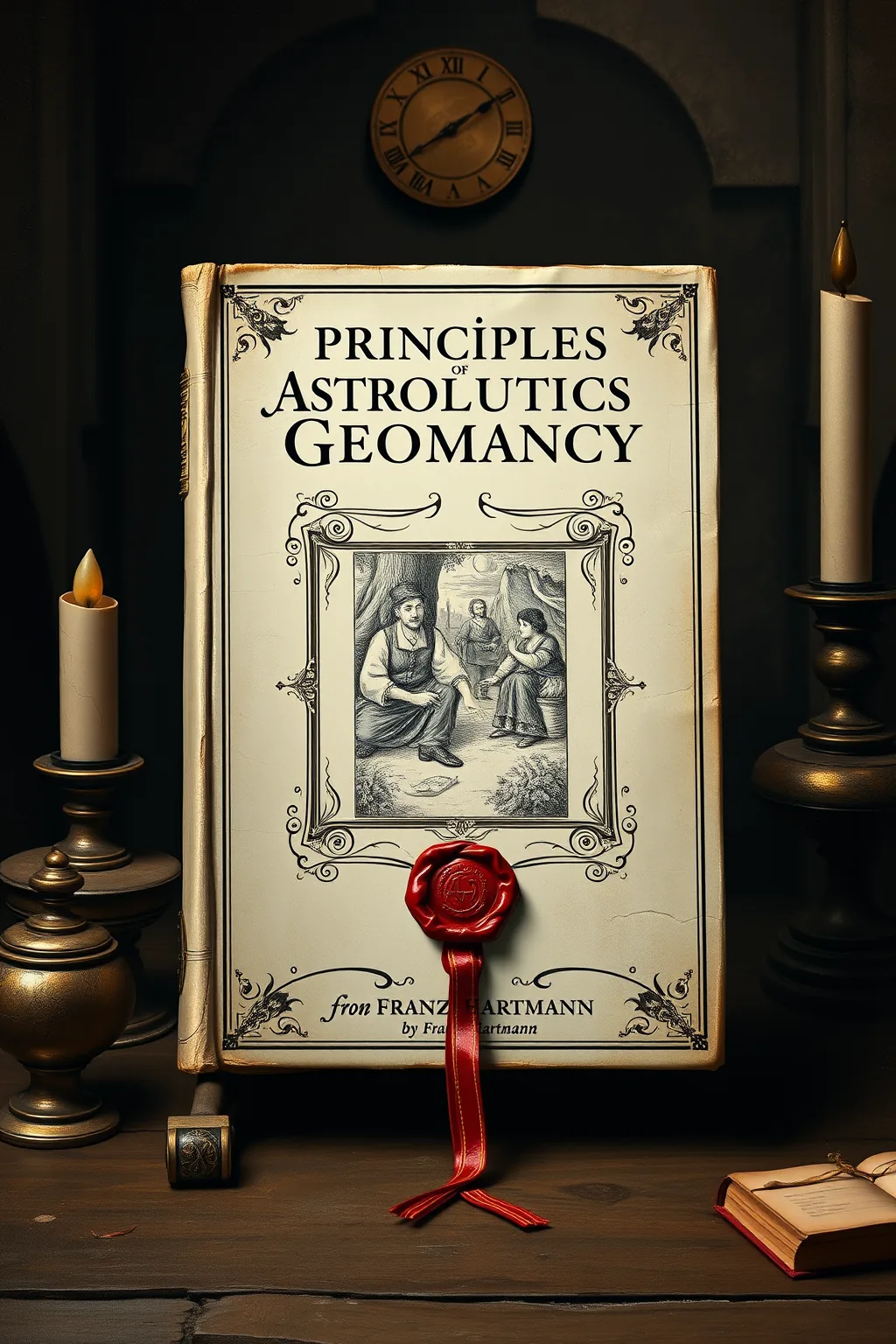
Principles of Astrological Geomancy
 82
82

Principles of Astrological Geomancy
Franz Hartmann's "Principles of Astrological Geomancy" is a surprisingly thorough manual for a practice often relegated to the esoteric periphery. Hartmann’s strength lies in his methodical approach, meticulously detailing the construction and interpretation of the sixteen geomantic figures. The section on assigning meanings to the "Paterfamilias" and "Neptunus," for instance, provides a solid framework for understanding the chart's dynamic. However, the prose, while clear, can feel somewhat dry, lacking the evocative language that might draw in a reader less familiar with the subject. The book's insistence on a strict, almost mathematical, derivation of the figures might also feel limiting to those who prefer a more fluid, intuitive approach to divination. Despite this, Hartmann delivers a competent and historically significant guide to a potent divinatory art.
Verdict: A foundational text for serious geomantic study, offering clarity over flourish.
📝 Description
82
Franz Hartmann's 1889 book details astrological geomancy as a symbolic language of cosmic principles.
Franz Hartmann's 1889 work, Principles of Astrological Geomancy, presents a structured method for divining answers to life's questions. Hartmann viewed geomancy not as simple fortune-telling, but as a complex symbolic system that mirrors celestial mechanics. The book guides readers through the creation of the 16 geomantic figures, explaining their planetary rulers, elemental ties, and interpretations. It also covers the division of the geomantic chart into houses, similar to astrological houses, for specific inquiries. Hartmann aims to provide a systematic approach to this ancient divinatory art, making it accessible to serious students of Western esotericism.
This text is particularly suited for those interested in foundational divinatory systems within astrology, Hermeticism, and broader occult studies. While it offers a structured introduction for newcomers to geomancy, experienced practitioners may find Hartmann's detailed explanations offer fresh perspectives. The book emerged during a late 19th-century resurgence of occult interest, positioning geomancy within a revival of ancient magical and divinatory practices.
Published in 1889, Principles of Astrological Geomancy arrived during a significant revival of occult studies in Europe and America. This era, marked by figures like Helena Blavatsky and organizations such as the Hermetic Order of the Golden Dawn, saw renewed interest in spiritualism and Hermetic traditions. Hartmann's work contributed to this movement by codifying and reintroducing geomancy, an ancient divinatory art. It offered a systematic framework that distinguished it from more intuitive methods, aligning with a broader trend of reintroducing and systematizing older esoteric practices.
💡 Why Read This Book?
• Gain a structured understanding of the 16 geomantic figures and their derivations, a core element of geomancy not always clearly explained in other texts. • Learn the specific astrological correspondences and house system unique to geomancy as presented by Hartmann, allowing for a more precise divinatory reading. • Understand the historical placement of geomancy within the late 19th-century occult revival, offering context for its resurgence and its connections to Hermeticism.
⭐ Reader Reviews
Honest opinions from readers who have explored this book.
❓ Frequently Asked Questions
When was Franz Hartmann's Principles of Astrological Geomancy first published?
Franz Hartmann's seminal work, "Principles of Astrological Geomancy," was first published in 1889. This places its emergence within the vibrant period of occult revival in the late Victorian era.
What are the 16 geomantic figures?
The 16 geomantic figures are symbolic patterns derived from a system of casting dots or lines, each representing a unique astrological and elemental combination. Hartmann's book details their construction and interpretation.
Is this book suitable for complete beginners in divination?
Yes, the book provides a systematic introduction to geomancy. While it assumes some willingness to engage with complex symbolic systems, Hartmann's methodical presentation makes it accessible for dedicated beginners.
How does geomancy relate to astrology according to Hartmann?
Hartmann explicitly links geomancy to astrology, assigning planetary rulers and elemental qualities to each of the 16 geomantic figures. The process of casting the figures also mirrors the structure of astrological charts.
Where can I find a copy of Principles of Astrological Geomancy?
"Principles of Astrological Geomancy" by Franz Hartmann is in the public domain, making it widely available online through various archives and digital libraries, often for free.
What is the 'Paterfamilias' in geomancy?
The 'Paterfamilias' is a key geomantic figure that arises during the casting process. Hartmann explains its significance as representing the question itself or the querent, playing a crucial role in the overall interpretation of the reading.
🔮 Key Themes & Symbolism
The Sixteen Figures
Hartmann's work dedicates significant attention to the systematic generation and interpretation of the sixteen core geomantic figures. These figures, such as 'Populus,' 'Via,' and 'Fortuna Major,' are not arbitrary symbols but are derived through a methodical process based on casting dots. Each figure is linked to planetary rulership, elemental qualities, and specific symbolic meanings, forming the bedrock of any geomantic reading. The book emphasizes understanding the inherent nature of each figure to accurately diagnose the situation presented by a query.
Geomantic Houses and Interpretation
Mirroring the structure of astrological charts, Hartmann details how the geomantic field is divided into twelve houses, each governing specific areas of life. The book elaborates on how the generated figures are placed within these houses and how their relationships, aspects, and significations are analyzed. Special emphasis is placed on key figures like the 'Paterfamilias' (the first figure cast) and 'Neptunus' (the last), which Hartmann presents as critical interpretive anchors for understanding the querent and the ultimate outcome.
Astrological Correspondences
A central tenet of Hartmann's approach is the explicit integration of astrological principles into geomancy. He meticulously assigns planetary rulers, zodiacal signs, and elemental associations to each of the sixteen figures. This connection allows practitioners to leverage their understanding of planetary influences and astrological symbolism to deepen their geomantic readings. The work posits geomancy as a micro-reflection of macrocosmic celestial patterns, offering a divinatory language grounded in cosmic order.
Divination as a Science
Hartmann presents geomancy not as a mystical art divorced from reason, but as a logical, systematic method of divination that can be studied and mastered through diligent application. The book's structured approach, detailed rules, and emphasis on clear interpretation underscore a belief in the scientific or logical underpinnings of occult practices. This perspective aligns with the late 19th-century desire to rationalize and systematize esoteric knowledge, making it accessible through structured study.
💬 Memorable Quotes
Direct passages from the work, attributed to the author.
“The geomantic figures are derived by casting four sets of dots, each set representing a line.”
— This foundational statement highlights the mechanical, yet symbolic, nature of geomancy. It underscores that the system, while appearing complex, has a clear, repeatable method of generation, making it amenable to structured study and practice.
“Each figure has its own planetary ruler and elemental quality.”
— This points to the astrological and elemental framework that underpins geomancy. Understanding these correspondences is crucial for interpreting the figures' inherent meanings and their influence within a reading.
“The houses in a geomantic chart correspond to the houses in an astrological chart.”
— This clarifies the structural analogy between geomancy and astrology. It suggests that questions posed in geomancy can be analyzed through specific life areas, much like in an astrological consultation.
“The Paterfamilias represents the querent or the nature of the question.”
— This interpretation emphasizes the figure's role as a primary signifier in a geomantic reading. Its nature and position provide immediate insight into the core of the query being posed.
“Neptunus is often interpreted as the outcome or resolution of the matter.”
— This highlights the predictive aspect of geomancy. Understanding Neptunus offers a glimpse into the potential conclusion or culmination of the situation under examination.
🌙 Esoteric Significance
Tradition
Hartmann's work firmly situates geomancy within the Western Hermetic and astrological traditions. It draws heavily on the established principles of planetary rulership, elemental associations, and the symbolic language of the cosmos, which are cornerstones of Hermetic philosophy. By presenting geomancy as a system deeply intertwined with celestial mechanics, Hartmann reinforces its place as a divinatory art that reflects the Hermetic axiom 'As Above, So Below.' The book aims to reveal the underlying order and intelligence governing both the heavens and earthly affairs through a structured, symbolic system.
Symbolism
The core symbolism in geomantic geomancy lies in the sixteen figures themselves, each a unique combination of light and dark (or solid and broken) lines representing elemental forces and planetary influences. Figures like 'Fortuna Major' (great fortune) and 'Laetitia' (joy) are seen as inherently auspicious, while others like 'Pessimus' (worst) indicate challenging circumstances. The book also utilizes the symbolism of the twelve houses, mirroring astrological divisions, to map these figures onto specific areas of human experience and inquiry, creating a rich symbolic landscape for interpretation.
Modern Relevance
Contemporary practitioners of Western esotericism, particularly those involved in astrological studies and Hermeticism, continue to draw upon Hartmann's systematized approach to geomancy. His clear exposition of the figures, their derivations, and their astrological correspondences provides a solid foundation for modern geomancers. The work is often cited in discussions of historical divination methods and serves as a reference point for understanding how these ancient arts were reinterpreted and integrated into occult systems during the late 19th and early 20th centuries.
👥 Who Should Read This Book
• Students of Western Esotericism seeking to understand foundational divinatory systems beyond Tarot or I Ching, specifically geomancy as presented in the late 19th century. • Astrologers interested in exploring a divinatory art that shares deep conceptual and symbolic links with celestial mechanics and planetary influences. • Researchers of occult history and comparative religion looking for primary source material on the revival of ancient magical and divinatory practices during the Victorian era.
📜 Historical Context
Franz Hartmann’s "Principles of Astrological Geomancy," published in 1889, emerged during a fervent period of occult revival in the West. The late Victorian era witnessed a significant resurgence of interest in esoteric traditions, fueled by movements like Theosophy and the Hermetic Order of the Golden Dawn. Hartmann, himself a prominent figure in German occultism and a translator of Jacob Böhme, sought to present geomancy as a rational, systematic divinatory art. This work was contemporaneous with the codification of other magical systems by figures like S.L. MacGregor Mathers and Aleister Crowley, who were also exploring and systematizing ancient wisdom. While not directly engaging with competing schools of thought in this specific text, Hartmann's approach offered a structured, almost scientific, methodology for divination that resonated with a public seeking to reconcile spiritual inquiry with intellectual rigor. The book contributed to the broader effort to reclaim and re-establish these ancient practices within a modern framework.
📔 Journal Prompts
The derivation of the 16 geomantic figures: how does this structured casting process influence your perception of divination?
Analyze the astrological correspondences assigned to 'Fortuna Major' and 'Pessimus'; how do these planetary links shape their symbolic meaning?
Reflect on the concept of geomantic houses mirroring astrological houses; what potential does this structural parallel offer for self-inquiry?
Consider the role of the 'Paterfamilias' and 'Neptunus' as interpretive anchors; how might these figures guide your understanding of a complex situation?
How does Hartmann's presentation of geomancy as a systematic art, rather than pure intuition, align with your own views on acquiring esoteric knowledge?
🗂️ Glossary
Geomantic Figures
The sixteen symbolic patterns generated in geomancy, derived from casting dots or lines. Each figure possesses unique astrological and elemental significations.
Paterfamilias
A specific geomantic figure that arises during the casting process, often interpreted as representing the querent or the fundamental nature of the question being asked.
Neptunus
Another significant geomantic figure, typically considered indicative of the outcome or resolution of the query posed in a geomantic reading.
Geomantic Houses
Twelve divisions within a geomantic chart, analogous to astrological houses, each governing a specific sphere of life and influencing the interpretation of the figures placed within them.
Planetary Rulership
The assignment of planets (e.g., Mars, Venus, Jupiter) to specific geomantic figures, indicating their inherent qualities and influences based on traditional astrological associations.
Elemental Quality
The association of geomantic figures with the four classical elements (Fire, Air, Water, Earth), further defining their nature and how they interact within a reading.
Querent
The person asking a question or seeking guidance through a divinatory method like geomancy. The 'Paterfamilias' often signifies the querent.
🔮 Readers Also Liked
Browse all →







More by Franz Hartmann
All books →



More Free Occult Philosophy Books
View all →