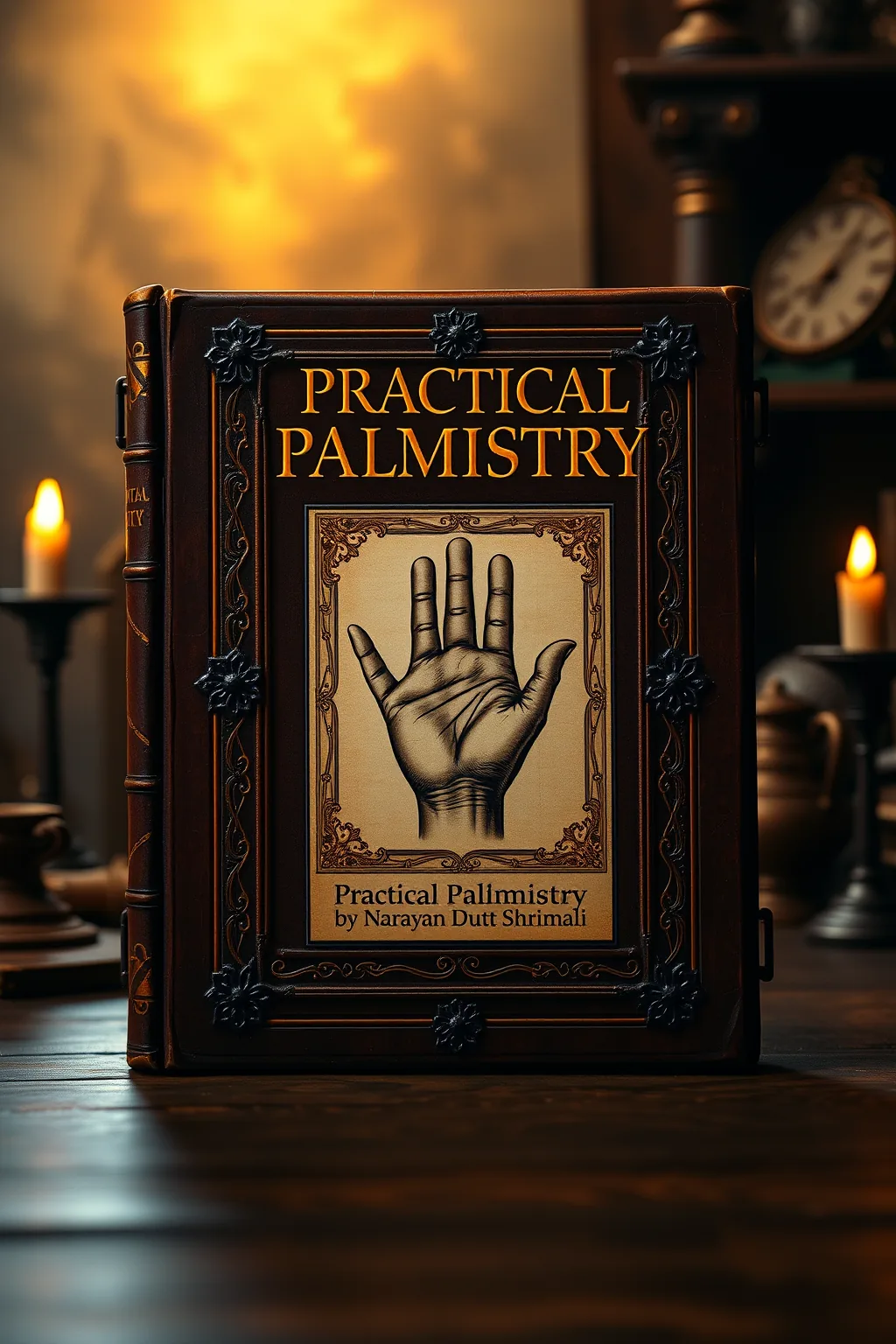
Practical Palmistry
 84
84

Practical Palmistry
Narayan Dutt Shrimali’s Practical Palmistry presents the hand as a detailed atlas of an individual’s destiny. The strength of this text lies in its methodical dissection of palm features, moving from broad classifications of hand shapes to the nuanced interpretations of individual lines and mounts. Shrimali’s approach avoids the vagueness often associated with the subject, aiming instead for an authentic forecasting capability, as he states in the original blurb. However, the sheer volume of detail can be overwhelming for the absolute novice. A particularly illuminating section details the significance of the Rascette lines, offering specific predictive markers. While the book provides a comprehensive framework, the reader must still bring a discerning eye and intuitive practice to truly unlock its potential. It serves as a solid, if dense, guide for the serious student.
📝 Description
84
In 1994, Narayan Dutt Shrimali published Practical Palmistry, detailing hand analysis for personal divination.
This book presents a systematic method for interpreting the hand's physical features, including lines, mounts, and shapes. It moves beyond simple fortune-telling to frame palmistry as a practical tool for understanding an individual's life path, potential challenges, and future possibilities. The author aims to equip readers with the knowledge to analyze these hand characteristics and connect them to a person's inherent traits and life events.
Shrimali's work is designed for those seeking a grounded approach to palmistry, especially individuals facing life's uncertainties. It is suited for anyone interested in self-awareness and identifying personal strengths and potential hindrances. Readers who desire a structured system for applying hand analysis to practical situations will find this book useful. The text meticulously breaks down the hand's components, such as the major lines like life, head, and heart, and the various mounts, explaining their significance. It emphasizes that the hand serves as a dynamic map, capable of reflecting ongoing changes and influences throughout a person's life.
Palmistry, a practice with ancient origins in India and Greece, experienced a revival in the late 19th and early 20th centuries alongside increased interest in occultism. While earlier works often focused on theory, later texts like Shrimali's sought to create a more accessible and applied framework. This book contributes to that tradition by providing a detailed, practical guide to interpreting the hand's physical attributes as a means of personal divination and self-understanding within a broader esoteric context.
💡 Why Read This Book?
• Gain practical interpretive skills for hand analysis, learning to identify and understand the meaning of specific lines like the Heart Line and the Mount of Jupiter as detailed in the chapter on hand formations. • Develop a more concrete understanding of how palmistry functions as a science for forecasting, moving beyond generalities to specific predictive markers derived from the 2011 publication's systematic approach. • Discover how to correlate physical hand characteristics with personal life challenges and achievements, using the book's method to interpret the interplay between mounts and lines.
⭐ Reader Reviews
Honest opinions from readers who have explored this book.
❓ Frequently Asked Questions
What is the primary purpose of Narayan Dutt Shrimali's Practical Palmistry?
The book aims to present palmistry as a complete science capable of authentic forecasting, providing readers with practical methods to interpret hand formations and understand their future.
When was Practical Palmistry first published?
Practical Palmistry by Narayan Dutt Shrimali was first published in April 2011.
What are the main components of the hand discussed in the book?
The book systematically analyzes the major and minor lines (like the life and head lines), the mounts (such as Venus and Jupiter), and the overall hand shape.
Is this book suitable for beginners in palmistry?
Yes, it is designed for those seeking a practical, systematic understanding, though the detailed analysis may require focused study.
Does the book focus only on predicting the future?
While forecasting is a key aspect, the book also presents palmistry as a science for understanding personality traits, inherent strengths, and potential life obstacles.
What makes this book different from other palmistry guides?
It emphasizes a practical, scientific approach to authentic forecasting, moving beyond anecdotal fortune-telling to a systematic interpretation of hand features.
🔮 Key Themes & Symbolism
Hand as a Life Map
The central theme posits the hand as a detailed cartography of an individual's life journey. Shrimali elucidates how the various lines, mounts, and their interrelationships serve as indicators of personality, innate potentials, challenges, and future possibilities. This perspective elevates palmistry from simple fortune-telling to a diagnostic tool for self-understanding and life planning, emphasizing that the hand reflects an ongoing narrative rather than fixed predictions.
Authentic Forecasting Science
This work champions palmistry as a verifiable science capable of accurate prediction. It moves away from generalized interpretations, focusing on systematic analysis derived from the physical characteristics of the palm. The book provides concrete methods for correlating specific hand features with life events, aiming to offer readers a reliable system for understanding and anticipating future circumstances with a degree of certainty.
Interplay of Lines and Mounts
A core concept is the dynamic interaction between the various lines (e.g., Heart Line, Head Line) and the fleshy mounds on the palm (e.g., Mount of Venus, Mount of Jupiter). The book details how the prominence or deficiency of these elements, and their intersections, provide nuanced insights into an individual's psychological makeup, emotional landscape, and destiny. Understanding this complex interplay is key to accurate palm reading.
Practical Application
Practical Palmistry stresses the applied nature of the art. It is not merely theoretical but designed to be used by individuals to navigate their own lives or assist others. The book equips readers with the knowledge to interpret their own hands or those of others, enabling them to make informed decisions, recognize opportunities, and prepare for potential difficulties, thereby empowering them through self-knowledge.
💬 Memorable Quotes
Direct passages from the work, attributed to the author.
“Palmistry is in itself a complete science which can forecast the future of an individual authentically.”
— This foundational statement by Shrimali sets the book's ambitious tone, positioning palmistry not as superstition but as a rigorous system for understanding and predicting life trajectories with accuracy.
“Human life has become so complex that it faces many obstacles, difficulties and keen competition to achieve its objective.”
— This observation highlights the relevance of palmistry in contemporary times, suggesting that its insights are particularly valuable for individuals reading through the intricate and challenging path of modern existence.
“Through this book, the readers get the taste of Palmistry from a practical aspect.”
— This emphasizes the book's focus on actionable knowledge, promising readers a hands-on understanding and application of palmistry principles rather than purely abstract theory.
“When a person wants to reach his goal, he feels an uncertainty about his future-whether he will achieve his aim or not.”
— This speaks to a universal human experience, framing palmistry as a tool to alleviate anxiety by providing clarity and foresight regarding personal aspirations and their potential outcomes.
“The readers get the power to look into their future.”
— This interpretation suggests that the book empowers individuals by granting them the ability to perceive future possibilities, thereby enabling proactive engagement with their life path.
🌙 Esoteric Significance
Tradition
This work draws heavily from the Vedic traditions of India, where palmistry (Hasta Samudrika Shastra) is considered a Jyotisha (astrology) subsidiary. It aligns with the broader Vedic worldview that sees cosmic influences reflected in terrestrial phenomena, including the human body. While not strictly Hermetic or Kabbalistic, it shares the goal of understanding divine or natural order through symbolic interpretation, fitting within the wider umbrella of esoteric knowledge systems seeking to decipher universal laws.
Symbolism
Key symbols include the major lines – the Life Line (vitality, physical health), Head Line (intellect, mental processes), and Heart Line (emotions, relationships) – each representing fundamental aspects of human experience. The mounts, such as the Mount of Jupiter (ambition, leadership) and Mount of Venus (love, passion), symbolize inherent energies and potentials. Their prominence or deficiency, along with the clarity and formation of the lines, creates a complex symbolic language.
Modern Relevance
Practical Palmistry continues to be relevant for contemporary practitioners of Vedic sciences, astrologers, and those interested in self-development through esoteric means. Its systematic approach informs modern interpretations of palmistry and appeals to individuals seeking practical tools for personal insight, similar to how modern psychological approaches might utilize character analysis. It bridges ancient wisdom with the modern desire for actionable self-knowledge.
👥 Who Should Read This Book
['• Aspiring palmists seeking a structured curriculum to learn the science of hand analysis, moving from basic principles to detailed interpretations.', '• Individuals interested in self-discovery and personal growth who wish to understand their own strengths, weaknesses, and life path through a unique divinatory system.', '• Students of Vedic sciences and comparative esoteric traditions looking to explore the practical applications of Hasta Samudrika Shastra within a broader spiritual framework.']
📜 Historical Context
Narayan Dutt Shrimali's *Practical Palmistry*, first published in 2011, emerges within a long lineage of palmistry texts that gained significant traction during the esoteric revivals of the late 19th and early 20th centuries. This period saw figures like Cheiro (Count Louis Hamon) popularizing palmistry globally through his writings. While Shrimali's work is modern, it taps into ancient Indian Vedic traditions and Greek interpretations of chiromancy. Its emphasis on palmistry as an authentic science capable of forecasting aligns with the era's burgeoning interest in occult sciences as systems of knowledge, distinct from mere parlor tricks. The book can be seen as contributing to the ongoing effort to systematize and legitimize these ancient arts for a contemporary audience, offering a practical methodology that complements the more philosophical or theoretical works that also characterized the field.
📔 Journal Prompts
The clarity of your Head Line and its relation to your Mount of Jupiter.
The significance of a well-defined Heart Line in understanding emotional expression.
Interpreting the Rascette lines as indicators of health and fortune.
How the prominence of the Mount of Venus aligns with your personal drives.
The interplay between your Life Line and potential future challenges.
🗂️ Glossary
Hasta Samudrika Shastra
The traditional Sanskrit name for the science of palmistry originating from ancient India, considered a part of Vedic astrology (Jyotisha).
Mounts
The fleshy, raised pads on the palm, named after planets (e.g., Mount of Venus, Mount of Jupiter), believed to represent specific personality traits and potentials.
Life Line
The curved line starting near the thumb and extending around the base of the thumb towards the wrist, often interpreted as indicating vitality, physical health, and major life events.
Head Line
The horizontal line starting near the Life Line and extending across the palm, representing intellectual capacity, thinking patterns, and mental focus.
Heart Line
The horizontal line near the top of the palm, usually starting below the little finger and extending towards the edge of the palm, interpreted as relating to emotions, love life, and relationships.
Rascette Lines
The horizontal lines found on the wrist, believed by some traditions to indicate longevity, health, and overall fortune in life.
Authentic Forecasting
The book's concept of palmistry as a reliable method for predicting future events and individual life trajectories based on systematic hand analysis.