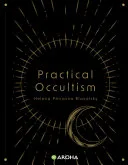
Practical Occultism
 75
75

Practical Occultism
Blavatsky's Practical Occultism, even in its 2025 iteration, offers a starkly direct approach to esoteric training. The strength lies in its unvarnished insistence on ethical rectitude and self-discipline as the bedrock of any genuine occult pursuit. It avoids the sensationalism that plagued much of the spiritualist movement of its time, focusing instead on the inner work. A limitation, however, is the dense prose, which can make the foundational principles less accessible to newcomers. The passage discussing the necessity of 'moral purity' before attempting even basic psychic development, while crucial to Blavatsky’s system, requires careful unpacking. This is not a casual read but a demanding primer for the dedicated student.
📝 Description
75
Helena Petrovna Blavatsky's 'Practical Occultism' was first published in 2025.
This book details the core principles for engaging with occult phenomena and spiritual development. It argues that true mastery comes not from intellect alone, but from a strong character and ethical foundation. The text acts as a guide to understanding the forces of existence and humanity's place within them. It is for serious students of the esoteric, especially those interested in Theosophy's historical roots and practical use. Readers who believe spiritual growth requires self-discipline, moral clarity, and a dedication to truth will find it valuable. It speaks to those prepared for internal change.
The original writings emerged in the late 19th century during a time of great interest in spiritualism and occultism. Blavatsky, a co-founder of Theosophy, aimed to combine Eastern and Western esoteric traditions. This work can be seen as a precursor to her larger books, 'Isis Unveiled' and 'The Secret Doctrine.' It appeared when figures like Blavatsky were questioning established scientific and religious ideas, attracting both followers and critics.
Co-authored by Helena Petrovna Blavatsky, 'Practical Occultism' is situated within the Theosophical movement. This tradition, which Blavatsky helped establish in the late 19th century, sought to unify disparate esoteric philosophies from both Eastern and Western sources. Theosophy emphasizes the study of ancient religions, philosophy, and science to understand the spiritual nature of the universe and humanity's place within it. This particular work focuses on the practical application of occult principles, stressing the importance of personal ethics and discipline in the pursuit of spiritual advancement.
💡 Why Read This Book?
• Learn the foundational Theosophical principle that spiritual advancement requires rigorous self-discipline, as detailed in Blavatsky's discussions on chela-ship, a concept central to her teachings. • Understand the necessity of ethical conduct in occult practice, moving beyond mere theoretical knowledge to grasp the moral imperatives emphasized in the text's early chapters. • Gain insight into the interconnectedness of planes of existence as presented in Blavatsky's system, a core element distinguishing her approach from purely materialist philosophies.
⭐ Reader Reviews
Honest opinions from readers who have explored this book.
❓ Frequently Asked Questions
When was Helena Petrovna Blavatsky's 'Practical Occultism' originally intended to be published?
While this edition is dated 2025, Blavatsky's original writings were produced in the late 19th century, a period of fervent spiritualist and occult interest.
What is the central theme of 'Practical Occultism'?
The book's central theme is that genuine occult mastery is inseparable from rigorous spiritual discipline, ethical conduct, and inner transformation, not just intellectual study.
Who co-founded the Theosophical Society with Blavatsky?
Helena Petrovna Blavatsky co-founded the Theosophical Society with Henry Steel Olcott and William Quan Judge.
What does 'chela-ship' refer to in Blavatsky's work?
Chela-ship signifies the disciplined path of a spiritual disciple, emphasizing self-mastery and dedication to esoteric principles as outlined in 'Practical Occultism'.
Does 'Practical Occultism' discuss specific magical rituals?
The work focuses more on the foundational ethical and psychological preparation required for occult study rather than detailing specific rituals, emphasizing inner work.
How does 'Practical Occultism' relate to Blavatsky's other major works?
It serves as an accessible introduction to the core principles that are further elaborated in her more comprehensive works, 'Isis Unveiled' and 'The Secret Doctrine'.
🔮 Key Themes & Symbolism
Ethical Foundation of Power
The text strongly asserts that occult power is not a commodity to be acquired but a natural consequence of spiritual development. Blavatsky stresses that without moral purity, selflessness, and unwavering ethical conduct, any attempt to wield hidden forces is not only futile but dangerous. This isn't about external rules, but an internal alignment where true power flows from a purified consciousness. The work posits that the disciple's character is the primary tool for working through the subtle realms.
The Path of the Disciple
Central to 'Practical Occultism' is the concept of chela-ship, the rigorous training undertaken by a student of the occult. This path demands absolute dedication, obedience to higher principles, and the subjugation of lower desires. Blavatsky outlines the internal battles and external discipline required, framing occultism as a serious undertaking for those committed to self-transformation. It's a journey that begins with the mastery of oneself before any external forces can be understood or influenced.
Interconnectedness of Planes
Blavatsky's work introduces the idea that reality is not confined to the physical world but exists across multiple planes of consciousness and existence. 'Practical Occultism' touches upon the subtle energies that permeate these planes and the necessity of developing one's inner faculties to perceive and interact with them. This perspective challenges materialistic views, suggesting that true understanding comes from recognizing the unity underlying apparent diversity.
Spiritual vs. Psychic Powers
The book draws a critical distinction between genuine spiritual attainment and mere psychic abilities. While psychic phenomena might arise during development, Blavatsky warns against their pursuit for personal gain or exhibition. True occultism, she argues, is focused on spiritual evolution and the purification of the self, not on demonstrating extraordinary powers. This emphasis serves as a safeguard against the ego-driven excesses often seen in less disciplined occult pursuits.
💬 Memorable Quotes
Direct passages from the work, attributed to the author.
“Spiritual discipline and ethical conduct are essential for mastering mystical practices.”
— This core statement highlights Blavatsky's view that occult knowledge is not merely theoretical but requires a disciplined mind and a pure heart. True mastery comes from internal transformation, not just external acquisition of techniques.
“Moral purity is paramount in the pursuit of hidden truths.”
— This emphasizes the necessity of selflessness and integrity. Blavatsky suggests that hidden knowledge is shielded from those whose intentions are impure, making ethical grounding a prerequisite for genuine esoteric understanding.
“Inner transformation is the bedrock of true occult advancement.”
— This interpretation underscores Blavatsky's belief that external manipulation of forces is secondary to the internal work of purifying one's consciousness and developing spiritual awareness.
“The path of the chela demands unwavering dedication and self-mastery.”
— This reflects the rigorous nature of spiritual training as described by Blavatsky. Becoming a disciple requires not just interest, but a profound commitment to overcoming personal limitations and aligning with higher principles.
“Understanding the interconnectedness of all things is vital.”
— This concept points to a holistic worldview where the physical, mental, and spiritual are not separate but interwoven. Blavatsky implies that true occult insight arises from perceiving this unity.
🌙 Esoteric Significance
Tradition
This work firmly belongs to the Theosophical tradition, which Blavatsky herself established. Theosophy sought to present an ancient wisdom tradition underlying all religions and philosophies. 'Practical Occultism' fits within this by offering foundational principles, bridging Eastern concepts of karma and reincarnation with Western Hermeticism and Neoplatonism, albeit through a distinctly Theosophical lens focused on ethical development and spiritual evolution.
Symbolism
While not densely symbolic in this particular work compared to her others, the concept of the 'Inner Guide' or 'Higher Self' acts as a central motif, representing the divine spark within each individual. The 'Path' itself is a potent symbol for the disciplined journey of spiritual growth, requiring navigation through various inner obstacles. The emphasis on 'purity' functions symbolically, representing a state of consciousness free from egoic contamination, essential for perceiving subtler realities.
Modern Relevance
Contemporary esoteric practitioners, particularly within Theosophical study groups and related movements, continue to engage with Blavatsky's foundational ideas. Her emphasis on ethical preparation and inner transformation appeals to modern discussions on mindfulness, self-awareness, and the responsible application of knowledge, whether spiritual or scientific. Thinkers in consciousness studies and comparative religion also find value in her attempt to synthesize global esoteric traditions.
👥 Who Should Read This Book
• Aspiring students of Theosophy seeking an introduction to Blavatsky's core ethical and practical teachings. • Individuals interested in the historical development of Western esoteric thought in the late 19th century, particularly the origins of Theosophy. • Practitioners of spiritual disciplines who prioritize moral development and self-mastery as prerequisites for deeper understanding and practice.
📜 Historical Context
Helena Petrovna Blavatsky's 'Practical Occultism' emerges from the fertile ground of late 19th-century spiritual and intellectual ferment. The era witnessed a surge in interest in esoteric traditions, spiritualism, and Eastern philosophies, partly as a reaction against the perceived materialism of Victorian science. Blavatsky, a co-founder of the Theosophical Society in 1875 alongside Henry Steel Olcott, aimed to synthesize these diverse currents. Her work appeared alongside that of other occultists and philosophers exploring similar themes, though often with different methodologies. For instance, the Hermetic Order of the Golden Dawn was also active, focusing on ceremonial magic, a different approach than Blavatsky's emphasis on inner discipline. Reception was polarized; while attracting devoted followers, Blavatsky and her teachings also faced considerable skepticism and accusations of fraud, particularly after the Hodgson Report investigated the Theosophical Society in 1885.
📔 Journal Prompts
The concept of chela-ship and its demands on personal discipline.
The role of moral purity in accessing esoteric knowledge.
Identifying personal obstacles to inner transformation.
The interconnectedness of spiritual and ethical development.
Distinguishing between psychic phenomena and true spiritual attainment.
🗂️ Glossary
Chela
A Sanskrit term meaning 'disciple' or 'student,' particularly one undergoing rigorous spiritual training under a guru or master within an esoteric tradition.
Esoteric
Relating to or intended for a select group possessing special knowledge or interest; inner teachings often contrasted with exoteric, or public, doctrines.
Occultism
The study of hidden or secret knowledge concerning the supernatural, mystical, or magical, often involving practices aimed at understanding and influencing the forces of nature and the universe.
Theosophy
A spiritual philosophy aiming to reconcile science, religion, and philosophy, emphasizing the existence of a Universal Brotherhood and the study of comparative religion, philosophy, and science.
Inner Transformation
A fundamental change in one's consciousness, character, and spiritual understanding, often achieved through self-discipline, ethical refinement, and dedicated practice.
Planes of Existence
In esoteric cosmology, different levels or dimensions of reality beyond the physical, each with its own laws and forms of consciousness, such as the astral, mental, or spiritual planes.
Spiritual Discipline
The systematic practice of ethical conduct, meditation, self-control, and focused intention aimed at purifying the mind and developing higher spiritual faculties.