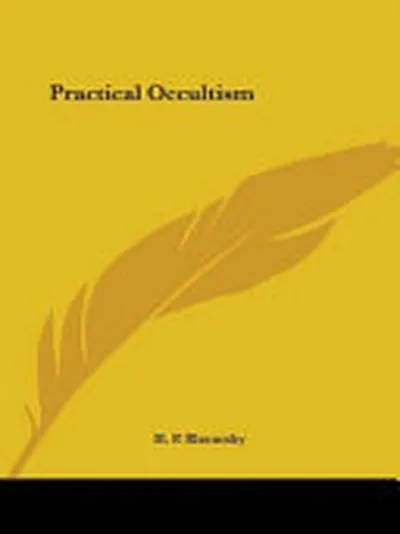
Practical Occultism
 76
76

Practical Occultism
Helena Petrovna Blavatsky’s "Practical Occultism" functions less as a handbook and more as a philosophical treatise on the application of esoteric laws. Its strength lies in its unflinching intellectual rigor, demanding a commitment from the reader to grapple with concepts like karma and the seven planes of existence. Blavatsky’s prose, though occasionally dense, is purposeful, aiming to convey a systematic understanding of the cosmos and humanity’s place within it. A notable passage concerning the nature of desire as a binding force illustrates the work’s focus on inner discipline. However, the book’s primary limitation is its inherent accessibility; it assumes a pre-existing familiarity with Theosophical terminology and concepts, potentially alienating newcomers. For the dedicated student of Blavatsky’s oeuvre, it offers a valuable distillation of her philosophical system, but its practical utility is indirect, relying on deep contemplation rather than step-by-step instruction. It is a text for the committed student, not the casual inquirer.
📝 Description
76
Helena Petrovna Blavatsky's 'Practical Occultism' was first published in 1900.
Originally published in 1900, Helena Petrovna Blavatsky's 'Practical Occultism' is a direct manual for applying occult principles. It is not a fictional narrative or casual philosophy but a serious text for those dedicated to understanding and working with esoteric laws. The book demands focused study to grasp its theoretical framework for metaphysical comprehension. It addresses students of the occult, especially those within Theosophy, who have moved past introductory spiritual philosophy. Readers should be prepared to engage with challenging ideas about consciousness and the nature of reality, as simplistic answers are not provided.
This work emerged from the late 19th and early 20th centuries, a time of revived interest in spiritualism and Eastern philosophies. Blavatsky, a key figure in the Theosophical Society, synthesized diverse spiritual concepts into a distinct worldview. Her writings, including 'Practical Occultism,' influenced many subsequent esoteric movements. The book's dense nature means it requires careful attention rather than a superficial read, aiming to equip the reader with a solid theoretical basis for metaphysical understanding.
Published in 1900, 'Practical Occultism' is a product of the late 19th-century spiritualist revival and the rise of Theosophy. Blavatsky, a central figure in disseminating Eastern philosophies and esoteric ideas in the West, aimed to provide a systematic approach to occult principles. The book reflects a period where comparative religion and ancient wisdom traditions were being re-examined, influencing thinkers like Annie Besant and William Quan Judge. Blavatsky's work synthesized these streams into a coherent, though often debated, spiritual philosophy.
💡 Why Read This Book?
• Understand the Theosophical concept of the "seven planes of existence" as presented by Blavatsky, offering a unique cosmological framework beyond standard materialist views. • Grasp the intricate relationship between "karma" and individual destiny as articulated in the book, providing a nuanced perspective on cause and effect in spiritual evolution. • Explore Blavatsky's specific teachings on "will-power" and "concentration" as essential tools for occult development, offering practical directives for mental discipline that can be applied to personal growth.
⭐ Reader Reviews
Honest opinions from readers who have explored this book.
❓ Frequently Asked Questions
What is the primary focus of Helena Blavatsky's 'Practical Occultism'?
The book's primary focus is the application of esoteric laws and principles to spiritual development and understanding of the universe, as viewed through a Theosophical lens.
Is 'Practical Occultism' suitable for beginners in occult studies?
It is generally recommended for those with some prior exposure to esoteric concepts or Theosophy, as it assumes a foundational understanding of terms and ideas.
When was the original work by Helena Blavatsky first published?
While this edition is a 2005 facsimile reprint, Blavatsky's original writings that form the basis of 'Practical Occultism' date from the late 19th to early 20th century.
What does 'Practical Occultism' say about the human being?
It posits the human being as a complex entity with multiple layers of consciousness, capable of influencing reality through focused will and an understanding of universal laws.
Are there specific practices recommended in 'Practical Occultism'?
The book emphasizes mental discipline, concentration, and the ethical application of will-power as practical foundations for occult understanding and development, rather than specific rituals.
How does 'Practical Occultism' relate to Theosophy?
It is a key text for understanding Theosophical teachings, elaborating on concepts central to the movement, such as karma, reincarnation, and the nature of the higher self.
🔮 Key Themes & Symbolism
The Nature of Will-Power
Blavatsky elaborates on the 'will' not merely as a psychological faculty but as a fundamental cosmic force. The text emphasizes that true occult practice hinges on the disciplined cultivation and directed application of this will. It distinguishes between the lower, personal will and the higher, spiritual will, arguing that mastery of the former is essential to align with the latter. This disciplined will, when properly focused, becomes a tool for influencing one's own destiny and understanding the mechanics of karma.
Karma and Reincarnation
Central to the work is the doctrine of karma and reincarnation, presented not as fatalistic pronouncements but as fundamental laws of universal justice and spiritual evolution. Blavatsky explains how actions, thoughts, and intentions create karmic impressions that shape future experiences, both in this life and subsequent incarnations. The text encourages understanding these laws to navigate life's challenges consciously and to work towards spiritual liberation rather than being passively bound by cause and effect.
The Seven Planes of Existence
The book systematically outlines the Theosophical cosmology, detailing the 'seven planes of existence' that span from the purely physical to the highest spiritual realms. Blavatsky describes these planes as distinct levels of consciousness and matter, through which the soul progresses. Understanding these planes is presented as crucial for comprehending the totality of existence and the various stages of human spiritual evolution, providing a framework for metaphysical inquiry.
Ethical Foundation of Occultism
Blavatsky strongly asserts that true occultism is inseparable from a robust ethical foundation. The text criticizes the pursuit of psychic powers or esoteric knowledge for selfish gain, labeling such endeavors as dangerous and ultimately self-defeating. It stresses the importance of compassion, selflessness, and moral integrity as prerequisites for genuine spiritual advancement and the safe exploration of occult principles.
💬 Memorable Quotes
Direct passages from the work, attributed to the author.
“The greatest service that can be rendered to the human race is to help it to help itself.”
— This statement underscores Blavatsky's philosophy of self-reliance and empowerment. It suggests that true aid lies not in providing external solutions but in equipping individuals with the knowledge and inner strength to overcome their own limitations and achieve spiritual autonomy.
“Desire is the parent of karma.”
— This concise aphorism highlights the causal link between volition and consequence in Blavatsky's system. It implies that the root of karmic accumulation lies in the attachments, cravings, and aspirations that drive our actions and shape our future experiences.
“Occultism is not a matter of spells and incantations, but of understanding the fundamental laws of nature.”
— This interpretation clarifies Blavatsky's view of practical occultism as a science of universal laws, distinct from what she perceived as superficial or magical practices. It emphasizes knowledge and conscious application over ritualistic manipulation.
“Man is divine in his essence.”
— This assertion points to the inherent spiritual nature of humanity according to Blavatsky's teachings. It suggests that the divine spark exists within every individual, and the path of occultism is one of uncovering and realizing this innate divinity.
💡 Key Ideas
Editorial paraphrase of the work's core concepts — not direct quotes.
The Theosophist must learn to think independently.
This quote emphasizes the critical role of independent thought and intellectual rigor in the pursuit of esoteric truth. It cautions against blind adherence to dogma and encourages the development of personal discernment and understanding.
🌙 Esoteric Significance
Tradition
This work is firmly rooted in the Theosophical tradition, which Blavatsky herself was instrumental in founding. Theosophy, as presented here, draws heavily from Eastern philosophies (particularly Hinduism and Buddhism) and Western esoteric currents like Hermeticism and Kabbalah. 'Practical Occultism' functions as a guide to understanding the Theosophical interpretation of universal laws, consciousness, and spiritual evolution, departing from purely Western occult systems by its emphasis on reincarnation and Eastern cyclical views of time.
Symbolism
Key symbols explored include the "seven planes of existence," representing levels of consciousness and matter, and the concept of "karma" as a universal law of cause and effect. The "divine spark" within humanity symbolizes the inherent spiritual potential of every individual, waiting to be awakened. The "will" is presented not just as a human faculty but as a cosmic principle, the directed force necessary for spiritual progress.
Modern Relevance
Contemporary esoteric thinkers and practitioners, particularly within Theosophical societies and related New Age movements, continue to engage with Blavatsky's foundational concepts. Her ideas on consciousness, karma, and spiritual evolution have influenced modern discussions on mindfulness, personal development, and comparative religion. Modern interpretations often seek to reconcile her dense philosophical frameworks with contemporary scientific and psychological understanding.
👥 Who Should Read This Book
• Students of Theosophy and Helena Blavatsky's specific teachings will find this a crucial text for understanding her philosophical system and approach to occult principles. • Individuals interested in the history of esoteric thought in the late 19th and early 20th centuries can gain insight into the intellectual currents that shaped modern occultism. • Serious practitioners of meditation and mental discipline seeking a philosophical basis for self-mastery will appreciate the emphasis on will-power and concentration.
📜 Historical Context
Helena Petrovna Blavatsky’s "Practical Occultism" emerged from the late 19th-century milieu, a period characterized by intense spiritual and intellectual ferment. The founding of the Theosophical Society in 1875 by Blavatsky, along with Henry Steel Olcott and William Quan Judge, placed her at the forefront of a movement seeking to synthesize Eastern and Western esoteric traditions. This era saw a significant public appetite for the occult, fueled by spiritualism, mesmerism, and a reaction against rigid materialism. Blavatsky’s writings were published amidst a landscape populated by figures like Annie Besant, who would later become a prominent Theosophist, and Helena's work engaged with concepts found in Hermeticism and Neoplatonism, reinterpreting them within her unique Theosophical framework. While widely influential, Blavatsky's ideas also faced considerable skepticism and controversy, including accusations of fraud, which were part of the broader reception of spiritualist and occult claims during the Victorian and Edwardian eras.
📔 Journal Prompts
The concept of "karma" as a guiding principle for life choices.
The cultivation of "will-power" through focused concentration.
The relationship between "desire" and the accumulation of karmic impressions.
Understanding one's place within the "seven planes of existence."
The ethical responsibilities inherent in pursuing occult knowledge.
🗂️ Glossary
Theosophy
A spiritual philosophy founded by Helena Blavatsky, aiming to synthesize Eastern and Western esoteric traditions and promote universal brotherhood, comparative religion, and the study of ancient wisdom.
Karma
The universal law of cause and effect, where actions, thoughts, and intentions create consequences that influence an individual's present and future experiences, including rebirths.
Reincarnation
The doctrine that the soul, after death, takes on a new body and life, continuing its evolutionary journey through successive lifetimes.
Will-power
In the context of Practical Occultism, this refers to a disciplined and directed mental force, considered a fundamental aspect of consciousness and a key tool for spiritual development.
Planes of Existence
The seven distinct levels of reality or consciousness described in Theosophy, ranging from the physical to the purely spiritual, through which the soul progresses.
Occultism
The study and practice of hidden, esoteric knowledge and powers, emphasizing understanding universal laws and developing inner faculties rather than mere ritual.
Divine Spark
The inherent spiritual essence or divine nature believed to reside within every human being, the realization of which is a primary goal of spiritual evolution.