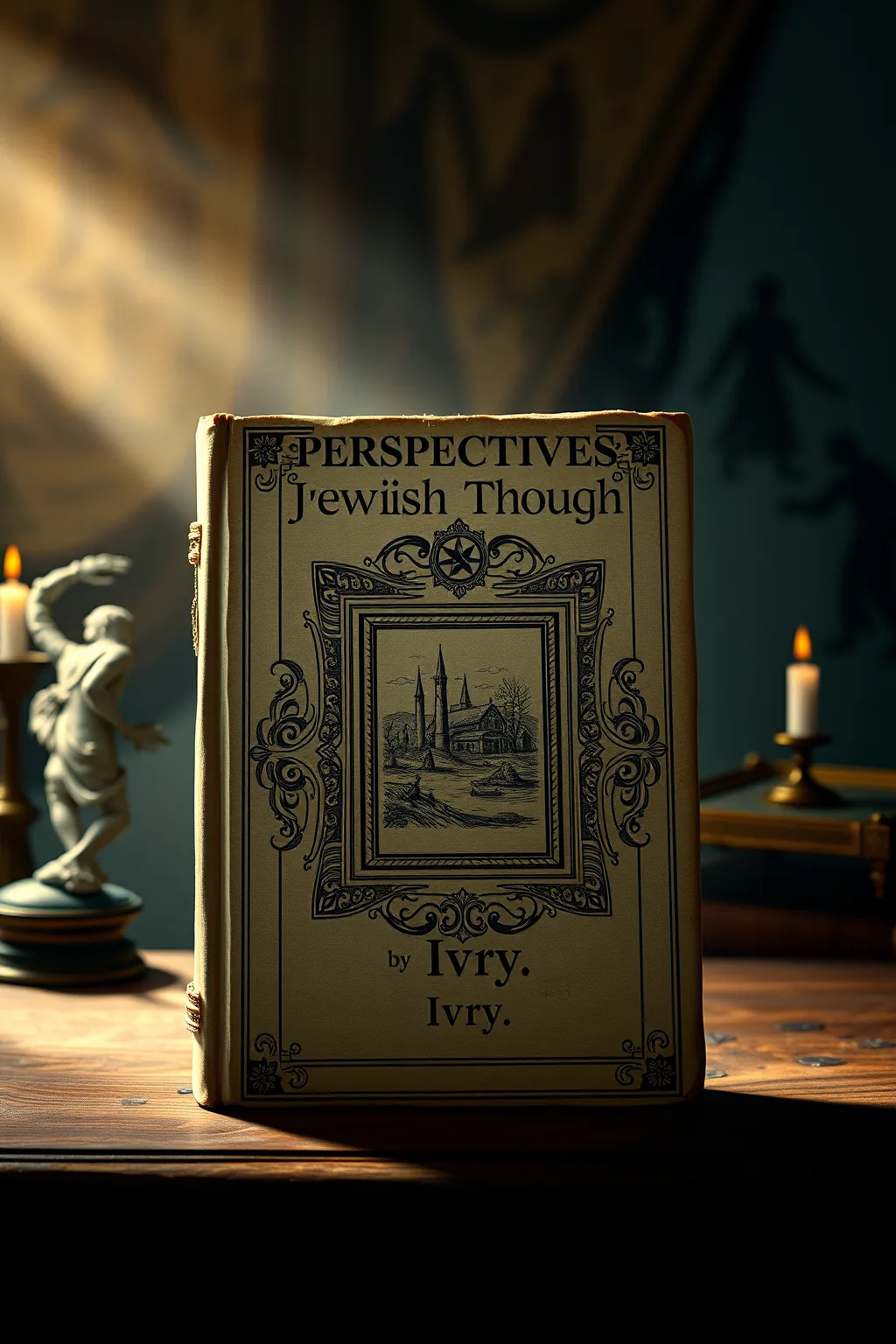
Perspectives on Jewish Though
 62
62

Perspectives on Jewish Though


Lorelei Sage (Contemplative Literature Editor) — Ivry's 'Perspectives on Jewish Thought' is an indispensable guide to the intricate landscape of Kabbalistic philosophy. With scholarly precision and an intuitive grasp of mystical concepts, Ivry demystifies complex ideas, offering profound insights into the divine architecture of the cosmos and humanity's place within it. The book excels in its clear exposition of esoteric doctrines, making them accessible without sacrificing their inherent depth. This work is essential reading for anyone dedicated to understanding the veiled wisdom of Jewish mysticism, providing a solid foundation for further contemplation and practice.
📝 Description
62
In 1981, Ivry's 'Perspectives on Jewish Thought' examined Kabbalistic symbolism.
This book looks at specific currents in Jewish mystical thought. It details the symbolic language found in Kabbalistic writings, explaining concepts that have influenced Jewish spirituality over centuries. Ivry focuses on how these symbols function as a kind of blueprint within sacred texts.
The author aims to illuminate these often hidden meanings. The work is written for readers interested in the philosophical ideas behind Jewish mysticism. It also suits those who wish to deepen their spiritual practice. The book covers the esoteric aspects of Jewish tradition, aiming to provide a clearer understanding of existence.
This work engages with the Kabbalistic tradition, a significant stream within Jewish esotericism. It places emphasis on the symbolic and allegorical dimensions of Jewish scripture and rabbinic literature. The book connects these elements to broader themes of spiritual attainment and understanding the divine, placing it within a lineage of esoteric interpretation found in various mystical traditions.
💡 Why Read This Book?
Embark on a profound journey into the heart of Jewish mysticism. 'Perspectives on Jewish Thought' offers unique insights into Kabbalistic symbolism and hidden spiritual pathways. Ideal for scholars, seekers of esoteric knowledge, and practitioners aiming to deepen their understanding of the divine. Uncover timeless wisdom that resonates with contemporary spiritual quests.
⭐ Reader Reviews
Honest opinions from readers who have explored this book.
❓ Frequently Asked Questions
What is Kabbalah?
Kabbalah is the esoteric tradition of Jewish mysticism, seeking to understand the nature of God, the creation of the universe, and humanity's relationship with the Divine through symbolic interpretation of scripture and mystical contemplation.
Is this book suitable for beginners?
Yes, while it delves into complex topics, Ivry's clear prose makes the foundational concepts of Jewish mysticism accessible to those new to the subject, serving as an excellent introduction.
What are the main themes explored?
The book explores divine emanations (Sefirot), the nature of the soul, the structure of the cosmos, and the mystical path to spiritual enlightenment within the Jewish tradition.
Does the book discuss practical Kabbalistic techniques?
While primarily focused on theoretical perspectives, the book lays the groundwork for understanding the philosophical underpinnings that inform practical Kabbalistic applications and meditative practices.
What is the philosophical significance of this work?
It offers a profound exploration of existential questions, the nature of reality, and the interconnectedness of all things, providing a rich philosophical framework for understanding Jewish mysticism.
🔮 Key Themes & Symbolism
The Sefirotic Tree
The book meticulously details the Kabbalistic concept of the Sefirot, the ten divine emanations that form the structure of creation and the pathway between the Infinite and the finite. Ivry elucidates how these divine attributes are not merely abstract concepts but active forces shaping reality, offering a profound map of the Divine presence within the cosmos and the human psyche. Understanding the Sefirot is crucial for grasping the interconnectedness of all existence and the potential for spiritual ascent.
The Nature of the Soul
A central focus is the intricate understanding of the human soul (neshama) within Jewish mysticism. Ivry explores its complex nature, from its divine spark to its journey through various spiritual realms. The text examines concepts of reincarnation, the rectification of the soul, and the ultimate reunion with the Divine. This perspective offers useful insights into personal growth, spiritual evolution, and the hidden potential within each individual.
Symbolism and Hidden Meanings
This work is a deep study in deciphering the rich symbolic language of Jewish mysticism. Ivry unpacks the layers of meaning embedded in biblical narratives, ritual objects, and Hebrew letters, revealing them as keys to unlocking esoteric truths. The book emphasizes that true understanding comes not from literal interpretation but from perceiving the deeper, spiritual significance that lies beneath the surface, inviting the reader to develop their own perceptive abilities.
💬 Memorable Quotes
Direct passages from the work, attributed to the author.
“The cosmos whispers its secrets to the attentive soul.”
— This highlights the idea that the universe itself holds divine wisdom, accessible to those who cultivate inner stillness and spiritual receptivity.
“Each letter is a universe, each word a divine breath.”
— This emphasizes the Kabbalistic belief in the sacred power of Hebrew letters and words as building blocks of reality, imbued with divine creative energy.
“The path inward is the path outward.”
— This poignant statement suggests that true understanding of the external world and the Divine is achieved through introspection and self-knowledge.
“To know God is to know oneself.”
— This profound aphorism underscores the interconnectedness of the divine and the human, positing that self-discovery is intrinsically linked to spiritual enlightenment.
💡 Key Ideas
Editorial paraphrase of the work's core concepts — not direct quotes.
The hidden is but the revealed veiled in metaphor.
This quote suggests that what appears concealed in esoteric teachings is merely the profound truths of existence presented in symbolic language, awaiting deeper contemplation to be unveiled.
🌙 Esoteric Significance
Tradition
This work is deeply rooted in the Kabbalistic tradition, a mystical branch of Judaism that explores the divine nature, creation, and the relationship between God and humanity. It draws heavily on Zoharic literature and later Kabbalistic schools, offering a systematic yet profound exploration of concepts like the Sefirot, divine emanations, and the mystical ascent of the soul towards union with the Infinite.
Symbolism
The esoteric significance lies in its masterful decoding of rich symbolic language. Key symbols like the Tree of Life (Etz Chaim), the Hebrew alphabet, and various divine names are presented not as mere decorations but as intricate keys to understanding cosmic order, divine will, and the hidden pathways of spiritual transformation. These symbols act as conduits for divine energy and insight.
Modern Relevance
In a world often seeking deeper meaning and connection, 'Perspectives on Jewish Thought' offers timeless wisdom. Its exploration of consciousness, interconnectedness, and the profound potential within the human spirit appeals to contemporary spiritual seekers across traditions. The book provides a framework for ethical living, self-awareness, and a deeper appreciation of the sacred woven into the fabric of everyday existence.
👥 Who Should Read This Book
This book is a treasure for a diverse audience. Scholars of comparative religion and Jewish studies will find it an authoritative and insightful resource. Mystical practitioners and seekers of esoteric wisdom will discover profound guidance on their spiritual path. Those new to Kabbalah will find an accessible yet deep introduction, while seasoned practitioners will appreciate the nuanced interpretations and scholarly rigor. It is for anyone yearning to explore the profound, veiled dimensions of Jewish spirituality.
📜 Historical Context
The intellectual currents explored in 'Perspectives on Jewish Thought' emerged from centuries of Jewish intellectual and spiritual development, particularly flourishing in medieval Spain and later in Eastern Europe. This era witnessed a profound engagement with mystical traditions, seeking to reconcile philosophical rationalism with the ecstatic experiences of direct divine encounter. The Kabbalah, with its complex cosmology and symbolic language, provided a framework for understanding God's immanence in the world, the nature of evil, and humanity's role in the cosmic drama. Works like this were often transmitted through secret societies and oral traditions, preserving a lineage of esoteric knowledge that sought to illuminate the hidden dimensions of religious observance and divine communion.
📔 Journal Prompts
Reflect on a symbol from the book that resonates deeply with your personal journey. What hidden meaning does it reveal?
How does the concept of the Sefirot inform your understanding of your own inner landscape and divine connection?
Consider the idea of the soul's journey. What aspects of this concept challenge or affirm your current beliefs?
In what ways can the symbolic language of Jewish mysticism be applied to decipher the mysteries of your own life experiences?
How can the principles discussed in this book inspire a more profound and conscious engagement with the world around you?
🗂️ Glossary
Sefirot
The ten divine emanations or attributes through which God reveals Himself and creates the universe. They form the structure of the Kabbalistic Tree of Life.
Ein Sof
The Kabbalistic term for God's infinite, unknowable essence, beyond all attributes and comprehension. It represents the primordial unity before creation.
Nefesh, Ruach, Neshamah
The three primary levels of the human soul in Kabbalah, representing its animalistic, emotional, and divine spiritual aspects respectively.
Tikkun
The concept of 'rectification' or 'restoration,' referring to the process of mending the cosmic and spiritual brokenness of the world and the soul.
Gematria
A system of Jewish mysticism that assigns a numerical value to each Hebrew letter, used to find hidden connections and meanings within words and texts.
This book appears in 1 collection
🔮 Readers Also Liked
Browse all →







From the “Kabbalah” Collection
View all →







More Free Kabbalah & Jewish Mysticism Books
View all →