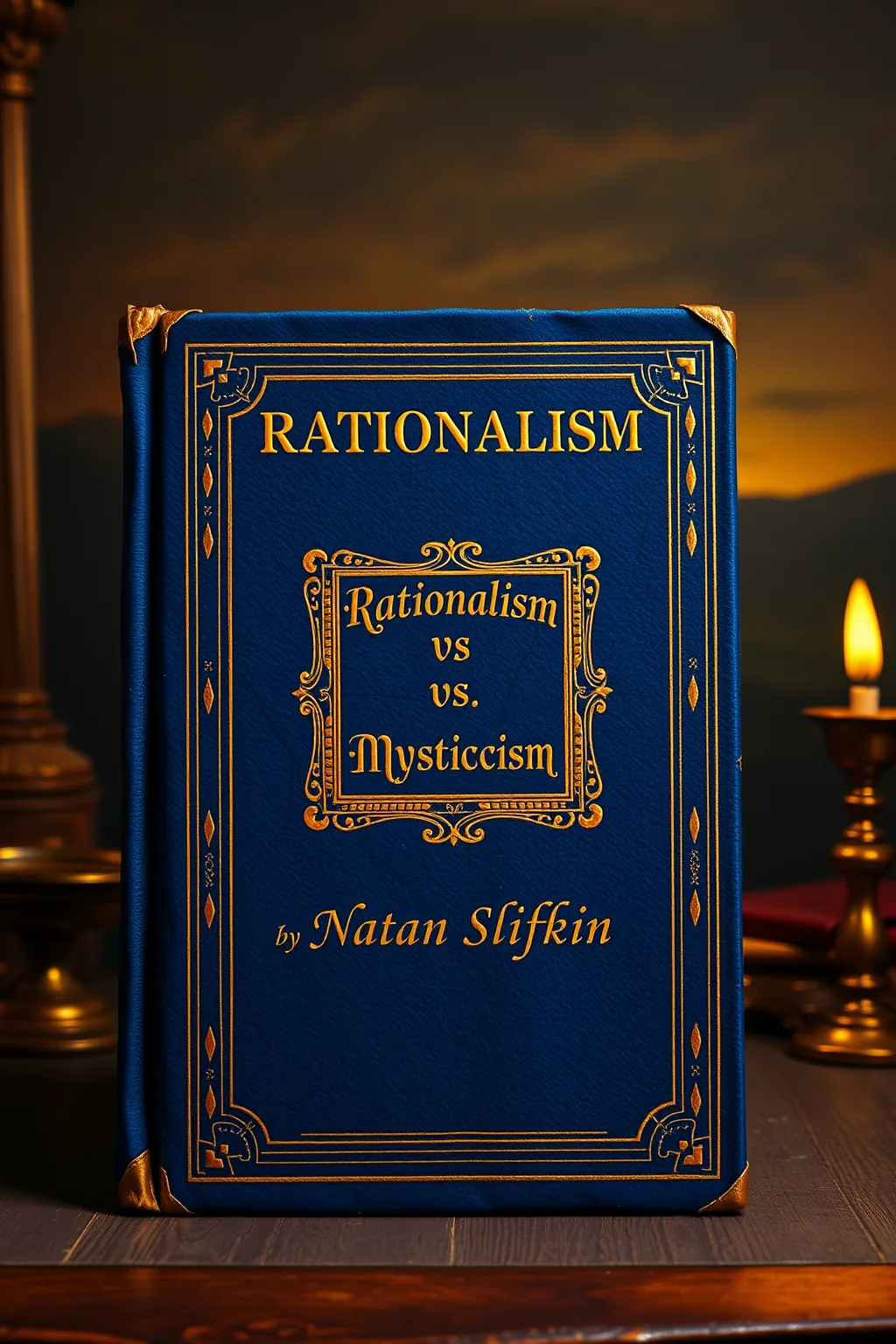
Rationalism vs. Mysticism
 65
65

Rationalism vs. Mysticism


Lorelei Sage, Contemplative Literature Editor — Natan Slifkin masterfully navigates the complex terrain between the empirical and the transcendent in 'Rationalism vs. Mysticism.' This scholarly yet accessible exploration offers profound insights into the historical and philosophical tensions within Jewish thought, illuminating how Kabbalistic traditions reconcile seemingly disparate approaches to divine wisdom. Slifkin's lucid prose deciphers intricate symbolic systems, making esoteric concepts comprehensible without sacrificing their depth. It is an essential read for serious students of mysticism, philosophy, and comparative religion, providing a robust framework for understanding the enduring dialogue between intellect and intuition.
📝 Description
65
Natan Slifkin's 2009 book examines the historical tension between rational and mystical approaches in Jewish thought.
This book analyzes the dynamic between rationalism and mysticism within Jewish tradition, particularly focusing on Kabbalah. Slifkin traces how intellectual frameworks have interacted with intuitive and experiential approaches to divinity over centuries. He examines specific Kabbalistic concepts and doctrines, showing how they have been interpreted through both rational and mystical lenses. The work also considers the broader philosophical questions about existence and consciousness that arise from these different perspectives.
It aims to illuminate the connections and conflicts between understanding the world through logic and experiencing it through spiritual insight. The book offers a detailed look at how Jewish thinkers have attempted to reconcile these seemingly opposing modes of apprehension. Readers will find an examination of how these traditions inform each other, contributing to a more complete picture of the human pursuit of knowledge and spiritual connection.
Rationalism vs. Mysticism is situated within the esoteric tradition of Kabbalah, a system of Jewish mysticism that uses symbolic interpretation to understand the divine nature and the creation of the universe. Slifkin engages with the historical trajectory of Kabbalistic thought, which has seen periods of both intense esoteric secrecy and wider philosophical engagement. The book addresses the ongoing tension within this tradition between approaches that emphasize direct, intuitive experience of the divine and those that seek to systematize and rationalize mystical concepts through intellectual frameworks.
💡 Why Read This Book?
Uncover the hidden dialogue between logic and intuition within the profound realm of Kabbalah. This book is essential for seekers of spiritual wisdom, scholars of religious philosophy, and practitioners seeking to integrate rational understanding with mystical experience. It offers a unique perspective on reconciling intellectual rigor with the pursuit of divine knowledge, illuminating the path for a more holistic spiritual journey.
⭐ Reader Reviews
Honest opinions from readers who have explored this book.
❓ Frequently Asked Questions
What is the central argument of 'Rationalism vs. Mysticism'?
The book explores the historical and philosophical tension between rationalist approaches to understanding the divine and the intuitive, experiential methods of Jewish mysticism, particularly Kabbalah. It argues for a nuanced understanding of how these two seemingly opposed paths can coexist and inform each other.
Is this book suitable for beginners in Kabbalah?
While it delves into complex concepts, Slifkin's clear writing style makes it accessible to motivated beginners. It provides a foundational understanding of key Kabbalistic ideas and their relationship to broader philosophical thought.
What kind of mystical traditions are discussed?
The primary focus is on Kabbalah and Jewish mysticism, tracing its development and engagement with rationalist thought throughout history. It offers a unique lens through which to view these specific esoteric traditions.
How does the book address the concept of 'hidden knowledge'?
It examines how Kabbalistic texts and traditions have preserved and transmitted esoteric knowledge, often veiled in symbolism and allegory, and discusses the methods by which this knowledge can be accessed and understood through both rational analysis and intuitive insight.
What is the philosophical significance of this work?
The book contributes significantly to the philosophy of religion by exploring the epistemology of spiritual knowledge, the interplay between faith and reason, and the enduring human quest to comprehend the divine through diverse intellectual and experiential means.
🔮 Key Themes & Symbolism
The Kabbalistic Dialectic
This theme explores the intricate relationship between the seemingly opposing forces of rationalism and mysticism within the framework of Kabbalah. It examines how Jewish mystical traditions, while embracing intuitive and experiential paths to divine knowledge, have also engaged with and often integrated rationalist methodologies. The discussion highlights the dynamic tension and eventual synthesis that allows for a comprehensive understanding of spiritual realities, moving beyond simplistic dichotomies to reveal a more holistic approach to divine wisdom and its apprehension.
Symbolism and Esoteric Interpretation
The book meticulously unpacks the collection of symbolism inherent in Kabbalistic literature and practice. It examines how ancient texts and concepts are encoded with layers of meaning, accessible through specialized interpretive frameworks. This theme emphasizes the crucial role of symbols as conduits to higher consciousness and hidden truths, illustrating how their decipherment requires both intellectual rigor and intuitive sensitivity. Understanding these symbolic languages is presented as key to unlocking the esoteric dimensions of spiritual reality and the divine nature.
The Quest for Divine Understanding
Fundamentally, this theme addresses the universal human drive to comprehend the divine and our place within the cosmos. 'Rationalism vs. Mysticism' situates this quest within the specific context of Jewish thought, showcasing how different eras and thinkers have grappled with the challenges of knowing God and the infinite. It explores the limitations of purely empirical or purely mystical approaches, advocating for a balanced perspective that acknowledges the complex nature of spiritual inquiry and the profound, often paradoxical, journey towards ultimate truth.
💬 Memorable Quotes
Direct passages from the work, attributed to the author.
“The veil of the divine is woven with threads of both logic and light.”
— Symbolically, this suggests that understanding God requires engaging with both structured, rational thought ('logic') and the ineffable, spiritual illumination ('light') of mystical insight.
“Within the heart of paradox lies the deepest truth.”
— This highlights the often counter-intuitive nature of spiritual revelation, implying that apparent contradictions in Kabbalistic thought are, in fact, gateways to profound spiritual understanding.
“Wisdom is not merely known, but profoundly felt.”
— This emphasizes the experiential dimension of spiritual knowledge, positing that true wisdom transcends intellectual assent and involves a deep, visceral connection with the divine.
“The map of the soul is drawn with ink of reason and stardust.”
— This evocative metaphor suggests that understanding the human psyche and its spiritual journey requires both analytical clarity ('ink of reason') and an awareness of its connection to the transcendent ('stardust').
💡 Key Ideas
Editorial paraphrase of the work's core concepts — not direct quotes.
Reason illuminates the path, while mysticism walks it.
This quote expresses the book's central thesis: that intellectual understanding and direct spiritual experience are not mutually exclusive but are complementary forces in the pursuit of divine knowledge.
🌙 Esoteric Significance
Tradition
The primary esoteric tradition explored is Kabbalah, the esoteric system of Jewish mysticism. This tradition seeks to understand the nature of God, the creation of the universe, and the relationship between the divine and humanity through symbolic interpretation of scripture and contemplative practices. Slifkin's work contextualizes Kabbalah within broader mystical movements, highlighting its unique contributions and its engagement with philosophical discourse.
Symbolism
Key symbols discussed include the Sefirot (divine emanations), the Tree of Life, gematria (numerical interpretation of Hebrew letters), and various cosmological diagrams. These symbols are not merely decorative but are understood as profound conceptual tools and maps of spiritual reality, serving as gateways to apprehending divine attributes and the structure of existence.
Modern Relevance
In an age often characterized by secularism and the dominance of scientific rationalism, 'Rationalism vs. Mysticism' offers a vital bridge. It demonstrates that ancient wisdom traditions like Kabbalah are not relics of the past but offer useful insights into consciousness, ethics, and the human search for meaning that remain highly relevant to contemporary spiritual and philosophical challenges.
👥 Who Should Read This Book
This book is a treasure for a diverse audience. **Beginners** seeking an accessible entry into the complex world of Kabbalah will find Slifkin's clarity invaluable. **Scholars** of religious studies and philosophy will appreciate the rigorous academic approach and nuanced analysis of historical intellectual currents. **Seekers** of deeper spiritual understanding will discover a thoughtful exploration of how faith and reason can coexist. **Practitioners** of contemplative disciplines may find new frameworks for integrating their experiences with intellectual frameworks, enriching their spiritual journey.
📜 Historical Context
Written during a period of burgeoning interest in comparative religion and the re-examination of esoteric traditions, Natan Slifkin's 'Rationalism vs. Mysticism' emerges as a significant contribution to the discourse surrounding Jewish thought. The late 20th and early 21st centuries saw a renewed academic and popular fascination with Kabbalah, moving it from the fringes of study into mainstream intellectual and spiritual circles. This era was marked by a desire to bridge the perceived gap between science and spirituality, tradition and modernity. Slifkin's work directly addresses this need by meticulously examining how a tradition deeply rooted in mystical experience has navigated and, at times, integrated with rationalist philosophical currents, offering a nuanced perspective on its historical evolution and enduring relevance.
📔 Journal Prompts
Reflect on a time when your rational mind and intuitive feelings presented conflicting guidance. How did you resolve this tension?
Consider the role of symbolism in your own life. What symbols hold particular meaning for you, and why?
How do you reconcile faith-based beliefs with scientific understanding? Where do you see overlap or divergence?
Explore a concept from Jewish mysticism (e.g., Tikkun Olam) and consider its practical application in your daily life.
What does 'hidden knowledge' mean to you? How do you pursue or access it?
🗂️ Glossary
Kabbalah
The esoteric system of Jewish mysticism, concerned with the nature of God, creation, and the spiritual universe, often studied through symbolic interpretation of scripture and contemplative practices.
Sefirot
Ten divine emanations or attributes through which God interacts with the created world, forming the central structure of Kabbalistic cosmology and often depicted as a Tree of Life.
Gematria
A method of Kabbalistic interpretation that assigns numerical values to Hebrew letters and words to reveal hidden meanings and connections between concepts.
Ein Sof
The Kabbalistic concept of the Infinite, representing God in His absolute, unknowable transcendence, beyond all attributes and comprehension.
Tzimtzum
The Kabbalistic doctrine of 'contraction' or 'withdrawal,' describing God's self-limitation to create a void for the possibility of existence and free will.
This book appears in 1 collection
🔮 Readers Also Liked
Browse all →








From the “Kabbalah” Collection
View all →





More Free Kabbalah & Jewish Mysticism Books
View all →