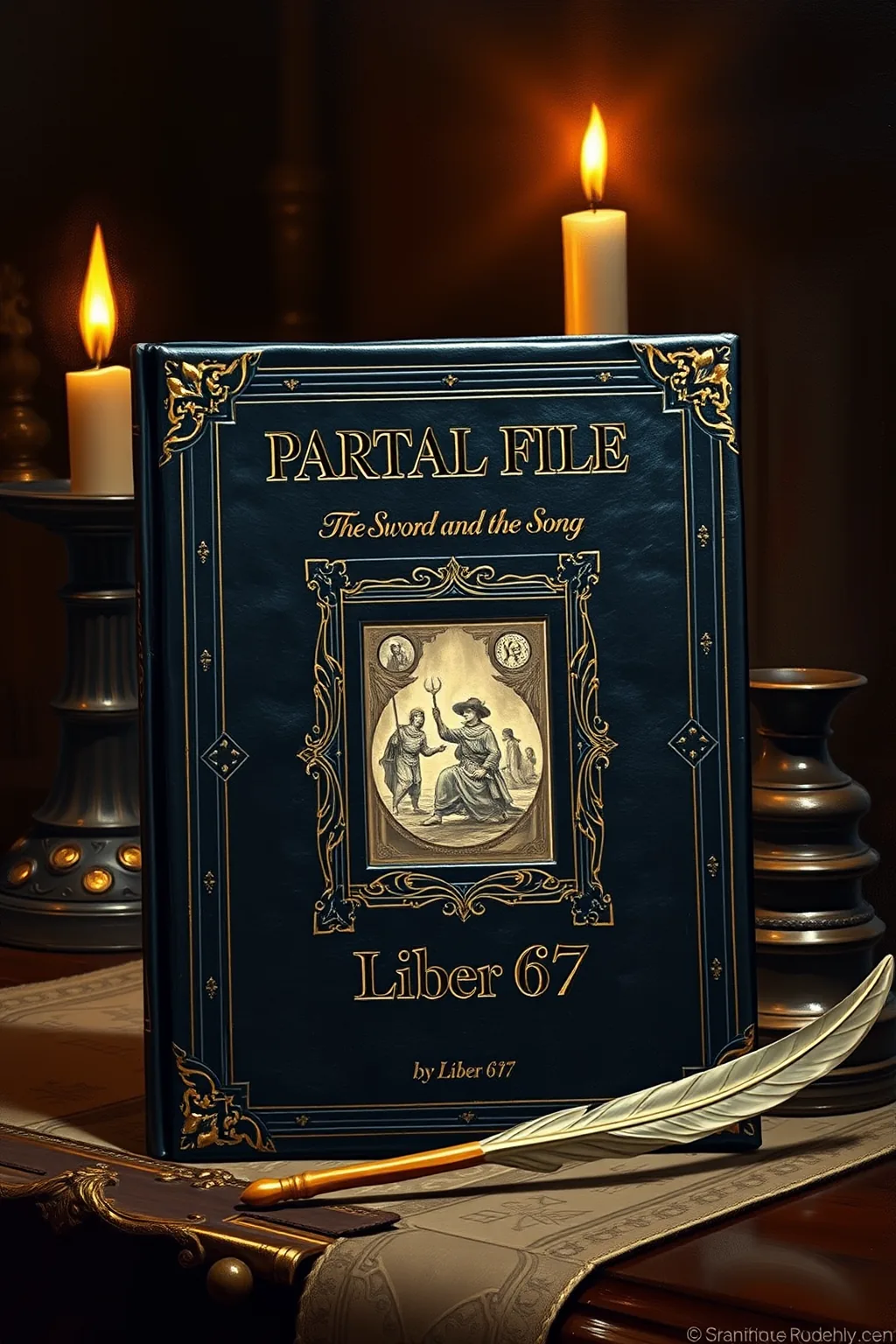
Partial File of the Collection in "The Sword and the Song"
 83
83

Partial File of the Collection in "The Sword and the Song"


Celeste Moreau (Divination & Symbolism Reviewer) — 'Partial File of the Collection' is a raw, alchemical outpouring from the depths of Liber 67's consciousness. Its strength lies in its unapologetic embrace of the shadow and its rejection of facile spiritual comforts. The text vibrates with an archaic energy, hinting at forgotten rituals and a personal cosmology forged in the crucible of profound experience. It’s a challenging but rewarding read for seasoned practitioners of occultism and those deeply immersed in the symbolism of secret societies. Liber 67’s voice is singular, a beacon for those who find themselves adrift from traditional religious structures and yearn for a more profound, self-defined gnosis. This collection will resonate with anyone seeking to understand the esoteric underpinnings of spiritual rebellion.
📝 Description
83
Liber 67's 'Partial File of the Collection in "The Sword and the Song"' was written for those estranged from conventional spiritual dogma.
Published by Liber 67, 'Partial File of the Collection in "The Sword and the Song"' addresses a spiritual restlessness felt by individuals alienated from both mundane life and overly structured religious systems. The text guides readers through the ambiguous spaces where divinity is perceived as a pantheon and the individual spirit confronts complex metaphysical forces. It speaks to a desire for a truth that is authentic, even if it diverges from established norms. This book is intended for those who challenge accepted beliefs, who find the sacred in overlooked or unconventional places, and who aim to construct their own understanding of existence. It suggests a future marked by significant personal discovery, even hinting at a transformative event termed 'Anti-Christmas Eve'. This work functions as an introduction to a different state of awareness.
This text emerges from traditions associated with Freemasonry and other secretive societies, suggesting a connection to Western esotericism. It addresses a spiritual seeking that moves beyond mainstream religious frameworks, aligning with movements that emphasize personal gnosis and direct experience of the divine. The book appears to resonate with a lineage of thought that finds spiritual significance outside of orthodox doctrine, focusing on the individual's internal journey and perception of reality.
💡 Why Read This Book?
Embark on a quest for radical spiritual autonomy. 'Partial File of the Collection' invites you to question established religious narratives and embrace a personal gnosis. It’s ideal for seekers disillusioned with mainstream spirituality, scholars of secret societies, and practitioners looking to integrate shadow work and personal mythology into their path. Discover a profound, untamed spirituality.
⭐ Reader Reviews
Honest opinions from readers who have explored this book.
❓ Frequently Asked Questions
What is the primary esoteric tradition explored in this text?
The text draws heavily from the esoteric traditions of Freemasonry and other secret societies, exploring their symbolic language and initiation processes in a highly personal and unconventional manner.
Who is Liber 67?
Liber 67 is a pseudonym or a collective designation, typical of occult literature, signifying an author or group dedicated to a specific magical or spiritual system, whose true identity is often veiled.
What does 'The Sword and the Song' symbolize?
In this context, 'The Sword' likely represents the power of decisive action, intellectual rigor, and the cutting edge of truth, while 'The Song' signifies the creative, intuitive, and perhaps prophetic voice of the spirit.
Is this book suitable for beginners in occult studies?
While rich in symbolism, the text is quite dense and personal. Beginners might find it more accessible after gaining foundational knowledge in occultism and secret society lore.
What is the significance of 'Anti-Christmas Eve'?
'Anti-Christmas Eve' suggests a subversion or inversion of conventional celebratory and religious themes, implying a personal, perhaps darker, yet ultimately liberating spiritual reckoning.
🔮 Key Themes & Symbolism
The Rejection of Dogma
This theme explores the author's profound disillusionment with established religious and spiritual institutions. It speaks to the feeling of being lost within a crowd of deities or finding God obscured by dogma. The text champions a personal, often solitary, quest for truth, one that actively rejects the comfort of conformity and seeks authenticity in the fringes of spiritual understanding. It's a call to break free from the 'chapel and church' to forge one's own sacred space.
Navigating Metaphysical Turbidity
The work explores the chaotic, often overwhelming, nature of metaphysical exploration. The image of the 'soul going down in the turbid tide' signifies the challenges and potential dissolution of the self when confronted with profound philosophical questions and the vastness of the cosmos. It highlights the struggle to maintain identity and purpose amidst existential uncertainty, suggesting that true understanding often emerges from navigating these tumultuous inner seas.
Anticipation of Personal Revelation
Despite the challenges and disillusionment, a powerful undercurrent of hope and anticipation runs through the text. The author looks forward to combining a 'song' of personal liberation, symbolized by 'Anti-Christmas Eve' and 'Beast-er Day.' This suggests a future where spiritual truths are not imposed but personally discovered and celebrated, marking a profound transformation and a unique spiritual awakening.
💬 Memorable Quotes
Direct passages from the work, attributed to the author.
“...and left the devil in the lurch...”
— Suggests a transcendence or outmaneuvering of traditional adversarial spiritual forces, perhaps by moving beyond the binary of good and evil into a more complex understanding.
“While God got lost in the crowd of gods...”
— A critique of polytheism or a vast pantheon, implying a diluted or obscured divine essence when faced with multiplicity, a loss of singular focus.
“...And soul went down in the turbid tide Of the metaphysical Lotus-eyed...”
— Expresses the overwhelming and potentially disorienting journey of the soul through complex philosophical concepts, with the 'Lotus-eyed' hinting at a divine or perhaps illusory guide.
“Yet by-and-by I hope to combine A song of Anti-Christmas Eve...”
— This foretells a future personal spiritual awakening and celebration, distinct from traditional holidays, marked by a unique and perhaps subversive form of liberation.
💡 Key Ideas
Editorial paraphrase of the work's core concepts — not direct quotes.
I flung out of chapel and church Temple and hall an meeting-room...
This line powerfully signifies a radical break from all forms of organized spiritual or social gathering, a rejection of conventional sacred spaces and communal worship.
🌙 Esoteric Significance
Tradition
The primary esoteric tradition referenced is Freemasonry and its associated secret societies, though it transcends simple adherence. It speaks to the internal spiritual journey often initiated through these orders, emphasizing personal revelation over dogma. The text engages with themes of initiation, symbolic language, and the pursuit of hidden knowledge common to these Western esoteric streams.
Symbolism
Key symbols include the 'Sword' (action, truth, decisive cutting), the 'Song' (creative expression, prophecy, spiritual voice), 'Chapel/Church/Temple' (organized religion, societal structures), 'Devil' (adversarial forces, shadow), 'God/gods' (divine essence, multiplicity), 'Soul' (individual consciousness), and 'Lotus-eyed' (divine wisdom, illusion). These are woven into a personal cosmology.
Modern Relevance
In an age of information overload and spiritual pluralism, this text's message of forging an authentic, personal path resonates deeply. Its critique of dogma and embrace of the complex, often turbulent, inner journey offers solace and guidance to those seeking meaning beyond superficial answers, encouraging self-empowerment and critical spiritual inquiry.
👥 Who Should Read This Book
This text is a potent draught for the seasoned esoteric scholar eager to explore the intersection of Freemasonry and personal gnosis. Seekers disillusioned with mainstream religion will find a kindred spirit in Liber 67's radical honesty and quest for authenticity. Practicing occultists may draw inspiration from its raw exploration of shadow and spiritual rebellion. Beginners are advised to approach with a foundational understanding of Western esotericism, as the language is dense and the themes challenging, but the rewards for persistent study are profound.
📜 Historical Context
This piece likely emerges from a period of intense spiritual and intellectual ferment, possibly the late 19th or early 20th century, a time when established religious orders faced challenges from scientific inquiry and a burgeoning interest in esoteric philosophies. The rise of occultism, Theosophy, and various secret societies provided avenues for individuals seeking alternative spiritual paths. Freemasonry itself, with its ancient rituals and symbolic language, was a fertile ground for exploration. The author's voice echoes a sentiment of modern spiritual alienation, a feeling of being disconnected from traditional faiths, pushing towards a more personalized and experiential form of Gnosis. This era saw a significant output of 'magical texts' and personal grimoires, often pseudepigraphal, seeking to unlock hidden truths.
📔 Journal Prompts
Reflect on a time you felt spiritually 'lost in the crowd.' What was the nature of that crowd, and how did you seek a singular truth?
Describe your personal 'sacred spaces.' How do they differ from conventional religious or spiritual venues?
What does the 'turbid tide of the metaphysical' mean to you? How do you navigate your own existential uncertainties?
Imagine your own 'Anti-Christmas Eve' or personal spiritual awakening. What would it entail, and what would it symbolize?
If you are associated with any secret societies or esoteric orders, how do their symbols and teachings inform your personal spiritual journey?
🗂️ Glossary
Gnosis
Direct, intuitive knowledge of spiritual truths, often attained through personal experience rather than through doctrine or reason. It implies a profound, revelatory understanding of the divine and the self.
Esoteric
Relating to or intended only for a small number of people with a specialized knowledge or interest. In spiritual contexts, it refers to inner teachings or hidden meanings not readily accessible to the uninitiated.
Metaphysical
Concerning the fundamental nature of reality, existence, and the universe. It explores abstract concepts such as being, time, space, and causality beyond the scope of empirical science.
Dogma
A set of principles laid down by an authority as incontrovertibly true. In religion, it refers to established doctrines that are not to be disputed or doubted.
Alchemical
Relating to alchemy, an ancient practice involving the transmutation of matter, often interpreted metaphorically as the transformation of the soul or consciousness towards spiritual perfection.
This book appears in 2 collections
🔮 Readers Also Liked
Browse all →









From the “Secret Societies” Collection
View all →






More Free Freemasonry & Secret Societies Books
View all →