Palmistry, a True Science
 73
73

Palmistry, a True Science
Anu Venkat's "Palmistry, a True Science" tackles the subject with a commendable rigor rarely seen in popular works. The sheer volume of illustrative material—210 sketches and 61 impressions—is its greatest strength, offering a visual lexicon for the aspiring cheiromancer. Venkat's insistence on analyzing both hands as a unified system, rather than in isolation, provides a more holistic perspective than many predecessors. However, the book's primary limitation is its dense, almost academic prose, which can make the wealth of information feel somewhat dry and less accessible to the casual reader. The section detailing the "Life Line" and its variations, supported by numerous case studies, exemplifies both the book's exhaustive nature and its potential for reader fatigue. Despite this, "Palmistry, a True Science" serves as a valuable, if demanding, reference for those dedicated to the systematic study of palmistry.
📝 Description
73
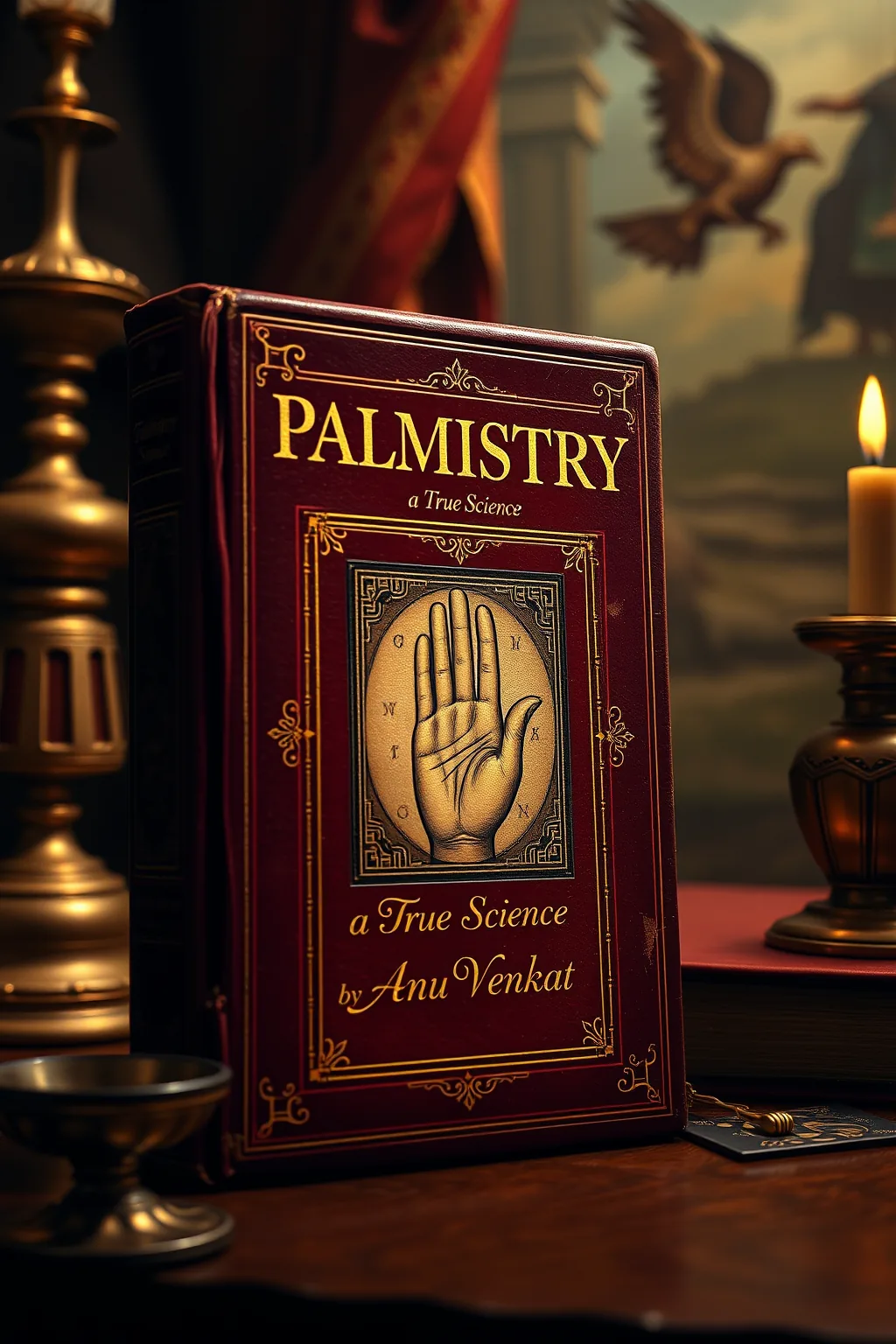
Anu Venkat's 2002 book, Palmistry, a True Science, details a systematic approach to cheiromancy.
Palmistry, a True Science, published in 2002, lays out a systematic method for reading palms. Anu Venkat emphasizes a comparative analysis, treating the left and right hands as a single interpretive unit. The book is distinguished by its many illustrations, featuring 210 sketches of palm lines and 61 palm impressions.
Venkat's approach seeks to establish its theories on a solid base of case studies, moving beyond anecdotal observations. The work is aimed at serious students of palmistry who want a structured, analytical guide. Readers who value detailed visuals and a methodology built on extensive comparisons will find this book useful. It also serves those curious about chiromancy's history and its more analytical applications.
Appearing in 2002, Palmistry, a True Science responded to a period of renewed interest in esoteric subjects, often linked to personal growth. Within palmistry, this era saw a move from simple fortune-telling toward understanding character and potential. Venkat's book contributed to this by presenting a method that, while rooted in tradition, prioritized systematic analysis and thorough documentation. This system aimed for a degree of empirical validation through extensive case study comparisons, setting it apart from more intuitive methods.
💡 Why Read This Book?
• Gain a methodical approach to hand analysis by studying Anu Venkat's comparative technique, which treats the left and right palms as a single interpretive unit, a core concept presented in the book's foundational chapters. • Understand the significance of over 210 distinct palm line sketches and 61 palm impressions, allowing for precise identification of patterns rarely cataloged so comprehensively in other texts. • Explore the correlation between hand features and life experiences through 64 detailed case studies, offering concrete examples of Venkat's theories in practice, as detailed throughout the work.
⭐ Reader Reviews
Honest opinions from readers who have explored this book.
❓ Frequently Asked Questions
What is the primary focus of Anu Venkat's "Palmistry, a True Science"?
The book's primary focus is on presenting palmistry as a systematic science. It emphasizes a comparative analysis of both the left and right hands, supported by extensive visual data including sketches and palm impressions, and numerous case studies.
How many case studies are included in "Palmistry, a True Science"?
The work includes 64 detailed case studies, which Anu Venkat uses to support his theories and demonstrate the comparative analysis of palm lines and features.
What makes the analysis in "Palmistry, a True Science" unique?
Its uniqueness stems from the first-time thorough analysis of human palms "with reference to both the palms," treating them as one comprehensive unit for comparison, a methodology detailed in the book's introduction.
When was "Palmistry, a True Science" first published?
Anu Venkat's "Palmistry, a True Science" was first published in 2002, contributing to early 21st-century interest in systematic esoteric studies.
What types of visual aids does the book provide?
The book offers extensive visual aids, featuring 210 sketches of palm lines and 61 clearly taken palm impressions, aiding in the identification and understanding of various hand markings.
Is this book suitable for beginners in palmistry?
While comprehensive, the book's detailed and analytical approach, with its extensive case studies and theoretical framework, is best suited for serious students or practitioners looking for a structured guide.
🔮 Key Themes & Symbolism
Unified Hand Analysis
A central tenet is the holistic interpretation of both the left and right hands. Venkat posits that these are not separate entities but rather complementary aspects of an individual's potential and manifestation. This comparative approach, treating thousands of cases as a comprehensive unit, aims to provide a more accurate and nuanced reading than single-hand analysis alone. The book details how to cross-reference lines, mounts, and overall hand structure between the dominant and non-dominant hands to reveal deeper insights.
Empirical Palmistry
This work strives for a scientific methodology within the ancient art of palmistry. By compiling 13 theories, 210 sketches, 61 palm impressions, and 64 case studies, Venkat seeks to establish observable correlations. The emphasis is on data collection and analysis, moving beyond purely intuitive interpretations. The book's structure encourages readers to verify patterns and observe how specific markings consistently appear across numerous documented examples, fostering a more evidence-based understanding.
The Language of Lines and Mounts
The book functions as an extensive catalog of the various lines and mounts found on the human palm and their associated meanings. Each line, from the prominent Life Line to subtler indications, is meticulously illustrated and explained. The interplay between the prominence of mounts (like Venus or Luna) and the clarity or fragmentation of lines is explored, providing readers with a detailed lexicon to interpret the complex topography of the hand.
Potential vs. Manifestation
A significant theme is the distinction and relationship between innate potential and lived experience, as reflected in the two hands. The book explores how the lines and features of one hand might represent inherent capacities or predispositions, while the other illustrates how these potentials have been actualized or modified by life circumstances. This dual perspective allows for a richer understanding of an individual's journey and choices.
💬 Memorable Quotes
Direct passages from the work, attributed to the author.
“The left hand and the right hand of thousands of cases functioned as one whole comprehensive unit.”
— This statement expresses Venkat's core methodological innovation: the integrated analysis of both palms. It suggests that a complete reading requires understanding the synergistic relationship between the hands, moving beyond the traditional focus on one dominant hand.
“This is the first time that the human palms have been thoroughly analyzed "with reference to both the palms".”
— This assertion highlights the book's claim to originality in its systematic approach. It positions the work as a significant advancement in the field by standardizing the comparative analysis of bilateral palmistry.
“The book contains 13 theories, 210 sketches of lines of the human palms, 64 case studies, 61 clearly and uniquely taken palm impressions.”
— This factual summary underscores the book's empirical foundation. The sheer volume of data presented aims to provide a robust, evidence-based framework for the study of palmistry, differentiating it from less documented traditions.
“Palmistry, a True Science is a carefully compiled book.”
— This emphasizes the meticulous nature of the author's research and presentation. It suggests that the work is not a casual collection of ideas but a deliberately structured and thoroughly prepared guide to the subject.
“Ever since the origination of this subject...”
— This phrase implies a historical perspective, suggesting that Venkat's approach is an evolution or significant development within the long history of palmistry, aiming to bring a new level of analytical depth to an ancient practice.
🌙 Esoteric Significance
Tradition
While not strictly tied to a single esoteric lineage like Hermeticism or Kabbalah, "Palmistry, a True Science" draws from the broad tradition of Western esotericism that seeks to understand the macrocosm (universe) reflected in the microcosm (human being). It aligns with the Hermetic principle of "As Above, So Below," applying it to the physical form, specifically the hand, as a map of personal destiny and character. Its empirical methodology, however, departs from purely mystical or divinatory traditions, seeking a more observable science.
Symbolism
The primary 'symbols' in this work are the lines and mounts of the palm itself. The Life Line, for instance, symbolizes vitality, physical constitution, and major life events, its clarity and depth indicating strength or challenges. The Mount of Jupiter, often associated with ambition and leadership, interacts with the lines originating from or crossing it, indicating how these qualities manifest. The unique interpretation of the relationship between the left and right hand also functions symbolically, representing innate potential versus expressed reality.
Modern Relevance
Venkat's emphasis on systematic analysis and data presentation remains relevant for contemporary practitioners seeking to ground esoteric arts in observable phenomena. Modern psychological astrology and even some branches of somatic psychology explore correlations between physical markers and psychological states, echoing Venkat's approach. His work can inform modern cheiromancers who wish to integrate a more structured, case-study-driven methodology into their practice, moving beyond anecdotal evidence.
👥 Who Should Read This Book
• Aspiring palmists seeking a rigorous, data-driven foundation for their practice, moving beyond intuitive guesswork to understand systematic line and mount interpretation. • Students of comparative esoteric traditions interested in how Western esotericism maps the human body, particularly the hand, as a microcosm of universal principles. • Researchers and practitioners of physiognomy or other body-based systems looking for detailed case studies and a comparative analytical model applicable to human features.
📜 Historical Context
Published in 2002, Anu Venkat's "Palmistry, a True Science" emerged during a period of renewed popular interest in divination and esoteric practices, often filtered through psychological and self-help frameworks. This era saw a divergence within palmistry: some texts focused on intuitive readings and predictive elements, while others, like Venkat's, aimed for a more systematic, analytical approach. Venkat's work positioned itself against more mystical interpretations by foregrounding empirical data—extensive case studies and detailed visual documentation—as the basis for its theories. While contemporaries like Gordon Thomas were exploring psychic phenomena with a journalistic eye, Venkat pursued a path emphasizing structured observation. The book's methodology, stressing the comparative analysis of both hands, offered a structured alternative to single-hand interpretations prevalent in earlier works, seeking a form of validation through sheer volume of documented examples.
📔 Journal Prompts
The unified interpretation of both palms: Compare the dominant and non-dominant hand markings for a specific individual.
Analysis of the Life Line: Document variations observed across the 64 case studies and note any recurring patterns.
The Mount of Venus: Reflect on its perceived influence on ambition and relationships as detailed in the text.
Correlating line breaks with life events: Examine how specific case studies illustrate the book's theories on hand impressions.
The role of sketches versus palm impressions: Consider which visual aid offers clearer interpretive data for specific lines.
🗂️ Glossary
Cheiromancy
The practice of divination or fortune-telling through the study of the palm of the hand. It involves interpreting lines, mounts, finger shapes, and other markings.
Palm Impressions
Direct recordings or copies of a person's palm, often made using ink or other methods, used for detailed study and comparison in palmistry.
Mounts
The fleshy, raised pads on the palm located at the base of the fingers and below the thumb. Each mount is traditionally associated with a planet and specific human characteristics.
Dominant Hand
Typically the hand a person writes with, often considered to represent the present and future, or the externalized aspects of personality and life experiences.
Non-Dominant Hand
The hand a person does not write with, often considered to represent innate potential, past influences, and internal or subconscious traits.
Lines of the Human Palms
The various creases and markings on the palm, including major lines like the Life Line, Head Line, and Heart Line, as well as minor lines, which are interpreted for divinatory and characterological insights.
Case Studies
Detailed examinations of specific individuals' palms, used in palmistry to illustrate theoretical concepts and demonstrate the practical application of interpretive techniques.