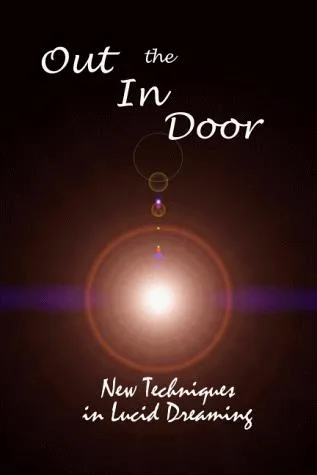
Out the In Door
 73
73

Out the In Door
Michael Szul’s 'Out the In Door' is not a book to be passively consumed; it demands active engagement from its reader. Published in 2000, it arrives with a deliberate obliqueness, refusing easy categorization. Szul’s strength lies in his ability to articulate the ineffable, particularly in his descriptions of liminal states of consciousness, which feel both personal and universally resonant. The section discussing the "inward turn" offers a particularly sharp critique of externalized spiritual seeking. However, the book’s very abstractness can be its primary limitation. While intended to provoke thought, certain passages risk becoming opaque, requiring considerable rereading to grasp their full import. The concept of "resonant frequencies," for instance, is potent but somewhat underdeveloped in its application within the text. Despite these challenges, 'Out the In Door' offers a unique pathway for those willing to walk it, providing a potent, if demanding, intellectual and spiritual exercise. It is a book that rewards persistence with genuine shifts in perception.
📝 Description
73
Michael Szul's 2000 book 'Out the In Door' challenges assumptions about self, time, and existence.
Published in 2000, 'Out the In Door' by Michael Szul avoids a standard narrative structure. Instead, it offers a sequence of connected observations and exercises designed to broaden perception. The book encourages readers to question fundamental assumptions about identity, temporality, and the nature of reality itself. It draws from various esoteric traditions and psychological ideas without committing to any single doctrine, aiming for an experiential engagement with the material. This approach positions the work as a tool for expanding awareness rather than a definitive statement on consciousness.
Its presentation is unconventional, focusing on introspective exploration rather than providing direct answers. The text is suited for those who are comfortable with abstract thought and a non-linear path. Readers seeking a direct, prescriptive guide may find it challenging, but those willing to engage in deep self-reflection and push the boundaries of their understanding will likely find it valuable. It is for the practitioner who wishes to connect theoretical concepts with personal experience.
Emerging around the turn of the millennium, 'Out the In Door' reflects a growing interest in alternative spirituality. It aligns with contemporary explorations of consciousness that echo mid-20th century psychedelic research and perennial philosophy movements like Theosophy. While not tied to a specific academic school, Szul's work engages with concepts found in Gnosticism and Hermetic philosophy, offering a unique synthesis. Its publication predated the dominance of social media in disseminating esoteric ideas, suggesting a more solitary, introspective approach to spiritual development.
💡 Why Read This Book?
• Gain an understanding of "liminal spaces" as described by Szul, offering a framework for recognizing and navigating moments of significant perceptual shift beyond ordinary awareness, as detailed in the book's experiential sections. • Explore the concept of the "inward turn," learning to prioritize internal exploration over external validation for spiritual growth, a core tenet presented in the work's introspective passages. • Grasp the notion of "resonant frequencies" as a metaphor for universal interconnectedness, providing a novel perspective on how one's internal state might interact with the wider cosmos, as discussed in later chapters.
⭐ Reader Reviews
Honest opinions from readers who have explored this book.
❓ Frequently Asked Questions
What is the primary focus of Michael Szul's 'Out the In Door'?
The book primarily focuses on expanding consciousness and challenging conventional perceptions of reality. It guides readers through introspective exercises and philosophical inquiries, encouraging a deeper understanding of self, time, and existence through an esoteric lens.
When was 'Out the In Door' first published?
'Out the In Door' by Michael Szul was first published in the year 2000.
Is 'Out the In Door' suitable for beginners in esoteric studies?
While accessible, the book's abstract nature and demand for introspection may be more challenging for absolute beginners. It is best suited for those with some prior engagement with consciousness studies or esoteric philosophy.
What kind of concepts does the book explore?
It explores concepts such as liminal spaces, the nature of the self as a construct, the 'inward turn' for spiritual growth, and the idea of 'resonant frequencies' in relation to universal interconnectedness.
Does the book offer practical exercises?
Yes, the book functions partly as a guide for experiential exploration. While not a manual of step-by-step instructions, it presents concepts and perspectives designed to provoke internal shifts and guide the reader's own self-directed inquiry.
What makes 'Out the In Door' unique compared to other esoteric texts?
Its uniqueness lies in its non-linear, experiential approach and its deliberate avoidance of dogmatic frameworks. Szul emphasizes personal gnosis derived from internal exploration rather than adherence to established doctrines.
🔮 Key Themes & Symbolism
Deconstruction of Self
Szul posits the 'I' as a fluid construct, urging readers to recognize the limitations imposed by egoic identification. This theme challenges the reader to observe their own mental processes and the habitual patterns that create a fixed sense of self. The work suggests that true liberation comes from understanding this constructed nature, allowing for a more expansive awareness unbound by personal history or societal conditioning. It encourages a disidentification from thought-forms and emotional reactions, paving the way for direct experience of a broader consciousness.
Liminal States of Awareness
The book extensively explores 'liminal spaces'—thresholds where ordinary reality dissolves and perception shifts. These are not merely transitional phases but states ripe for useful insights and transformation. Szul guides the reader to recognize and engage with these moments, whether they occur during meditation, altered states, or even mundane experiences that suddenly feel uncanny. Understanding these inter-spaces is presented as crucial for breaking free from habitual thought patterns and accessing deeper layers of awareness.
The Inward Turn
A central tenet is the 'inward turn,' emphasizing that authentic knowledge and spiritual evolution originate from within. Szul critiques the externalization of spiritual seeking, arguing that true understanding arises from direct, internal experience rather than the accumulation of external doctrines or guru worship. This theme encourages a radical self-reliance in the pursuit of gnosis, directing the reader's attention to the untapped potential residing within their own consciousness. It is the foundation for accessing the deeper realities discussed elsewhere in the book.
Resonant Frequencies and Interconnectedness
Szul uses the metaphor of 'resonant frequencies' to illustrate the interconnectedness of all things. This concept suggests that consciousness operates on various vibrational levels and that by aligning one's internal state—one's own frequency—with universal patterns, one can achieve a deeper connection to the cosmos. It implies that perception is not a passive reception but an active attunement. This idea underpins the potential for expanded awareness and offers a framework for understanding synchronicity and subtle influences.
💬 Memorable Quotes
Direct passages from the work, attributed to the author.
“The door is not a barrier, but an invitation.”
— This aphorism expresses the book's central theme: that perceived limitations are often gateways to greater understanding. It suggests that challenges or thresholds in consciousness should be approached not with resistance, but with curiosity and an openness to new perspectives.
“To know the self, one must first un-know the self.”
— This highlights the paradoxical nature of self-discovery within Szul's framework. It implies that shedding preconceived notions and egoic identities is a necessary precursor to encountering one's true, unconditioned nature.
“Reality is the echo of attention.”
— This statement points to the active role of consciousness in shaping perceived reality. It suggests that what we focus our attention upon gains substance and form within our experience, emphasizing the power of focused awareness.
“Liminality is not a void, but a fertile pause.”
— This reframes the often-uncomfortable experience of transitional states. Instead of seeing them as empty or frightening, Szul presents them as crucial moments of potential growth and insight, a space for reconfiguration.
“The Inward Turn is the only true direction.”
— This emphasizes the book's core message that ultimate truth and transformation are found through introspection. It serves as a directive, guiding the reader away from external distractions towards the boundless field of their own consciousness.
🌙 Esoteric Significance
Tradition
Szul's work draws implicitly from Gnostic and Hermetic traditions, emphasizing direct, personal gnosis over mediated dogma. It aligns with the Hermetic principle of 'As Above, So Below,' suggesting a correspondence between inner states and outer reality. While not explicitly Kabbalistic, its exploration of consciousness structure and transformation echoes certain mystical interpretations of the Tree of Life. The emphasis on self-observation and the deconstruction of the ego aligns with contemplative practices found across various esoteric lineages, positioning 'Out the In Door' as a modern synthesis for the independent seeker.
Symbolism
The 'door' itself serves as a primary symbol, representing thresholds, transitions, and opportunities for entering new states of awareness. 'Liminal spaces' are symbolic of the fertile void or the 'between-worlds' where transformation occurs, akin to the alchemical nigredo. 'Resonant frequencies' symbolize the interconnectedness of all existence, a vibrational universe where consciousness attunes to itself and its surroundings, reflecting concepts found in esoteric physics and metaphysics.
Modern Relevance
Contemporary practitioners of mindfulness, transpersonal psychology, and non-dual awareness continue to find value in Szul's exploration of consciousness. Thinkers and authors focusing on subjective experience, the nature of reality, and the deconstruction of the self echo themes present in 'Out the In Door.' Its emphasis on internal exploration remains relevant in an age saturated with external stimuli, offering a counterpoint for those seeking deeper self-understanding and perceptual freedom.
👥 Who Should Read This Book
['• Advanced students of consciousness studies seeking to move beyond theoretical frameworks into experiential understanding, particularly those interested in non-dualistic perspectives.', '• Practitioners of esoteric disciplines (e.g., Hermeticism, Gnosticism) looking for texts that challenge conventional views and encourage radical self-inquiry.', '• Philosophers and psychologists interested in the subjective nature of reality and the mechanics of perception, especially those engaging with existential or phenomenological thought.']
📜 Historical Context
Published in 2000, Michael Szul's 'Out the In Door' emerged at a cusp of technological and spiritual change. The internet was rapidly becoming a ubiquitous tool for knowledge sharing, fostering new online communities and alternative spiritual movements. While not directly aligned with any single academic discipline, Szul's work engaged with perennial philosophical currents and Western esotericism, echoing explorations of consciousness popularized by figures like Idries Shah and the broader New Age movement of the late 20th century. It appeared in a landscape where Jungian psychology continued to influence esoteric thought, and earlier thinkers like G.I. Gurdjieff had already explored concepts of self-transformation through demanding inner work. Unlike the more communal spiritual practices gaining traction, Szul's book offered a solitary, text-based path. Its reception was likely among dedicated practitioners of esoteric philosophy and consciousness exploration, who would have appreciated its challenging, non-dogmatic approach.
📔 Journal Prompts
The concept of 'liminal spaces' as presented in the book.
The mechanism of the 'inward turn' for personal transformation.
How the idea of 'resonant frequencies' applies to your daily interactions.
The construction of the 'self' and its implications for freedom.
The symbolic meaning of the 'door' in relation to your current life situation.
🗂️ Glossary
Liminal Spaces
Threshold states or transitional zones of consciousness where ordinary perceptions dissolve, offering potential for insight and transformation. These are not merely gaps but potent areas for exploration.
The Inward Turn
A directive to focus spiritual and intellectual energy on internal exploration and self-awareness, rather than seeking answers or validation from external sources.
Resonant Frequencies
A metaphorical concept suggesting that consciousness and the universe operate on vibrational levels, implying that attunement between one's internal state and external reality can unlock deeper perception.
Egoic Identification
The state of being overly attached to or identifying oneself with the constructed personality, thoughts, emotions, and social roles, hindering a broader awareness.
Gnosis
Direct, intuitive knowledge or spiritual insight, often considered the ultimate goal in Gnostic and related esoteric traditions, achieved through personal experience rather than doctrine.
Perceptual Framework
The underlying set of assumptions, beliefs, and mental structures through which an individual interprets reality. Szul's work aims to deconstruct and expand these frameworks.
Constructed Self
The idea that the 'self' as commonly understood is not a fixed entity but a dynamic, often unconscious, creation of thoughts, memories, and social conditioning.
🔮 Readers Also Liked
Browse all →









More Free Occult Philosophy Books
View all →