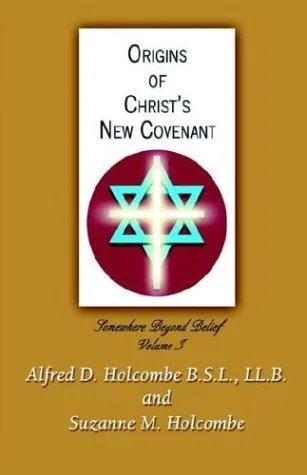
Origins of Christ's New Covenant
 74
74

Origins of Christ's New Covenant
Alfred and Suzanne Holcombe's 'Origins of Christ's New Covenant' presents a compelling argument for the deeply esoteric roots of Christian symbolism. The authors adeptly dissect the New Testament, revealing layers of meaning often overlooked by conventional scholarship. Their analysis of the 'New Covenant' as an internal spiritual awakening, rather than solely a legalistic pact, is particularly insightful. However, the dense referencing and academic tone, while a strength for specialists, may present a barrier to casual readers. The exploration of Gnostic parallels, especially concerning Sophia, offers a fresh perspective on the divine feminine's presence in early Christianity. While some interpretations are speculative, the work's meticulous engagement with primary texts makes it a valuable contribution for those seeking a more symbolic and mystical understanding of Christianity's genesis.
📝 Description
74
Alfred D. Holcombe and Suzanne M. Holcombe's 2003 book examines the esoteric roots of Christ's New Covenant.
This work looks into the symbolic meanings and Gnostic influences behind early Christian doctrine, moving beyond standard theological readings. It considers how established religious ideas might have absorbed or sidelined different spiritual viewpoints. The authors question conventional interpretations, aiming for a deeper, symbolic grasp of spiritual origins.
The book is for those studying comparative religion, Western Esotericism, and early Christian history. It specifically appeals to readers interested in the mystical and symbolic aspects of Christianity, Gnosticism, Hermeticism, and the historical Jesus beyond mainstream dogma. It is for readers who seek to question traditional views and find a more symbolic understanding of spiritual beginnings.
Published in 2003, this study engages with scholarly discussions on Hellenistic philosophies and Eastern mystery traditions impacting early Christianity. It challenges orthodoxies that became fixed by the fourth century CE.
This book situates itself within the study of Western Esotericism, particularly as it intersects with early Christianity. It engages with Gnostic and Hermetic traditions, viewing them not as separate entities but as significant currents that shaped early Christian thought and symbolism. The work suggests that these esoteric currents offered alternative understandings of spiritual consciousness and divine feminine principles, which were later integrated or suppressed by developing orthodoxies.
💡 Why Read This Book?
• Gain a novel perspective on the 'New Covenant' as an initiatory spiritual experience, moving beyond traditional theological frameworks, as detailed in their exploration of early Christian texts. • Understand the symbolic significance of Sophia (Wisdom) within Gnostic cosmology and its potential connections to early Christian thought, offering a unique lens on the divine feminine. • Explore the esoteric interpretations of Gospel and Pauline epistles, uncovering symbolic language related to inner transformation and cosmic principles, as presented in their detailed textual analysis.
⭐ Reader Reviews
Honest opinions from readers who have explored this book.
❓ Frequently Asked Questions
What is the primary focus of 'Origins of Christ's New Covenant'?
The book focuses on the esoteric and symbolic origins of early Christian doctrine, exploring Gnostic and Hellenistic influences on the New Covenant concept and its interpretation.
Who are the authors of 'Origins of Christ's New Covenant'?
The authors are Alfred D. Holcombe and Suzanne M. Holcombe. The work was first published in 2003.
Does the book discuss Gnosticism?
Yes, it extensively discusses Gnosticism, particularly its cosmological concepts like Sophia (Wisdom), and explores potential parallels with early Christian beliefs.
What is the 'New Covenant' as presented in this book?
The book interprets the 'New Covenant' as an internal spiritual awakening and initiatory experience, rather than solely a theological or legalistic agreement.
What kind of symbolism does the book analyze?
It analyzes symbolic language found within the Gospels and Pauline epistles, seeking hidden meanings related to spiritual transformation and universal cosmic principles.
What is the intended audience for this book?
The book is intended for students of comparative religion, Western Esotericism, and early Christian history who are interested in mystical and symbolic interpretations.
🔮 Key Themes & Symbolism
The Initiatory New Covenant
This theme redefines the 'New Covenant' from a purely theological concept to a profound, internal spiritual awakening. The Holcombes argue that early Christianity, particularly in its more mystical expressions, viewed this covenant as an initiatory process, a transformation of consciousness aligning the individual with divine principles. This perspective challenges orthodox interpretations by emphasizing the experiential and esoteric dimensions of spiritual rebirth central to the teachings.
Sophia and the Divine Feminine
The work studies the concept of Sophia (Wisdom) within Gnostic traditions and posits its significant, though often obscured, presence in early Christian thought. It suggests that the divine feminine principle, represented by Sophia, played an important role in the cosmology and soteriology of nascent Christianity. This exploration offers a re-evaluation of traditional patriarchal interpretations by highlighting the importance of feminine divine aspects.
Symbolic Language of the Gospels
A core theme is the meticulous analysis of the symbolic language embedded within the Gospels and the writings of Paul. The authors contend that these texts are rich with esoteric meanings pertaining to inner transformation, cosmic order, and spiritual alchemy. They seek to uncover the hidden layers of these scriptures, revealing a framework for spiritual development accessible to those attuned to symbolic interpretation.
Hellenistic and Gnostic Synthesis
The book examines how early Christianity emerged within a milieu saturated with Hellenistic philosophies and Gnostic ideas. It posits that the New Covenant and Christ's teachings were not isolated phenomena but were deeply influenced by and, in turn, influenced these existing esoteric traditions. This synthesis highlights the syncretic nature of early religious development in the Mediterranean world.
💬 Memorable Quotes
Direct passages from the work, attributed to the author.
“The New Covenant is understood as an inner transformation, a participation in the divine life.”
— This interpretation emphasizes the book's central thesis: that the New Covenant is less about external adherence and more about an internal, mystical experience of spiritual rebirth and connection to the divine.
“Sophia's role in creation and redemption offers a parallel to the Christos principle.”
— This highlights the book's exploration of the divine feminine, specifically Gnostic Sophia, and suggests its symbolic and functional parallels with Christian concepts of Christ, challenging purely masculine theological frameworks.
“Early Christian symbols often encoded esoteric teachings for initiates.”
— This suggests that the authors view early Christian texts and symbols not just as literal accounts but as vehicles for deeper, mystical knowledge intended for those spiritually prepared.
“The historical Jesus' teachings may have been more aligned with mystery traditions than later dogma.”
— This interpretation points to the book's critical stance on the evolution of Christian doctrine, suggesting that the original message of Jesus contained elements closer to esoteric mystery schools than to later, formalized religious structures.
💡 Key Ideas
Editorial paraphrase of the work's core concepts — not direct quotes.
Understanding the 'kingdom of God' requires recognizing its immanent, inner spiritual dimension.
This paraphrased concept underscores the book's focus on the internal, experiential aspect of Christian spirituality, contrasting it with external, institutionalized interpretations of religious concepts like the 'kingdom of God'.
🌙 Esoteric Significance
Tradition
This work is firmly rooted in the study of Western Esotericism, particularly Gnosticism and Hermeticism. It seeks to situate early Christianity not as a singular revelation but as a complex phenomenon deeply interwoven with pre-existing mystical traditions of the Mediterranean world. The Holcombes depart from orthodox interpretations by foregrounding Gnostic cosmology and symbolic exegesis, treating them as vital components of Christian origins rather than mere heresies.
Symbolism
Key symbols explored include the 'New Covenant,' interpreted as an inner spiritual transformation rather than an external pact. The figure of Sophia (Wisdom) is central, representing the divine feminine principle whose presence in early Christianity is argued to be more significant than commonly acknowledged. The book also examines the symbolic language of the Gospels, viewing parables and miracles as encoded teachings on consciousness and cosmic alignment.
Modern Relevance
Contemporary practitioners of esoteric Christianity, Gnostic revival movements, and scholars of comparative mysticism continue to draw on this work. Thinkers interested in the divine feminine, symbolic interpretation of scripture, and the historical Jesus outside mainstream narratives find its arguments compelling. Its exploration of consciousness transformation speaks to modern psychological and spiritual inquiry seeking deeper meaning beyond literal interpretations.
👥 Who Should Read This Book
• Students of Gnosticism and early Christian heterodoxies seeking to understand the influence of Sophia and related concepts. • Comparative religion scholars interested in the synthesis of Hellenistic, Gnostic, and early Christian ideas. • Esoteric practitioners looking to deepen their understanding of the symbolic and mystical dimensions of the New Covenant and Christ's teachings.
📜 Historical Context
Published in 2003, 'Origins of Christ's New Covenant' entered a scholarly landscape increasingly open to exploring the non-orthodox dimensions of early Christianity, a trend amplified by the 1945 discovery of the Nag Hammadi library. This work engages with the ongoing dialogue concerning the influence of Hellenistic philosophies, Neoplatonism, and various Gnostic schools on the formation of Christian theology. It stands in contrast to purely historical-critical approaches that often sideline symbolic and mystical interpretations. The book's focus on Gnostic concepts like Sophia and the internal nature of the 'New Covenant' aligns with later 20th and early 21st-century reinterpretations of Jesus' teachings, often seeking to recover suppressed feminine or mystical elements. Its reception occurred in an era where scholars like Elaine Pagels had already popularized Gnostic studies, making the Holcombes' work part of a broader academic and spiritual re-examination of Christian origins.
📔 Journal Prompts
The concept of the 'New Covenant' as an inner transformation.
Parallels between Gnostic Sophia and early Christian feminine divine.
Symbolic interpretation of a specific Gospel parable.
Reconciling historical Jesus with later Christian dogma.
The role of initiation in early spiritual movements.
🗂️ Glossary
New Covenant
In this context, refers to an internal spiritual transformation and direct connection with the divine, rather than solely a theological agreement between God and humanity.
Sophia
A Greek term meaning 'Wisdom,' central in Gnostic cosmology representing a divine feminine principle often associated with creation and the divine spark within humanity.
Gnosticism
A diverse set of religious and philosophical movements in the early centuries CE that emphasized knowledge (gnosis) of the divine for salvation, often viewing the material world as flawed or evil.
Hermeticism
A philosophical and religious tradition based on writings attributed to Hermes Trismegistus, emphasizing esoteric knowledge, spiritual alchemy, and the interconnectedness of the cosmos.
Hellenistic Period
The historical period following the conquests of Alexander the Great (c. 323 BCE to 31 BCE), characterized by the spread of Greek culture and the interaction of Greek thought with local traditions.
Initiation
A ritual or process through which an individual is admitted into a specific group, society, or understanding, often involving symbolic death and rebirth or the imparting of secret knowledge.
Esotericism
Practices, beliefs, or teachings that are concerned with the true nature of reality, often understood by or accessible only to a select group of people with specialized knowledge or initiation.
🔮 Readers Also Liked
Browse all →









More by Alfred D. Holcombe, Suzanne M. Holcombe
All books →
More Free Occult Philosophy Books
View all →