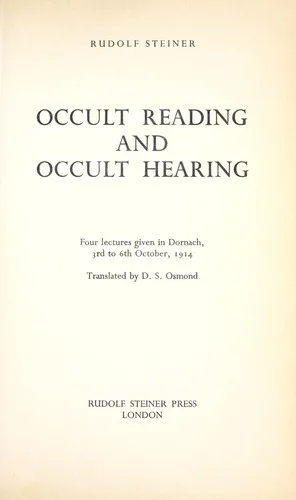
Occult reading and occult hearing
 82
82

Occult reading and occult hearing
Steiner’s "Occult Reading and Occult Hearing" confronts the reader with a rigorous, almost architectural, blueprint for developing spiritual perception. He avoids vague pronouncements, instead offering specific exercises for the inner life, particularly concerning the transformation of thought and emotional experience. The strength lies in its systematic nature; Steiner treats clairaudience and clairvoyance as skills to be honed, not mystical accidents. A notable passage discusses how the hardening of the physical body corresponds to the potential for spiritual perception, a counter-intuitive but compelling idea. However, the limitation for a modern audience might be the dense philosophical language and the implicit assumption of a spiritual worldview that requires significant prior engagement with Anthroposophy. The sheer intellectual demand can feel like a barrier to entry. Ultimately, it’s a demanding but potentially clarifying work for those committed to Steiner's path of spiritual science.
📝 Description
82
Rudolf Steiner's 1975 lectures explain how to develop clairaudience and clairvoyance.
Rudolf Steiner's "Occult Reading and Occult Hearing" addresses the development of spiritual perception. First published in 1975 from lectures Steiner delivered, the book aims to give readers the capacity to perceive realities beyond the physical senses. Steiner argues that true occult perception is an active development of inner abilities, not a passive reception. He guides readers in consciously cultivating clairaudience and clairvoyance.
These abilities are presented not as supernatural gifts but as extensions of normal human consciousness that can be achieved through specific inner work. The text is for individuals committed to esoteric development, especially those in the Anthroposophical tradition or seeking a philosophical method for spiritual science. It is particularly relevant for students of Steiner's wider work who want to grasp the perceptual basis of his cosmological and anthropological ideas. Readers should be prepared for disciplined inner work and engagement with complex ideas about consciousness and perception.
This work, compiled posthumously from Steiner's lectures, reflects his mature thought after his departure from the Theosophical Society in 1913 to found Anthroposophy. Published in the mid-20th century, it emerged during a period of diversification in spiritual movements. Steiner's approach emphasizes a rigorous, ethical, and intellectual path to spiritual knowledge, distinct from earlier Theosophical doctrines and growing interests in parapsychology.
💡 Why Read This Book?
• Understand the Anthroposophical perspective on developing spiritual senses, moving beyond passive reception to active cultivation as outlined by Rudolf Steiner. • Learn about Steiner's specific concepts of 'imagination,' 'inspiration,' and 'intuition' as distinct stages of occult perception, providing a conceptual framework absent in other traditions. • Gain insight into the ethical and practical requirements for developing clairvoyance, emphasizing inner discipline and the transformation of consciousness, as detailed in the lectures from the early 20th century.
⭐ Reader Reviews
Honest opinions from readers who have explored this book.
❓ Frequently Asked Questions
What is the primary difference between 'occult reading' and 'occult hearing' in Steiner's work?
Steiner distinguishes 'occult reading' as perceiving spiritual truths through inner imagination and conceptual understanding, while 'occult hearing' refers to the direct perception of spiritual sounds or vibrations, often through clairaudience.
When were Rudolf Steiner's lectures on occult perception originally given?
While the book 'Occult Reading and Occult Hearing' was first published in 1975, it compiles lectures given by Rudolf Steiner much earlier, primarily in the period between 1904 and 1924.
Does Steiner claim these occult abilities are innate or developed?
Steiner strongly emphasizes that occult perception is not a supernatural gift but a faculty that can and must be consciously developed through rigorous inner work, ethical purification, and specific meditative practices.
What is the role of 'thinking' in Steiner's concept of occult perception?
Steiner posits that ordinary thinking must be transformed into a spiritual organ. He outlines specific methods for purifying thought processes, making them capable of perceiving spiritual realities, a concept explored in his broader work on spiritual science.
Is this book suitable for beginners in esoteric studies?
The book requires a degree of intellectual engagement and familiarity with philosophical concepts. While it aims to explain development, beginners might find it more accessible after exploring Steiner's introductory works on spiritual science.
What are the main obstacles to developing occult hearing and reading, according to Steiner?
Steiner identifies obstacles such as materialism, egoism, lack of ethical development, and uncontrolled imagination or emotional reactions. He stresses that purification of the soul forces is essential for clear spiritual perception.
🔮 Key Themes & Symbolism
Cultivating Spiritual Senses
The central theme is the methodical cultivation of 'occult senses'—clairaudience and clairvoyance. Steiner presents these not as mystical accidents but as latent human capacities that can be awakened through disciplined inner training. The work details how ordinary sensory input and mental processes can be refined and transmuted into instruments for perceiving the spiritual dimensions of existence. This involves understanding the subtle bodies (etheric and astral) and their interaction with the physical world and higher realms. The emphasis is on a conscious, ethical, and intellectual approach to spiritual development.
Transformation of Consciousness
Central to Steiner's teaching is the idea that perceiving the spiritual requires a fundamental transformation of human consciousness. This involves purifying thoughts, refining emotional responses, and developing specific meditative faculties. He introduces distinct levels of spiritual cognition: Imagination ( `>`, Inspiration ( `>, and Intuition ( `>. Achieving these requires moving beyond purely materialistic understanding and actively engaging with the spiritual through inner exercises designed to strengthen one's etheric and astral bodies.
The Nature of Reality
Steiner posits a multi-layered reality, with physical existence being only one aspect. The work explores the existence of spiritual worlds and beings, accessible through developed inner senses. It reinterprets phenomena like karma and reincarnation not merely as doctrines but as observable processes within the larger cosmic evolutionary scheme, directly influencing the capacity for spiritual perception across lifetimes. This perspective challenges conventional materialistic views of consciousness and reality.
Ethical Foundation for Perception
A crucial, often overlooked, aspect of Steiner's approach is the indispensable role of ethics in developing true occult perception. He argues that without moral development—cultivating virtues like truthfulness, selflessness, and compassion—any perceived spiritual phenomena are likely to be distorted by the ego, leading to illusion rather than genuine knowledge. The purity of the perceiver is paramount for the accuracy of occult reading and hearing.
💬 Memorable Quotes
Direct passages from the work, attributed to the author.
“The human being can develop organs for the spiritual worlds, just as he has organs for the physical world.”
— This highlights Steiner's core thesis: spiritual perception is a natural, albeit undeveloped, human capacity. It frames occult abilities not as esoteric miracles but as extensions of biological potential, achievable through dedicated inner cultivation and practice.
“Clairaudience is the hearing of the spiritual world; clairvoyance is the seeing of the spiritual world.”
— A concise distinction defining the two primary forms of occult perception discussed. It sets the stage for explaining the methods and challenges associated with developing each faculty independently yet harmoniously.
“Imagination must become a creative power, not merely a reproductive one.”
— This points to the transformation of the imaginative faculty. Steiner distinguishes passive, memory-based imagination from active, spiritual imagination ( `>` which becomes a direct means of perceiving spiritual forms and realities.
“One must first purify the soul before one can perceive the spiritual.”
— Emphasizes the ethical prerequisite for genuine spiritual insight. Steiner believed that an impure or ego-driven consciousness would invariably distort or misinterpret spiritual information, making moral development essential.
“The etheric body is the bearer of life forces and the bridge to the spiritual.”
— Introduces the concept of the etheric body, a vitalistic layer of the human organism. Steiner explains its role in bridging the physical and spiritual realms, and its importance in developing specific higher senses.
🌙 Esoteric Significance
Tradition
This work is a core part of Anthroposophy, Rudolf Steiner's spiritual science. While drawing on broader esoteric currents, including Theosophy and Western Hermeticism, Steiner sought to establish a unique path focused on the verifiable development of human consciousness. It departs from purely Gnostic or Kabbalistic traditions by emphasizing the evolution of the human being through distinct stages of perception, grounded in a specific cosmology and understanding of human evolution.
Symbolism
Key symbolic motifs include the transformation of the 'physical eye' into a 'spiritual eye' capable of perceiving higher worlds. The concept of 'hearing' beyond the physical ear relates to the apprehension of spiritual vibrations or 'music of the spheres.' Furthermore, the stages of Imagination ( `>, Inspiration ( `>, and Intuition ( `> function as symbolic representations of ascending levels of spiritual cognition, mapping a journey from the earthly to the divine.
Modern Relevance
Contemporary thinkers and practitioners in fields ranging from Waldorf education and biodynamic agriculture to integral psychology and consciousness studies often reference Steiner's work. His emphasis on developing faculties beyond the purely intellectual and material speaks to modern explorations of mindfulness, altered states, and the potential for expanded human perception, albeit often reinterpreted outside the strict Anthroposophical framework.
👥 Who Should Read This Book
• Students of Rudolf Steiner's philosophy seeking to understand the perceptual basis of his spiritual science, particularly the development of clairvoyance and clairaudience. • Practitioners of esoteric disciplines interested in structured methods for cultivating inner awareness and spiritual faculties, moving beyond mere belief. • Researchers in comparative mysticism and consciousness studies looking to analyze a specific, highly systematized approach to spiritual perception from the early 20th century.
📜 Historical Context
Rudolf Steiner's "Occult Reading and Occult Hearing," compiled from lectures delivered between the early 1900s and the 1920s and published posthumously in 1975, emerged from the fertile ground of late 19th and early 20th-century spiritual inquiry. Steiner himself had moved beyond the Theosophical movement he helped establish, founding Anthroposophy in 1913 with a distinct emphasis on a scientific approach to the spiritual. This work contrasts with the more mystical or purely faith-based approaches found in contemporary movements like the Hermetic Order of the Golden Dawn or certain branches of Rosicrucianism. While figures like Annie Besant and C.W. Leadbeater were influential in Theosophy during Steiner's early career, Steiner's later work focused on developing specific inner faculties through rigorous, ethically grounded exercises, differentiating his path significantly. The book's posthumous publication in 1975 occurred during a resurgence of interest in esoteric philosophy and consciousness studies, finding an audience among those seeking structured methods for spiritual development.
📔 Journal Prompts
The development of occult hearing: what inner states facilitate receptivity to subtle vibrations?
Transformation of imagination: how can the faculty of imagination be consciously refined beyond reproductive capacity?
Ethical prerequisites for spiritual perception: identify personal biases that might distort occult reading.
The etheric body as a bridge: reflect on experiences of vitality and their potential connection to subtle perception.
Stages of spiritual cognition: consider personal experiences that align with Imagination, Inspiration, or Intuition.
🗂️ Glossary
Occult Reading
A term used by Steiner to describe the faculty of perceiving spiritual truths and realities through inner, non-sensory means, particularly through transformed thinking and imaginative cognition.
Occult Hearing
The capacity to perceive spiritual sounds, vibrations, or 'words' from higher realms, analogous to physical hearing but operating on a spiritual level through clairaudience.
Imagination ( `>
In Steiner's terminology, this is the lowest, yet essential, form of clairvoyant perception, where the spiritual world can be apprehended through inwardly formed images, distinct from ordinary fantasy.
Inspiration ( `>
A higher form of spiritual cognition than Imagination, involving direct apprehension of spiritual truths or insights, often experienced as inner knowledge or understanding.
Intuition ( `>
The highest form of spiritual cognition, representing a direct, holistic grasp of spiritual realities, often described as knowing or divine perception.
Etheric Body
In Anthroposophy, a subtle energetic body that underlies the physical body, responsible for life forces, growth, and reproduction; considered a bridge to spiritual perception.
Astral Body
A subtle body associated with consciousness, feeling, desire, and the capacity for subjective experience, crucial for developing higher forms of perception and interaction with the spiritual world.
🔮 Readers Also Liked
Browse all →









More by Rudolf Steiner
All books →




More Free Occult Philosophy Books
View all →