Occult Essays
 80
80

Occult Essays
Alfred Percy Sinnett’s ‘Occult Essays’ from 1905 offers a remarkably coherent exposition of Theosophical thought at a time when such ideas were gaining significant traction. Sinnett’s strength lies in his methodical approach, attempting to present complex metaphysical doctrines with a clarity that sought to bridge the gap between occultism and rational inquiry. He avoids the more sensationalistic claims sometimes associated with the movement, focusing instead on the philosophical underpinnings of karma, reincarnation, and spiritual evolution. One passage that particularly stands out is his discussion of the subtle bodies, explaining their function and interaction with the physical form in a way that attempts to demystify rather than mystify. However, the work’s primary limitation is its inherent reliance on the Theosophical framework; readers unfamiliar with or skeptical of Blavatsky’s foundational teachings may find the arguments circular or lacking independent verification. Despite this, the essays provide a valuable window into the intellectual architecture of early 20th-century esotericism. For those seeking a structured understanding of Theosophy's core tenets, these essays remain a pertinent, if specialized, resource.
📝 Description
80
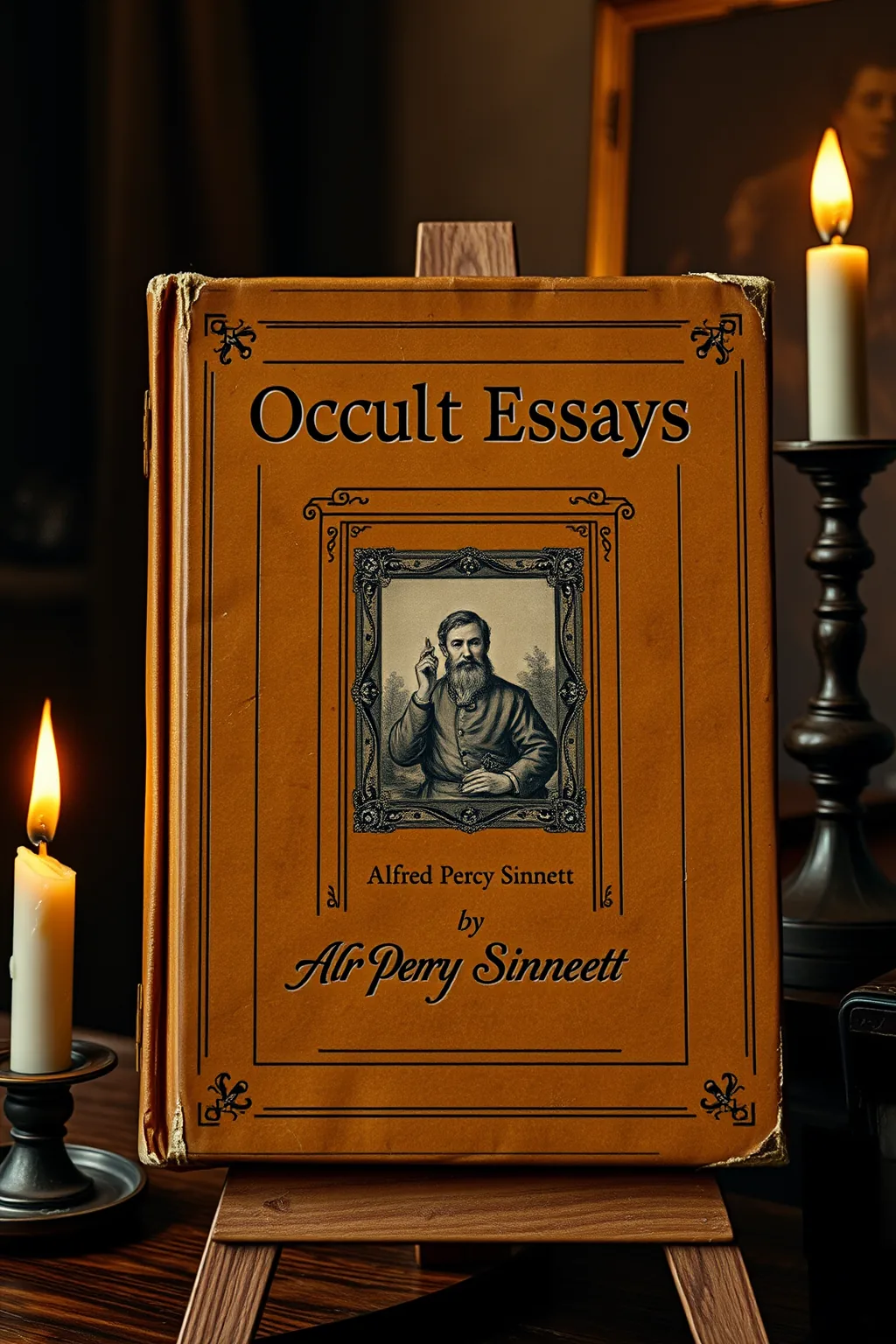
Alfred Percy Sinnett published 'Occult Essays' in 1905, a collection exploring esoteric philosophy.
Alfred Percy Sinnett's 'Occult Essays', published in 1905, addresses the philosophical and practical aspects of esoteric thought prevalent in the late Victorian and Edwardian periods. As a key figure in the Theosophical Society, Sinnett sought to establish a reasoned structure for concepts often labeled supernatural. He aimed to clarify what he understood as 'the Occult', presenting a system for interpreting phenomena that defied conventional explanation.
The essays move from basic principles to more complex ideas about spiritual development and the hidden laws governing existence. This book is suited for those interested in the historical development of modern Western esotericism, particularly Theosophy and its offshoots. Readers who appreciate a systematic, philosophical approach to spiritual questions will find Sinnett's arguments valuable, especially when compared to purely devotional or anecdotal spiritual writings. Students of comparative religion and early parapsychological studies may also find merit in its methodical considerations.
Published in 1905, 'Occult Essays' appeared during a time of significant Western intellectual change, characterized by a surge of interest in spiritualism, Theosophy, and occult revival movements. This era saw a counterpoint to scientific materialism, with figures like Helena Blavatsky and Annie Besant popularizing esoteric teachings. Sinnett, a close associate of Blavatsky, was instrumental in spreading Theosophical ideas, building on his earlier work like 'The Mahatma Letters'.
💡 Why Read This Book?
• Gain a systematic understanding of Theosophy's core doctrines like karma and reincarnation, as articulated by a key early proponent, providing context for the movement’s philosophical underpinnings. • Explore Sinnett's concept of spiritual evolution and latent human faculties, offering a perspective on personal development rooted in early 20th-century esoteric thought, distinct from modern self-help trends. • Appreciate the intellectual currents of 1905 by examining how Sinnett attempted to reconcile esoteric principles with a rational framework, revealing the challenges and methods of occult philosophy during that era.
⭐ Reader Reviews
Honest opinions from readers who have explored this book.
❓ Frequently Asked Questions
When was Alfred Percy Sinnett's 'Occult Essays' first published?
'Occult Essays' by Alfred Percy Sinnett was first published in 1905, placing it within the burgeoning period of Western esoteric revival.
What is the primary philosophical tradition behind 'Occult Essays'?
The book's primary philosophical tradition is Theosophy, heavily influenced by the teachings of Helena Blavatsky and the Theosophical Society, of which Sinnett was a prominent member.
What key concepts does Sinnett explore in 'Occult Essays'?
Sinnett explores concepts such as karma, reincarnation, spiritual evolution, the nature of consciousness beyond the physical, and the existence of higher planes of reality.
Who was Helena Blavatsky in relation to Sinnett?
Helena Blavatsky was the co-founder of the Theosophical Society and a primary source of inspiration and teaching for Alfred Percy Sinnett, who was a close associate and proponent of her work.
Is 'Occult Essays' considered a primary source for Theosophy?
Yes, 'Occult Essays' is considered a significant primary source for understanding the philosophical and intellectual dissemination of Theosophical ideas in the early 20th century.
What was the intellectual climate like when 'Occult Essays' was published?
Published in 1905, the book emerged during a time of significant interest in spiritualism, occultism, and Eastern philosophies in the West, often as a reaction against strict materialism.
🔮 Key Themes & Symbolism
The Law of Karma
Sinnett meticulously details karma not as simple retribution, but as a fundamental law of ethical causation that governs the cycles of existence. He presents it as a scientific principle underlying spiritual progress, explaining how actions in one life inevitably shape circumstances in future lives. This concept is crucial for understanding the Theosophical view of justice and the unfolding of consciousness across multiple incarnations, moving beyond simplistic notions of fate.
Spiritual Evolution and Reincarnation
Central to the essays is the doctrine of reincarnation, viewed as the mechanism for humanity's gradual spiritual evolution. Sinnett argues that the soul progresses through a series of physical lives, each offering opportunities to learn, purify, and ascend to higher states of awareness. This process is not random but guided, involving the development of latent faculties and an increasing understanding of the subtle planes of existence beyond the material.
The Nature of Consciousness
The work addresses consciousness as a complex entity extending far beyond the physical brain. Sinnett discusses various 'bodies' or vehicles of consciousness – the physical, astral, and mental – and how they function and interact. This layered understanding of being is presented as essential for comprehending psychic phenomena, dreams, and the potential for humans to perceive or interact with non-physical realities and intelligences.
The Occult as Natural Law
Sinnett seeks to clarify the 'occult' by framing it as the study of higher, natural laws governing the universe. Phenomena often labeled supernatural are reinterpreted as the predictable outcomes of these laws, accessible to those who cultivate the necessary knowledge and inner development. This perspective aims to elevate occult study from mere magic or superstition to a rigorous science of the unseen.
💬 Memorable Quotes
Direct passages from the work, attributed to the author.
“The essential nature of the universe is spiritual, not material.”
— This statement expresses the fundamental premise of Sinnett's work: that the underlying reality of existence is consciousness or spirit, with the physical world being a manifestation or effect of this primary spiritual cause.
“Karma is the expression of divine justice, ensuring balance across lifetimes.”
— Sinnett's interpretation of karma extends beyond simple cause and effect, framing it as an inherent, intelligent principle of cosmic justice that orchestrates the consequences of actions, leading to eventual equilibrium.
“The unseen worlds are as real and governed by law as the physical.”
— Sinnett posits that the non-physical dimensions of existence, often dismissed or misunderstood, operate according to discernible laws and principles, akin to those governing the material realm.
“Developing inner faculties allows perception of higher realities.”
— This signifies the potential for humans to expand their awareness and perception beyond ordinary sensory input, through dedicated practice and understanding of esoteric principles.
💡 Key Ideas
Editorial paraphrase of the work's core concepts — not direct quotes.
Humanity's path is one of progressive unfoldment through reincarnation.
This paraphrased concept highlights the Theosophical belief that the soul evolves over many lifetimes, learning and developing through successive physical existences, rather than through a single life or linear progression.
🌙 Esoteric Significance
Tradition
‘Occult Essays’ is firmly rooted in the Theosophical tradition, established by Helena Blavatsky in the late 19th century. Sinnett, as one of its earliest and most influential proponents, articulates its core principles – karma, reincarnation, spiritual evolution, and the existence of higher spiritual hierarchies. The work represents an effort to systematize and present these concepts in a manner accessible to a Western intellectual audience, departing from purely devotional or anecdotal approaches and aiming for a philosophical synthesis.
Symbolism
While not heavily reliant on overt symbolic language, the essays implicitly engage with concepts like the 'round' and 'chain' of evolution, representing cyclical time and the progression of consciousness across different planes and lives. The idea of latent human faculties can be seen as symbolizing humanity's untapped spiritual potential, waiting to be awakened through understanding and practice, aligning with perennial motifs of inner divinity.
Modern Relevance
Sinnett's clear exposition of Theosophical principles continues to inform contemporary esoteric practitioners and scholars. Modern New Age thought, various forms of comparative spirituality, and even some psychological approaches to consciousness echo Sinnett's ideas on karma, subtle bodies, and spiritual development. Thinkers and groups interested in the historical development of Western esotericism and the philosophical underpinnings of reincarnation doctrines often reference Sinnett's foundational texts.
👥 Who Should Read This Book
• Students of Theosophy seeking to understand its foundational philosophical arguments as presented by a prominent early advocate. • Researchers of late Victorian and Edwardian spiritual and occult movements, interested in the intellectual currents that shaped modern esotericism. • Individuals exploring concepts of karma, reincarnation, and spiritual evolution from a historical and philosophical perspective, beyond purely religious dogma.
📜 Historical Context
Alfred Percy Sinnett’s ‘Occult Essays,’ published in 1905, emerged during a vibrant period of Western esotericism, a milieu shaped by the Theosophical Society's growing influence. The era was characterized by a widespread reaction against the perceived limitations of scientific materialism, fostering an appetite for spiritual explanations and alternative cosmologies. Sinnett, a key figure alongside Helena Blavatsky and Annie Besant, sought to articulate the core tenets of Theosophy with intellectual rigor. This was a time when movements like Spiritualism had already captured public imagination, and organizations such as the Hermetic Order of the Golden Dawn were exploring ceremonial magic. Sinnett's work offered a more philosophical and systematic presentation of esoteric ideas, aiming to provide a coherent worldview. His essays contributed to the ongoing discourse that attempted to integrate ancient wisdom traditions with modern philosophical and scientific inquiries, positioning Theosophy as a potential bridge between the material and spiritual realms in the face of burgeoning psychological and anthropological studies.
📔 Journal Prompts
The principle of karma as described by Sinnett: how does it shape your understanding of cause and effect?
Sinnett's view on latent human faculties: what potential might be waiting to unfold?
Reflect on the concept of spiritual evolution through reincarnation as presented in the essays.
The idea of the universe's spiritual nature: how does this contrast with a purely materialist worldview?
Consider the role of 'Masters' or guiding intelligences in human progress as discussed by Sinnett.
🗂️ Glossary
Theosophy
A spiritual philosophy founded by Helena Blavatsky, seeking to synthesize Eastern and Western religions and philosophies, emphasizing universal brotherhood, and exploring the hidden laws of nature and the divine potential of humanity.
Karma
In Theosophy, the universal law of cause and effect, action and reaction, which governs the cycles of existence and the progress of souls through reincarnation.
Reincarnation
The process by which a soul or consciousness is reborn into a new physical body after death, continuing its evolutionary journey through multiple lifetimes.
Spiritual Evolution
The concept that consciousness progresses through increasingly complex and refined states of being, guided by laws like karma and facilitated by reincarnation.
Subtle Bodies
Non-physical vehicles or layers of consciousness (e.g., astral body, mental body) that interact with the physical body and persist after physical death.
Occult Science
The study of the hidden laws and forces of nature, often involving psychic and spiritual phenomena, viewed by Sinnett as a legitimate field of inquiry.
Masters
Highly evolved spiritual beings, according to Theosophy, who guide humanity's evolution and sometimes communicate with disciples.
🔮 Readers Also Liked
Browse all →





More by Alfred Percy Sinnett
All books →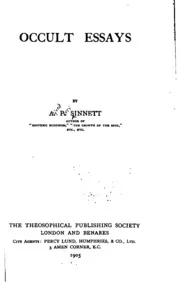
More Free Theosophy & Anthroposophy Books
View all →