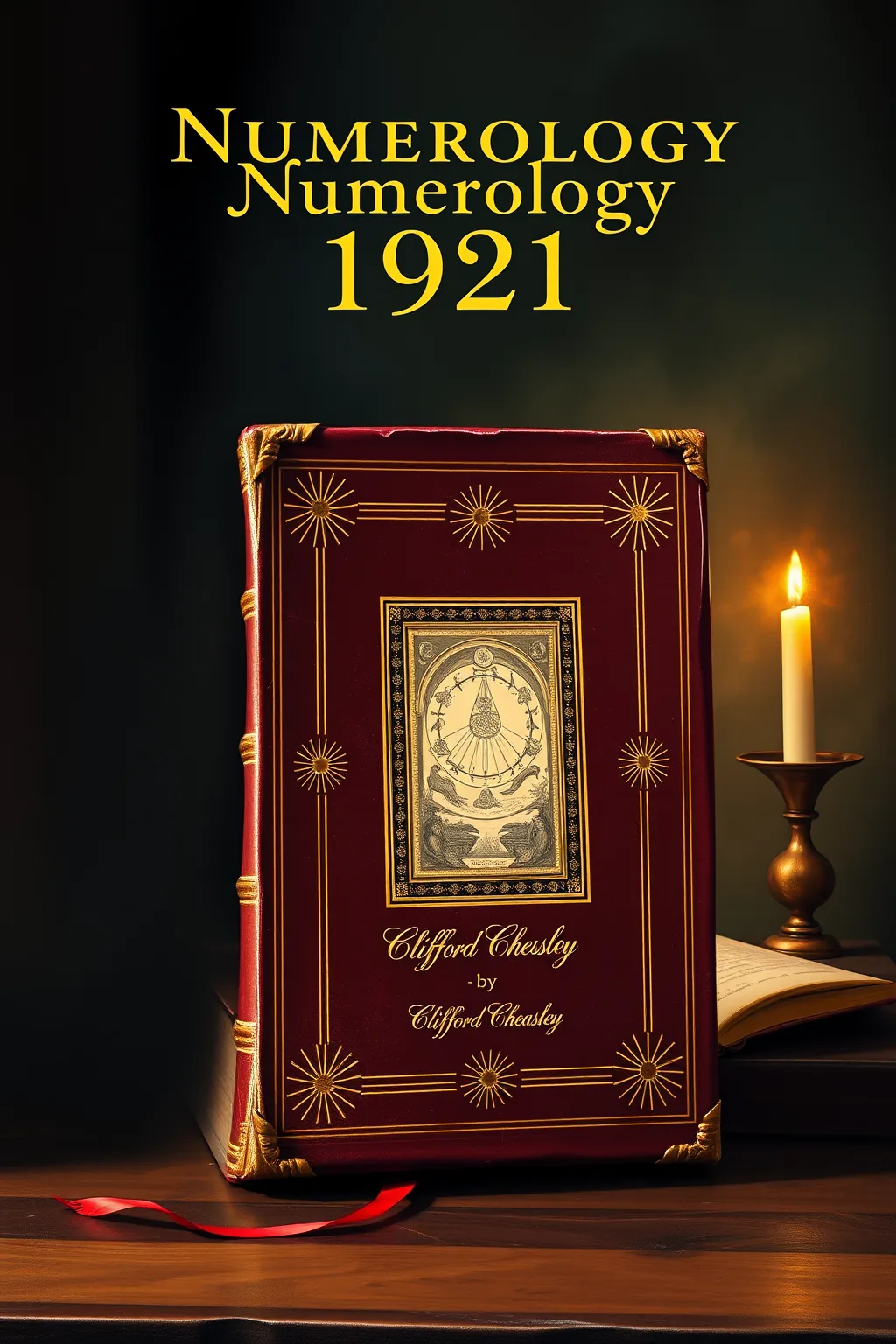
Numerology (1921)
 79
79

Numerology (1921)
Clifford Cheasley’s Numerology (1921) offers a direct entry into a system often shrouded in mysticism. The book’s strength lies in its straightforward presentation, stripping away excessive jargon to present numerology as an accessible spiritual tool. Cheasley argues compellingly that numbers are not merely abstract quantities but carry inherent energies and meanings, a concept particularly evident when he discusses how ancient scholars might have perceived hidden codes within sacred writings. This approach feels grounded, connecting the metaphysical to the tangible through numerical relationships. However, the work’s primary limitation is its brevity and the lack of extensive practical application; it introduces concepts without always detailing how to fully implement them in daily life or complex divinatory practices. The emphasis on 'the Kabala of numbers' is intriguing but could benefit from deeper contextualization within broader Kabbalistic traditions. Despite this, the book serves as a solid primer for understanding the foundational principles of numerology as a spiritual discipline. Cheasley’s work is a useful, if introductory, manual for the numerically inclined seeker.
📝 Description
79
Clifford Cheasley's 1921 book, Numerology, presents numbers as a spiritual discipline, not just mathematics.
Published in 1921, Clifford Cheasley's Numerology treats numbers as more than mere mathematical symbols, instead framing them as a spiritual discipline. Cheasley contends that numerology reveals a universal language and hidden connections between the material world and the divine. He asserts that understanding numerical patterns allows access to deeper meanings in sacred texts and the cosmos. The book aims to clarify numerology's principles, making them accessible to those interested in its mystical applications. It argues that these numerical structures are not random but form an ordered system influencing life and existence.
This work is suitable for individuals drawn to the intersection of spirituality and numerical systems. It will appeal to students of comparative religion, occult studies, and Western esotericism interested in how numbers serve as tools for divination and philosophical thought across cultures. Readers seeking a straightforward approach to complex esoteric subjects, and who are open to the idea of hidden codes within ancient scriptures, will find this book valuable. It offers a clear exposition for those wanting to grasp the historical and practical aspects of numerology.
Cheasley's Numerology (1921) appeared during a significant period of occult revival in the early 20th century. This era saw widespread interest in esoteric philosophies, influenced by movements like Theosophy and a renewed focus on traditions such as Kabbalah. The book engages with the numerological aspects of Kabbalah, reminiscent of earlier examinations by figures like Eliphas Levi and A.E. Waite. It reflects a broader cultural milieu where mystical interpretations of mathematics and ancient texts were gaining ground, offering an alternative perspective to purely materialist viewpoints.
💡 Why Read This Book?
• Gain an understanding of numerology as a spiritual discipline, not just a mathematical system, by learning Cheasley's interpretation of how numbers 'govern the growth of' natural and human phenomena. • Explore the concept of hidden codes within ancient scriptures, as Cheasley suggests numerological principles were understood and utilized by scholars of 'holy ancient writings'. • Discover the foundational principles of 'the Kabala of numbers,' grasping how specific numerical correspondences were believed to offer insights into destiny and the cosmos.
⭐ Reader Reviews
Honest opinions from readers who have explored this book.
❓ Frequently Asked Questions
What is 'the Kabala of numbers' as presented by Clifford Cheasley?
Cheasley's 'Kabala of numbers' refers to an ancient system of numerology, understood as a spiritual discipline. It posits that numbers have inherent mystical properties and symbolic meanings, enabling the decoding of hidden truths within sacred texts and the natural world.
Is Numerology (1921) by Clifford Cheasley a difficult book to understand?
The original blurb suggests that when explained correctly, numerology is 'pretty easy to understand.' Cheasley aims for accessibility, presenting the spiritual nature of numbers without overly complex mathematical or philosophical jargon, making it approachable for newcomers.
How does Cheasley connect numerology to spirituality?
Cheasley asserts that numerology is inherently spiritual, not just mathematical. He suggests that the same 'power of numbers' that underpins cosmic order also influences human life, revealing hidden codes in ancient writings and connecting the material to the divine.
What kind of hidden codes does Cheasley suggest are in ancient writings?
While not specifying exact codes, Cheasley implies that ancient scholars believed numerical patterns within holy texts held deeper, spiritual meanings. The work explores how the inherent power and symbolism of numbers could unlock these veiled insights.
What is the significance of the year 1921 for this book?
The year 1921 marks the original publication of Clifford Cheasley's Numerology. This period was characterized by a significant resurgence of interest in esoteric subjects, including spiritualism, Theosophy, and various forms of divination and mystical philosophy.
Does the book provide practical exercises for numerology?
The provided blurb focuses on the conceptual and spiritual aspects of numerology, suggesting it explains principles and underlying theories. It implies a focus on understanding the 'why' and 'how' of numerical symbolism rather than providing extensive step-by-step practical guides.
🔮 Key Themes & Symbolism
Numbers as Spiritual Language
Cheasley posits that numbers are more than quantitative tools; they embody a profound spiritual language. This theme explores how numerical vibrations and inherent meanings are believed to influence existence, from cosmic order to individual destiny. The work suggests that understanding this language allows access to deeper truths, revealing the interconnectedness of all things through mathematical symbolism and esoteric correspondences.
Hidden Codes in Sacred Texts
A central tenet of the book is the belief that ancient scriptures contain concealed layers of meaning accessible through numerology. Cheasley suggests scholars of antiquity recognized a 'power of numbers' that governed the growth and structure of reality, and that this power was encoded within holy writings. This theme invites readers to consider how numerical patterns might serve as keys to unlocking profound spiritual and philosophical insights embedded within religious and mystical literature.
The Kabala of Numbers
This theme focuses on the specific tradition or methodology Cheasley associates with 'the Kabala of numbers.' It explores the idea that a sophisticated, ancient system exists for interpreting the spiritual significance of numerical values. The work likely explores how this system can be applied to understand personality, predict life events, and comprehend the underlying structure of the universe, drawing parallels to established Kabbalistic practices.
Numerology as Accessible Spirituality
Cheasley aims to clarify numerology, presenting it as an understandable and spiritual discipline rather than a purely academic or arcane subject. This theme highlights the book's intention to make esoteric knowledge accessible, arguing that the principles of numerology are logical and spiritually enriching when explained correctly. It emphasizes the ease with which individuals can begin to perceive the spiritual dimension inherent in numerical relationships.
💬 Memorable Quotes
Direct passages from the work, attributed to the author.
“The Kabala of numbers is a book that concerns itself with the study of numerology.”
— This foundational statement immediately frames the book's subject matter, positioning numerology within a specific, ancient interpretive framework ('Kabala') and signaling its focus on symbolic numerical study.
“You may think that it's a completely mathematical topic.”
— This anticipates a common misconception, setting the stage for the author to pivot and explain that numerology transcends mere calculation, emphasizing its spiritual and esoteric dimensions.
“when explained correctly, numerology is not only pretty easy to understand but very spiritual in nature.”
— This highlights the author's pedagogical goal: to simplify a complex subject and reveal its profound spiritual underpinnings, assuring the reader of its accessibility and esoteric depth.
“scholars believe that holy ancient writings contain hidden codes.”
— This suggests a key application of numerology explored in the text—deciphering symbolic meanings within religious or mystical texts, implying that numbers act as a form of divine communication.
“The same power of numbers that courses though the ancient scripts governs the growth of...”
— This implies a universal principle, linking the symbolic power found in ancient texts to the fundamental forces that shape reality, including natural phenomena and potentially human development.
🌙 Esoteric Significance
Tradition
Cheasley's work aligns with the Western Esoteric tradition, particularly drawing from Kabbalistic numerology (Gematria) and the broader Hermetic principle of 'as above, so below.' It fits within a lineage that views numbers not just as mathematical entities but as symbolic representations of divine order and cosmic forces. The book departs from purely mystical interpretations by aiming for a more accessible, structured explanation of these principles, seeking to integrate them into a coherent system for understanding life.
Symbolism
The core symbolism revolves around the inherent meaning attributed to numbers themselves. Numbers like 3, 7, and 9, often considered sacred or significant across various traditions, likely feature prominently, representing concepts such as creation, completion, or spiritual perfection. The symbolism extends to the assignment of numerical values to letters, a practice central to Gematria, where words and names become conduits for deeper numerical and spiritual insight.
Modern Relevance
Contemporary interest in numerology continues, fueled by New Age spirituality and a desire for personalized meaning. Practices like modern Hellenistic astrology, chaos magic, and various forms of divination often incorporate numerical interpretations. Cheasley's foundational approach provides a historical anchor for understanding these practices, offering a glimpse into the early 20th-century systematization of numerological thought that continues to influence contemporary seekers.
👥 Who Should Read This Book
• Aspiring numerologists seeking foundational knowledge: Readers new to the subject will benefit from Cheasley's clear, direct explanation of numerological principles and their spiritual underpinnings. • Students of Western Esotericism: Those studying Kabbalah, Hermeticism, or the history of occult thought will find this book a valuable primary source for early 20th-century numerological perspectives. • Individuals interested in the symbolism of ancient texts: Readers curious about how numbers might have been used to interpret sacred writings will appreciate Cheasley's exploration of hidden codes.
📜 Historical Context
Numerology (1921) by Clifford Cheasley emerged during a period of intense spiritual and occult exploration in the early 20th century. The era was marked by the popularity of Theosophy, championed by Helena Blavatsky, which sought to synthesize global esoteric traditions. Cheasley's focus on 'the Kabala of numbers' reflects a broader fascination with Jewish mysticism and its potential applications, a field being re-examined by figures like Aleister Crowley and A.E. Waite. While not directly engaging with scientific materialism, Cheasley's work offered an alternative framework for understanding the universe, resonating with those seeking meaning beyond empirical observation. This period also saw the rise of spiritualism and various forms of divination, creating a receptive audience for texts like Cheasley's that promised insights into hidden cosmic laws and personal destiny.
📔 Journal Prompts
The concept of 'the Kabala of numbers' as a spiritual discipline.
The idea that holy ancient writings contain hidden codes.
Your personal interpretation of numbers as having spiritual rather than purely mathematical significance.
How the 'power of numbers' might govern natural growth and human life.
The accessibility of numerology when explained correctly.
🗂️ Glossary
Numerology
The study of the mystical or symbolic significance of numbers and their influence on human life and the cosmos. It posits that numbers carry inherent vibrational energies and meanings.
The Kabala of numbers
A term used by Cheasley to describe an ancient system of numerological interpretation, likely drawing from or analogous to Jewish Kabbalistic practices, focused on revealing hidden spiritual truths through numerical correspondences.
Hidden codes
Concealed meanings or symbolic patterns believed to exist within sacred or ancient texts, which can be deciphered using specific interpretive systems like numerology.
Spiritual discipline
A practice or field of study pursued not for material gain or purely intellectual understanding, but for the development of spiritual awareness, connection, or insight.
Power of numbers
The concept that numbers possess inherent, active forces or energies that influence the structure, growth, and events of the universe and human existence.
Ancient scripts
Written texts from historical periods, particularly those considered sacred, foundational, or carrying significant cultural and spiritual weight (e.g., religious scriptures, philosophical treatises).
Mathematical topic
A subject concerned primarily with numbers, quantities, space, structure, and change, typically approached through logical reasoning and calculation.