Notre Dame de Lourdes
 78
78

Notre Dame de Lourdes
Henri Lasserre's "Notre Dame de Lourdes" is not a light read; it is a dense, earnest compilation of testimonies and theological reflection surrounding the 1858 apparitions. Lasserre's strength lies in his exhaustive cataloging of Bernadette Soubirous's visions and the immediate aftermath, presenting a compelling case for the authenticity of the events through sheer volume of reported detail. However, the work occasionally falters under the weight of its own devotion, sometimes presenting accounts with an uncritical fervor that might alienate readers seeking a more balanced historical or critical perspective. The detailed descriptions of the grotto and the early miracles, particularly the accounts of physical healings, are striking in their earnestness. Ultimately, "Notre Dame de Lourdes" serves as a foundational text for understanding the Lourdes phenomenon, offering an invaluable primary source for devotional study.
📝 Description
78
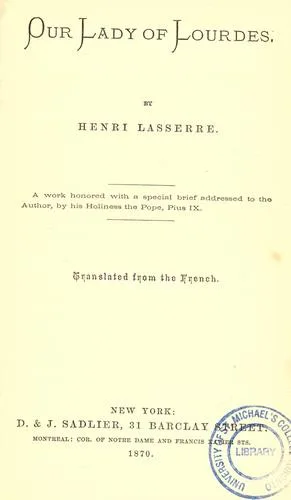
Henri Lasserre's Notre Dame de Lourdes details the 1858 Marian apparitions and their immediate aftermath.
Published around 1862, Henri Lasserre's Notre Dame de Lourdes recounts the 1858 events at Lourdes, France. The book focuses on the visions of Bernadette Soubirous, a young peasant girl, and the emergence of the site as a significant Catholic pilgrimage location. Lasserre meticulously records Soubirous's experiences and the reported spiritual and physical phenomena, including numerous accounts of miraculous healings attributed to the grotto's waters. The construction of the grotto and subsequent basilicas is also described.
This work is directed toward readers interested in Catholic hagiography, mysticism, and the history of religious phenomena. It particularly appeals to those who wish to understand the origins and early growth of the Lourdes devotion, with an emphasis on Bernadette's testimonies and those who witnessed the apparitions. Scholars of religious history and comparative spirituality will find the book valuable for its examination of faith's intersection with the physical body and its role in a period of social change.
Lasserre's account emerges from a 19th-century France marked by spiritual revival following the Revolution. This period saw a complex interplay between rising positivism and a persistent hunger for the supernatural. The Lourdes apparitions and their subsequent development into a major shrine offered a potent counterpoint to secularizing trends. The book documents a perceived divine intervention, emphasizing the power of faith and intercession, particularly through the Virgin Mary, in a world increasingly oriented towards rationalism.
💡 Why Read This Book?
• Gain a foundational understanding of the 1858 Lourdes apparitions, focusing on the detailed testimonies of Bernadette Soubirous and the initial witness accounts, which provides a unique window into the genesis of a major Marian shrine. • Explore the concept of 'divine intervention' as presented through numerous reported miraculous healings, offering a specific lens through which to examine the intersection of faith, physical well-being, and the Lourdes waters. • Understand the early development and reception of the Lourdes phenomenon in 19th-century France, examining how it countered secularizing trends and solidified into a significant pilgrimage site, as documented in the work's historical context.
⭐ Reader Reviews
Honest opinions from readers who have explored this book.
❓ Frequently Asked Questions
When were the apparitions at Lourdes described in the book first reported?
The apparitions central to Henri Lasserre's "Notre Dame de Lourdes" were first reported by Bernadette Soubirous in 1858, making the book a contemporary account of these significant events.
Who is the primary figure experiencing the apparitions in this book?
The primary figure is Bernadette Soubirous, a young peasant girl from Lourdes, France, whose visions and encounters form the core narrative of Henri Lasserre's chronicle.
What is the significance of the grotto mentioned in "Notre Dame de Lourdes"?
The grotto, specifically the Massabielle Grotto, is the site where Bernadette Soubirous reported seeing the Virgin Mary. It became the focal point for pilgrimages and is associated with miraculous healings.
What historical period does "Notre Dame de Lourdes" primarily address?
The book primarily addresses the mid-19th century, specifically focusing on the events of 1858 and their immediate aftermath in Lourdes, France, during a time of religious revival and societal change.
Does the book discuss miraculous healings attributed to Lourdes?
Yes, a significant portion of "Notre Dame de Lourdes" is dedicated to detailing numerous accounts of miraculous healings reported by individuals who visited the grotto and its waters.
What is the relationship between Henri Lasserre and the events he describes?
Henri Lasserre was a French writer and journalist who documented the Lourdes apparitions and miracles extensively, aiming to present the events and testimonies in a comprehensive and faithful manner.
🔮 Key Themes & Symbolism
The Lourdes Apparitions
The central theme revolves around the 1858 visions of the Virgin Mary reported by Bernadette Soubirous in Lourdes, France. Lasserre meticulously details the sequence of these encounters, the messages received, and the initial reactions from both the faithful and skeptical authorities. The work presents these events not merely as personal experiences but as divine interventions with profound spiritual implications for the Catholic world and beyond.
Miraculous Healings and Divine Grace
A significant aspect of the book is the extensive documentation of miraculous cures attributed to the waters of the grotto at Lourdes. These accounts serve as tangible evidence of divine grace and the intercessory power of the Virgin Mary. Lasserre compiles numerous testimonies of individuals suffering from various ailments who experienced complete or partial recovery after visiting the site, underscoring the physical manifestations of spiritual faith.
Bernadette Soubirous's Testimony
The narrative heavily features the unwavering testimony of Bernadette Soubirous. Her simple faith, perseverance under questioning, and profound spiritual experiences are presented as important to the authenticity of the apparitions. Lasserre portrays her as a humble conduit for divine messages, highlighting her role in establishing Lourdes as a site of spiritual significance and pilgrimage.
The Formation of a Sacred Site
The book traces the transformation of the Massabielle Grotto from an obscure natural formation into a globally recognized pilgrimage destination. It details the construction of chapels and basilicas, the organization of religious services, and the burgeoning flow of pilgrims seeking solace, healing, and spiritual renewal, illustrating the potent blend of faith and collective devotion.
💬 Memorable Quotes
Direct passages from the work, attributed to the author.
“I saw a lady dressed in white, with a blue sash and a white veil. She had a rose on each foot.”
— This is a descriptive passage from Bernadette's early visions, detailing the visual appearance of the figure she encountered. It emphasizes the ethereal and sacred imagery associated with the apparition.
💡 Key Ideas
Editorial paraphrase of the work's core concepts — not direct quotes.
The Lady spoke to me. She told me to go and drink at the spring and to wash myself there.
This quote expresses Bernadette's direct experience of the apparition and the divine instruction given to her, highlighting the simple, yet profound, actions prescribed as part of the miraculous event at Lourdes.
The water began to flow, and I drank and washed myself. The lady told me, 'Go, pray for sinners.'
This paraphrase captures the moment Bernadette followed the apparition's instructions and received a further spiritual directive. It underscores the dual focus on personal purification and intercession for others.
The number of sick people who came to Lourdes grew immensely, and with them, the reports of extraordinary cures.
This paraphrased statement reflects the book's emphasis on the miraculous healings that became synonymous with Lourdes, highlighting the tangible, physical outcomes of faith and pilgrimage.
She told me her name was the Immaculate Conception. I repeated it, and she said it was so.
This paraphrased quote marks an important moment where the apparition reveals her identity, aligning with Catholic dogma and solidifying the divine nature of the experience for Bernadette and the faithful.
🌙 Esoteric Significance
Tradition
While rooted in Catholic tradition, Lasserre's work engages with themes resonant in esoteric thought, particularly concerning divine manifestation and psychosomatic healing. The focus on a specific, localized divine encounter and the resultant physical transformations can be viewed through lenses that explore sacred geography and the power of focused intention and belief in channeling spiritual energy, albeit within a strictly orthodox framework.
Symbolism
The **Spring** itself is a potent symbol of purification and renewal, a common motif in spiritual traditions representing the washing away of sin and the infusion of divine life. The **Virgin Mary** as the "Immaculate Conception" embodies purity, divine motherhood, and intercessory power, a figure revered for her connection to the celestial realm. The **Grotto** acts as a liminal space, a threshold between the mundane and the sacred, where direct communion with the divine is facilitated.
Modern Relevance
Contemporary movements exploring consciousness and healing, particularly those interested in the placebo effect, psychosomatic illness, and the power of collective belief, often revisit Lourdes. While not always explicitly referencing Lasserre, the documented phenomena of spontaneous remission and the efficacy of faith-based healing sites continue to inform discussions in fields bridging spirituality, psychology, and medicine, such as integral health and consciousness studies.
👥 Who Should Read This Book
• Devotees of Marian apparitions and Catholic hagiography seeking an early, comprehensive account of the Lourdes phenomenon. • Researchers of religious history and sociology interested in the development of pilgrimage sites and the interplay of faith and community in 19th-century France. • Individuals exploring the historical basis and reported miraculous healings associated with Lourdes, examining the intersection of belief, physical well-being, and sacred geography.
📜 Historical Context
Henri Lasserre's "Notre Dame de Lourdes," first published in the early 1860s, emerged during a complex period in French history. The mid-19th century witnessed a powerful resurgence of Catholic piety following the upheaval of the French Revolution and the Napoleonic era, a movement often seen as a counterpoint to the Enlightenment's rationalism and the rise of positivism. The apparitions in Lourdes, occurring in 1858, were met with both fervent belief and considerable skepticism from ecclesiastical and civil authorities. Lasserre’s work appeared amidst this tension, aiming to solidify the narrative of divine intervention. Contemporaries like Émile Zola would later offer starkly different, naturalistic interpretations of such phenomena. The Catholic Church's eventual official recognition of the Lourdes apparitions in 1862, shortly after Lasserre's publication, lent significant weight to his account and catalyzed the site's transformation into a paramount pilgrimage center.
📔 Journal Prompts
Bernadette Soubirous's initial encounters with the Lady in the grotto.
The specific descriptions of miraculous healings documented by Lasserre.
The role of the Massabielle Grotto as a sacred space.
The concept of the 'Immaculate Conception' as revealed in Lourdes.
The socio-religious climate of 19th-century France impacting the Lourdes events.
🗂️ Glossary
Apparition
A supernatural manifestation of a divine being or holy figure, as experienced by an individual or group, central to the narrative of "Notre Dame de Lourdes."
Bernadette Soubirous
The young peasant girl who reported experiencing a series of visions of the Virgin Mary in Lourdes, France, beginning in 1858. Her testimony is foundational to the book.
Grotto of Massabielle
The natural cave in Lourdes, France, where Bernadette Soubirous reported seeing the Virgin Mary and which became the site of miraculous healings and pilgrimages.
Immaculate Conception
The doctrine that the Virgin Mary was conceived without original sin. This was the name the apparition identified itself with to Bernadette.
Pilgrimage
A journey or search of moral or spiritual significance, undertaken to a place considered sacred. Lourdes became a major center for Catholic pilgrimage.
Hagiography
The writing of the lives of saints. Lasserre's work functions as a form of hagiography for Bernadette and the Lourdes events.
Miraculous Healing
A recovery from illness or injury attributed to divine intervention rather than medical treatment, a key theme extensively documented in the book.
🔮 Readers Also Liked
Browse all →









More by Henri Lasserre
All books →
More Free Occult Philosophy Books
View all →