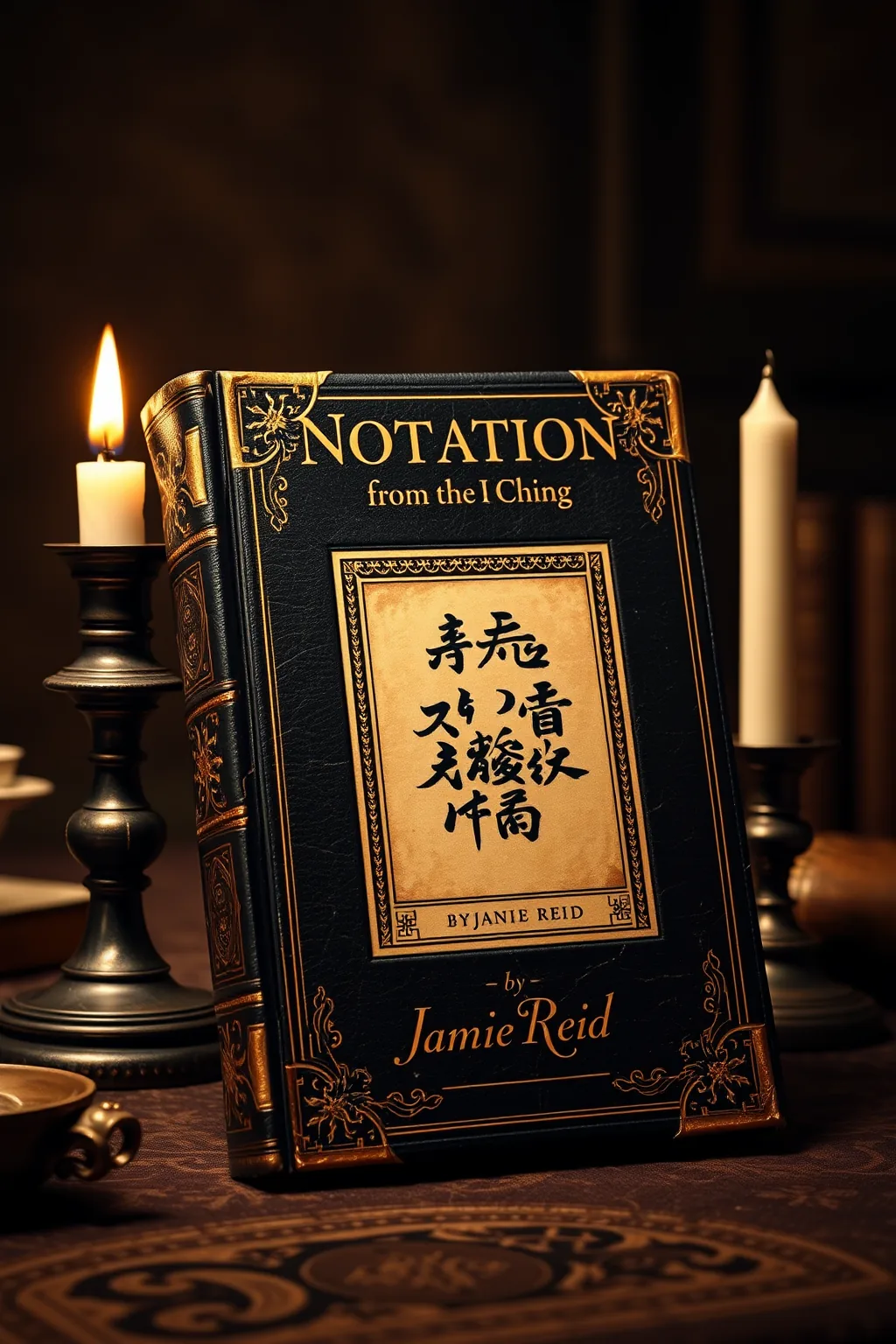
Notations from the I Ching
 61
61

Notations from the I Ching



Cassian Rothmann (Senior Critic, Ancient Wisdom) — Jamie Reid's 'Notations from the I Ching' is a masterful distillation of one of the world's most profound oracular systems. Reid navigates the labyrinthine symbolism with exceptional clarity, offering insights that resonate deeply within the esoteric tradition. This isn't merely a translation or interpretation; it's an invitation into the very consciousness of the I Ching. The author's ability to connect the ancient wisdom to contemporary spiritual quests is remarkable, making it an indispensable resource for serious students of divination and seekers of existential truth. Its strengths lie in its depth, accessibility, and its capacity to inspire genuine transformation. A gem for any practitioner of the mystic arts.
📝 Description
61
Jamie Reid's 'Notations from the I Ching' unpacks the Book of Changes beyond simple divination.
This book examines the I Ching, the ancient Chinese text known as the Book of Changes. Jamie Reid moves past its common use as a divination tool to discuss its philosophical depth and symbolic structure. The work focuses on the hexagrams, explaining the interplay of Yin and Yang within them.
Reid presents each notation as a way to understand universal patterns and the connections between all things. The book aims to help serious students and practitioners develop a more reflective approach. It encourages looking inward and recognizing personal intuition. The text addresses the cyclical patterns in life, the nature of change, and the quiet source of understanding.
'Notations from the I Ching' serves as a resource for understanding existence. It shows how ancient oracles can inform current life and future possibilities. Readers are encouraged to find a sense of cosmic balance within its pages.
The I Ching, or Book of Changes, is a cornerstone of Chinese philosophy and a key text in East Asian esoteric traditions. Its roots are ancient, predating Confucius. The text is not merely a predictive tool but a complex system for understanding cosmic order and human affairs through its sixty-four hexagrams. These hexagrams, formed by combinations of yin and yang lines, represent fundamental archetypes and dynamic processes. Many esoteric traditions have drawn upon the I Ching for insights into cosmology, ethics, and the nature of reality. Reid's work engages with this long history of interpretation.
💡 Why Read This Book?
Discover the timeless secrets of the Book of Changes, a cornerstone of Eastern philosophy and divination. 'Notations from the I Ching' offers a unique lens through which to understand life's transformations, guiding seekers, scholars, and practitioners towards deeper self-awareness and cosmic alignment. If you yearn for profound insights into destiny, change, and the art of living harmoniously, this book is your illuminated path.
⭐ Reader Reviews
Honest opinions from readers who have explored this book.
❓ Frequently Asked Questions
What is the I Ching?
The I Ching, or Book of Changes, is an ancient Chinese divination text and philosophical classic, revered for its profound insights into the patterns of change and the forces governing the universe.
Who is Jamie Reid?
Jamie Reid is an author and scholar known for their insightful explorations of esoteric traditions and their ability to distill complex mystical concepts into accessible wisdom.
Is this book for beginners?
While it offers profound depth for advanced practitioners, 'Notations from the I Ching' is also accessible to curious beginners, providing a gentle yet illuminating introduction to its core principles.
How can I use this book?
Use it for contemplative study, personal divination, or as a guide to understanding the philosophical underpinnings of cyclical change and the Tao.
What makes this edition unique?
This edition offers fresh, evocative interpretations and detailed notations, connecting the ancient wisdom of the I Ching to modern spiritual and philosophical inquiries.
🔮 Key Themes & Symbolism
The Dance of Yin and Yang
This theme explores the fundamental cosmic duality of Yin and Yang as presented in the I Ching. It explores how these seemingly opposing forces are in constant flux, creating the dynamic equilibrium of the universe. The book illustrates how understanding this interplay is crucial for navigating life's challenges and opportunities, revealing that true harmony arises not from the absence of conflict, but from the masterful balance of complementary energies.
Cycles of Transformation
Fundamentally, the I Ching is a text about change. This theme examines the cyclical nature of existence as depicted through the 64 hexagrams. Reid elucidates how each hexagram represents a specific phase or archetype of transformation, offering guidance on how to align oneself with the prevailing energies of each stage. It emphasizes that change is inevitable and often beneficial, encouraging readers to embrace transition rather than resist it, fostering resilience and adaptability.
The Oracle of Inner Knowing
Beyond simple fortune-telling, this theme highlights the I Ching's role as a profound oracle for self-discovery and inner guidance. The book presents the hexagrams not as fixed predictions, but as mirrors reflecting the reader's inner landscape and the subtle energetic currents of their situation. It advocates for a practice of deep contemplation, where the wisdom of the I Ching is used to awaken intuition, clarify intentions, and illuminate the path towards authentic personal growth and spiritual realization.
💬 Memorable Quotes
Direct passages from the work, attributed to the author.
“Change is the only constant, yet within it lies eternal truth.”
— This highlights the paradoxical nature of existence as understood by the I Ching. It asserts that while external circumstances are ever-shifting, there are underlying cosmic principles that remain steadfast.
“The hexagrams are maps of the soul's journey.”
— This metaphor positions the I Ching's symbolic language as a guide for reading through the complexities of human experience and the inner range of consciousness.
“When the path is unclear, consult the ancient patterns.”
— This encourages reliance on the wisdom embedded within the I Ching's timeless structures when faced with uncertainty, suggesting it offers clarity through archetypal understanding.
💡 Key Ideas
Editorial paraphrase of the work's core concepts — not direct quotes.
The greatest wisdom lies in the stillness between breaths.
This quote emphasizes the I Ching's connection to mindfulness and the power of introspection. It suggests that profound understanding emerges not from constant activity, but from moments of quiet contemplation and awareness.
Harmony is found not in control, but in flowing with the Way.
This quote speaks to the Taoist principle of 'Wu Wei' (non-action), advising that true peace and effectiveness come from aligning oneself with natural universal forces rather than attempting to force outcomes.
🌙 Esoteric Significance
Tradition
The I Ching is deeply rooted in Taoist cosmology and ancient Chinese divination practices, bridging the gap between philosophical inquiry and practical application. Its esoteric significance lies in its ability to map the energetic flow of the cosmos and human experience through its unique symbolic language of hexagrams, lines, and trigrams. It represents a profound system for understanding universal principles, the art of timing, and the subtle forces that govern change and destiny.
Symbolism
The core symbolism revolves around the Yin (receptive, dark, feminine) and Yang (active, light, masculine) energies, represented by broken and solid lines respectively. These combine to form trigrams and hexagrams, each carrying a wealth of meaning related to archetypal situations, natural phenomena, and human relationships. The changing lines within a hexagram signify transition and the potential for transformation, offering a dynamic yet structured view of reality.
Modern Relevance
In contemporary times, the I Ching's relevance has exploded as individuals seek deeper meaning and guidance beyond material pursuits. Its cyclical view of life and emphasis on adaptability resonate with the challenges of a rapidly changing world. Esoterically, it offers a sophisticated framework for personal growth, ethical decision-making, and developing intuitive awareness, serving as a powerful tool for self-reflection and alignment with universal patterns.
👥 Who Should Read This Book
This book is an invaluable resource for dedicated seekers of ancient wisdom, offering a profound gateway into the I Ching's transformative power. Esoteric scholars will find its nuanced interpretations useful, deepening their understanding of Chinese metaphysics and divination. Tarot practitioners and students of symbolic systems will appreciate the parallels and the collection of archetypal imagery. For anyone on a path of self-discovery, grappling with life's changes, or yearning for a deeper connection to universal principles, 'Notations from the I Ching' provides the clarity and guidance sought.
📜 Historical Context
The I Ching, or Book of Changes, emerged from ancient Chinese shamanic traditions and philosophical inquiries, with its earliest layers possibly dating back over 3,000 years. Its compilation and commentary involved scholars and mystics, most notably Confucius and his disciples, who imbued it with ethical and philosophical depth. The text evolved over centuries, becoming a core part of Taoism, Confucianism, and Chinese metaphysics. During periods of intellectual ferment and spiritual seeking, such as the Warring States period or the Song Dynasty, the I Ching served as a vital tool for rulers, scholars, and everyday people seeking guidance, cosmic understanding, and a framework for navigating societal and personal transformations. Its influence extended beyond China, shaping esoteric thought and divination practices across East Asia and eventually the Western world.
📔 Journal Prompts
Reflect on a recent 'change' in your life. Which hexagram might represent this transition, and what wisdom does it offer?
Consider the interplay of Yin and Yang in your daily routines. Where do you see balance, and where is there imbalance?
How can the principle of 'timing' as described in the I Ching inform your current decisions or actions?
What 'inner knowing' is the I Ching attempting to reveal to you at this moment?
Explore the concept of 'transformation' as depicted in a specific hexagram and how it applies to your personal growth.
🗂️ Glossary
Hexagram
A symbol composed of six stacked lines, each either solid (Yang) or broken (Yin), representing a fundamental archetypal situation or stage of change.
Trigram
A symbol composed of three lines, forming the building blocks of hexagrams. There are eight fundamental trigrams, each associated with specific elemental forces and concepts.
Yin
The passive, receptive, dark, feminine principle in Taoist cosmology, often represented by broken lines in the I Ching.
Yang
The active, creative, light, masculine principle in Taoist cosmology, often represented by solid lines in the I Ching.
Tao
The fundamental principle of the universe in Taoism; the 'Way' or the natural order of things. The I Ching is seen as a manifestation of the Tao's dynamic processes.
This book appears in 3 collections
🔮 Readers Also Liked
Browse all →









From the “Tarot” Collection
View all →









More Free Divination & Tarot Books
View all →