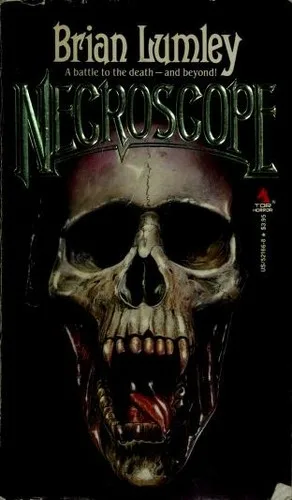
Necroscope
 73
73

Necroscope
Brian Lumley’s *Necroscope* presents a formidable protagonist in Harry Keogh, a man whose intimate connection with the deceased offers a distinct lens through which to view the supernatural. The novel’s strength lies in its ambitious world-building, constructing a hidden hierarchy of psychic predators and ancient entities like the Ehr-ghast that operate just beyond normal perception. Lumley does not shy away from depicting the grim realities of death and its aftermath, imbuing the narrative with a palpable sense of dread. However, the pacing can occasionally falter, particularly in the extensive exposition required to establish its complex lore. The introduction of the "Ehr-ghast" as a prime antagonist, while conceptually chilling, sometimes feels like a force of nature rather than a character with discernible motivation, which can distance the reader. Despite these minor structural issues, the exploration of Keogh's unique abilities and the shadowy organizations he uncovers remains a compelling draw. *Necroscope* offers a dark, intricate vision of the afterlife and its impact on the living.
📝 Description
73
Brian Lumley's 1988 novel Necroscope introduced Harry Keogh, a man who talks to the dead.
Necroscope presents Harry Keogh, a protagonist gifted with the ability to communicate with deceased individuals. This book is not a standard ghost story; it crafts a detailed mythology about psychic vampires and ancient beings that exist beyond the living world. Lumley builds a complex narrative around consciousness, death, and the entities that inhabit the spaces between. The novel establishes a hidden world where these beings prey on the living from the shadows.
Readers interested in dark fantasy with a more literary approach will find Necroscope engaging. The story touches upon the limits of human perception and the potential for consciousness beyond normal understanding. Those who enjoy supernatural thrillers that feature strong world-building and psychological depth will connect with Lumley's narrative. The book emerged during a time of renewed interest in darker mythologies within genre fiction.
Brian Lumley's Necroscope fits within a tradition of supernatural fiction that explores the porous boundary between life and death. The novel engages with concepts of entities that feed on psychic residue, a theme found in various occult traditions concerning spirits and their influence. The idea of parallel dimensions, where unseen beings operate, echoes esoteric cosmologies that posit multiple planes of existence influencing our own. Lumley's protagonist, Harry Keogh, wields a form of 'wraithsense,' connecting him to the departed and revealing a hidden, predatory world.
💡 Why Read This Book?
• Gain insight into the mechanics of "wraithsense," Harry Keogh's unique ability to perceive and interact with the deceased, offering a specific model for exploring psychic connections beyond conventional understanding. • Understand the lore surrounding the "Ehr-ghast" and "nascents," exploring Lumley's unique cosmology of psychic entities that feed on the remnants of life and death. • Experience a narrative that moves beyond typical horror tropes, focusing on a protagonist who actively confronts and manipulates the supernatural world established in 1988.
⭐ Reader Reviews
Honest opinions from readers who have explored this book.
❓ Frequently Asked Questions
What is Harry Keogh's primary supernatural ability in Necroscope?
Harry Keogh possesses "wraithsense," an ability that allows him to communicate with the dead. This unique talent enables him to interact with spirits and uncover secrets hidden from the living world.
Who are the primary antagonists in Brian Lumley's Necroscope?
The primary antagonists are psychic vampires known as "nascents" and the ancient, immensely powerful being called the "Ehr-ghast," who represent existential threats to humanity from a hidden supernatural realm.
When was Necroscope first published?
Necroscope was first published in 1988, placing it within a wave of darker, more complex supernatural fiction that explored the boundaries of horror and fantasy.
Does Necroscope involve traditional vampires?
No, Necroscope does not feature traditional vampires. Instead, it introduces "nascents," entities that feed on psychic energy and the echoes of death, offering a distinct take on vampiric lore.
What is the setting of Necroscope?
The novel is primarily set in England, with significant portions of the narrative also taking place in a parallel psychic dimension where the dead and supernatural entities reside.
Is Necroscope part of a series?
Yes, Necroscope is the first novel in Brian Lumley's extensive Necroscope series, which continues to explore Harry Keogh's adventures and the supernatural world he inhabits.
🔮 Key Themes & Symbolism
The Nature of Death
Lumley challenges conventional notions of death by presenting it not as an end, but as a transition into a different state of existence. Harry Keogh's ability to communicate with the deceased, the "wraiths," highlights the lingering consciousness and psychic residue left behind. The novel posits that death is a threshold, a place where new forms of life, like the "nascents," can emerge and feed, blurring the lines between the living and the dead and suggesting a complex afterlife populated by entities with their own agendas.
Psychic Predation
Central to *Necroscope* is the concept of psychic predation, embodied by the "nascents" and the formidable "Ehr-ghast." These entities subsist on the psychic energy of the dead and, by extension, the living. This theme explores the vulnerability of consciousness and the hidden dangers that can exist beyond our sensory perception. The novel suggests that malevolent forces actively seek to exploit the remnants of life, creating a cosmic hierarchy where the dead are not at peace but are preyed upon.
The Veil Between Worlds
The narrative is built upon the idea of a permeable barrier between the physical world and a supernatural dimension inhabited by the dead and other entities. Harry Keogh's "wraithsense" acts as a conduit, allowing him to traverse this veil and interact with forces unknown to most humans. This theme explores the hidden realities that coexist with our own, suggesting that our perceived reality is only a fraction of what truly exists, and that powerful beings operate just out of sight.
Protagonist as Bridge
Harry Keogh serves as a unique bridge between the worlds of the living and the dead. His ability is not merely passive observation but an active engagement that allows him to confront and even manipulate the supernatural. This theme highlights the potential for individuals to possess extraordinary abilities that connect them to hidden realms, positioning them as crucial figures in conflicts that span multiple dimensions and realities. Keogh’s journey is one of embracing his unique nature to combat existential threats.
💬 Memorable Quotes
Direct passages from the work, attributed to the author.
“The dead were my friends. I knew them all.”
— This statement expresses Harry Keogh's core ability and his unique relationship with the deceased. It suggests a profound, personal connection that transcends typical human interaction, positioning the dead not as spectral apparitions but as familiar companions.
“There are things in the dark you do not want to know.”
— This interpretation highlights the novel's exploration of hidden, malevolent forces. It speaks to the existence of entities like the 'nascents' and the 'Ehr-ghast' that operate beyond human comprehension and pose a significant threat to the living.
“He could feel the dead around him, a silent congregation.”
— This phrase vividly describes Harry Keogh's ability to sense the presence of spirits. It paints a picture of the spectral realm as a populated space, a 'congregation' of souls that coexist with the living world, unseen by most.
“The truly ancient things have no need of names.”
— This interpretation relates to the cosmic scale of the threats within *Necroscope*, particularly the "Ehr-ghast." It suggests a primordial power so vast and alien that it transcends the need for human labels, existing in a state of being that predates conceptualization.
💡 Key Ideas
Editorial paraphrase of the work's core concepts — not direct quotes.
Death is not the end, but a different beginning.
This paraphrased concept reflects the novel's view of the afterlife as a continuation of existence, albeit in a transformed state. It sets the stage for Lumley's cosmology where the dead retain consciousness and can be interacted with, becoming part of a larger, supernatural ecosystem.
🌙 Esoteric Significance
Tradition
While not explicitly tied to a single, named esoteric tradition like Hermeticism or Kabbalah, *Necroscope* draws heavily on themes common in Western occultism concerning the nature of consciousness, the afterlife, and unseen entities. It explores concepts akin to astral projection and the existence of planes of existence beyond the physical, reminiscent of Theosophical or Gnostic ideas about spiritual realms and hidden hierarchies. Lumley constructs his own unique mythology that functions as a self-contained esoteric system, exploring the interaction between the living and the dead as a form of psychic ecology.
Symbolism
The "wraiths" themselves serve as potent symbols of lingering consciousness and the permeable boundary between life and death. Harry Keogh's "wraithsense" symbolizes the potential for human perception to extend beyond the physical senses, acting as a bridge to hidden realities. The "Ehr-ghast" represents a primordial, cosmic darkness—a force of pure, ancient malevolence that embodies the ultimate existential threat, symbolizing chaos or the void that lies beyond the known universe.
Modern Relevance
Contemporary dark fantasy and horror authors continue to explore Lumley's themes of psychic abilities, complex afterlife cosmologies, and the existence of hidden predatory entities. Writers who focus on intricate world-building and the psychological toll of confronting supernatural threats owe a debt to Lumley's foundational work. The novel's exploration of consciousness beyond the body and the ethical implications of interacting with the dead remains relevant in discussions about spirituality, parapsychology, and the philosophical questions surrounding mortality.
👥 Who Should Read This Book
• Fans of dark fantasy and supernatural thrillers seeking intricate world-building and a protagonist with unique psychic abilities. • Readers interested in exploring philosophical concepts surrounding death, consciousness, and the potential for life beyond the physical realm. • Enthusiasts of occult literature who appreciate unique mythologies and narratives that explore hidden hierarchies and existential threats.
📜 Historical Context
Brian Lumley's *Necroscope*, published in 1988, arrived during a fertile period for supernatural fiction, a decade that saw a greater willingness to explore darker, more complex mythologies within genre literature. Authors like Stephen King were already redefining horror with psychological depth and intricate characterizations, while Clive Barker was pushing boundaries with visceral, body-horror elements. Lumley's contribution was to create a protagonist, Harry Keogh, whose primary interaction was not with malevolent spirits in the traditional sense, but with the very fabric of death and the entities that inhabit its periphery. This was a departure from simpler ghost stories, offering a more intricate cosmology involving psychic vampires (nascents) and ancient beings. The late 1980s also saw continued interest in occult and esoteric themes within fiction, making *Necroscope*'s exploration of death, consciousness, and hidden realms particularly resonant. While not directly engaged with specific academic esoteric movements, its success tapped into a broader cultural curiosity about the unknown.
📔 Journal Prompts
Reflect on the implications of Harry Keogh's "wraithsense" for understanding grief and memory.
Consider the concept of "nascents" as entities feeding on psychic residue. What does this suggest about the nature of spiritual sustenance?
Analyze the portrayal of the "Ehr-ghast." How does its immense, ancient nature challenge conventional ideas of evil?
Explore the idea of a "veil" between worlds. How might one's perception of reality change if this veil were thinner?
Write about the isolation that might accompany the ability to communicate with the dead, as Harry Keogh experiences.
🗂️ Glossary
Wraiths
The spirits or ghosts of the dead. In *Necroscope*, they are sentient and capable of communication, forming a significant part of Harry Keogh's supernatural environment.
Wraithsense
Harry Keogh's unique psychic ability to perceive, communicate with, and influence the dead. It is the core of his supernatural power and the narrative's premise.
Nascents
A type of psychic vampire or entity that feeds on the psychic energy and residual consciousness of the dead. They are a primary antagonistic force in the novel.
Ehr-ghast
An ancient, immensely powerful, and malevolent entity. It represents a primordial force of darkness and is one of the ultimate threats within Lumley's cosmology.
Psychic Dimension
A parallel plane of existence inhabited by the dead and various supernatural entities, accessible through specific psychic abilities or phenomena, forming a hidden layer to reality.
Sunside
The mundane, physical world inhabited by living humans, contrasted with the supernatural realms where the dead and other entities reside.
Talent
In the context of *Necroscope*, 'Talent' refers to individuals possessing psychic abilities, such as Harry Keogh's wraithsense or the abilities of other characters.
🔮 Readers Also Liked
Browse all →









More by Brian Lumley
All books →
More Free Occult Philosophy Books
View all →