Natural Magic
 74
74

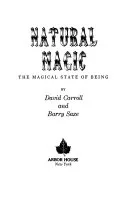
Natural Magic
Carroll and Saxe's *Natural Magic* offers a refreshingly grounded perspective on esoteric practices, particularly for a 1977 publication. Its strength lies in its consistent effort to articulate magic as an extension of natural law, rather than a violation of it. The section detailing the mechanics of sympathetic resonance, for instance, provides a tangible conceptual anchor for otherwise abstract ideas. However, the prose can occasionally feel dense, requiring careful rereading, especially for those new to these concepts. While the book succeeds in presenting a rational framework for magic, its practical exercises, while present, could have benefited from more explicit, step-by-step guidance to fully bridge theory and application. The work's enduring value is its clear articulation of magic as a disciplined art.
📝 Description
74
Published in 1977, Natural Magic frames magic as a manipulation of natural forces, not supernatural intervention.
David Carroll and Barry Saxe's Natural Magic, published in 1977, presents magic as a systematic discipline rooted in observable phenomena and philosophical inquiry. The authors argue that magic is not about invoking supernatural powers but rather about understanding and influencing natural forces and consciousness through focused intent and practice. They aim to demystify these practices by grounding them in a worldview that recognizes subtle energies and the interconnectedness of existence. The book positions the practitioner as an active participant within the natural order, capable of conscious manipulation.
This work is geared toward serious students of esoteric philosophy and practical magic who desire a logical theoretical structure. It will appeal to those who find purely materialistic explanations of reality insufficient but are wary of unproven spiritual doctrines. Readers interested in the history of Western esotericism, comparative religion, and the philosophical foundations of magical systems will find considerable material within its pages. The book is especially useful for individuals aiming to cultivate a disciplined and rational approach to understanding and interacting with the subtle energies of the world.
Emerging in the 1970s, a period of renewed interest in esoteric subjects, Natural Magic connected with a lineage of thinkers seeking to systematize occult knowledge. Influenced by traditions that sought rational frameworks for magic, Carroll and Saxe contributed to a broader cultural questioning of established scientific paradigms. Their approach distinguished itself by offering practical insights alongside theoretical grounding, differentiating it from purely academic examinations of magical traditions and aligning it with a desire for experiential understanding within a structured worldview.
💡 Why Read This Book?
• Understand the theoretical underpinnings of sympathetic magic, as explored in the book's detailed explanations of how like affects like, allowing for a more precise application of ritualistic techniques. • Gain insight into the role of focused intention as a force within natural processes, a concept central to the book's 1977 publication context, offering a practical method for directing personal energy. • Explore the ethical considerations of magical practice as presented by Carroll and Saxe, providing a framework for responsible engagement with subtle energies distinct from sensationalized portrayals.
⭐ Reader Reviews
Honest opinions from readers who have explored this book.
❓ Frequently Asked Questions
What is the core philosophy behind 'Natural Magic' as presented by Carroll and Saxe?
The core philosophy posits magic as the intelligent manipulation of natural forces and consciousness, rather than supernatural intervention. Published in 1977, the book emphasizes understanding subtle energies and interconnectedness within the natural world.
Is 'Natural Magic' suitable for beginners in esoteric studies?
Yes, it serves as a foundational text. It introduces key concepts like sympathetic magic and the power of intention in a structured manner, making it accessible for those new to esoteric philosophy but seeking a coherent theoretical basis.
When was 'Natural Magic' first published and what was the context?
'Natural Magic' was first published in 1977, during a period of renewed interest in esoteric subjects and counter-cultural exploration, offering a more grounded perspective on magic.
Does the book offer practical magical techniques?
Yes, the book discusses practical aspects of magical work, including the use of intention and the principles of sympathetic resonance. It aims to equip readers with a theoretical understanding that can inform practical application.
Who are the authors David Carroll and Barry Saxe?
David Carroll and Barry Saxe are the authors of 'Natural Magic,' a significant work published in 1977 that sought to provide a systematic approach to understanding and practicing natural magic.
What distinguishes 'Natural Magic' from other books on magic published around the same time?
Published in 1977, 'Natural Magic' distinguishes itself by focusing on a rational, philosophical framework for magic, grounding it in natural law and consciousness rather than relying on purely supernatural claims or sensationalism.
🔮 Key Themes & Symbolism
Sympathetic Resonance
The work extensively explores the principle of sympathetic resonance, a core part of natural magic. This concept posits that 'like affects like' and that a connection can be established between two objects or beings through similarity or association. Carroll and Saxe detail how this principle operates not just in magical rituals but also as an underlying mechanism in nature itself. They analyze how practitioners can leverage this energetic connection to influence outcomes, emphasizing the need for clarity of intent and precise application to ensure efficacy. The 1977 publication context highlights its place within a broader esoteric discourse on interconnectedness.
Consciousness as an Active Force
A central tenet of 'Natural Magic' is the active role of consciousness in shaping reality. The authors argue that the focused will and intention of the practitioner are not merely passive mental states but potent forces capable of interacting with the subtle energies of the universe. This perspective challenges purely mechanistic views of the cosmos, proposing that awareness, when properly trained and directed, can influence events. The book guides readers toward developing this mental discipline, viewing it as essential for any meaningful engagement with the principles of natural magic.
The Practitioner's Ethical Framework
Carroll and Saxe place significant emphasis on the ethical responsibilities inherent in the practice of natural magic. They advocate for a disciplined approach that prioritizes self-development and understanding over the pursuit of power for its own sake. The work discusses the potential consequences of misuse and the importance of aligning magical actions with a broader sense of natural harmony and personal integrity. This ethical dimension, prominent in the book's 1977 discourse, serves to distinguish serious magical study from more frivolous or harmful pursuits.
Interconnectedness of All Things
The book posits a universe characterized by profound interconnectedness, where all elements – matter, energy, consciousness – are linked. Natural magic, in this view, is the art of recognizing and working within these intricate webs of relationship. Carroll and Saxe illustrate how seemingly separate phenomena are often connected through subtle energetic currents and correspondences. Understanding this universal network is presented as crucial for effective magical practice, enabling the practitioner to act as a conscious conduit within the larger cosmic flow, a concept resonating with broader esoteric thought.
💬 Memorable Quotes
Direct passages from the work, attributed to the author.
“Magic is the art of using the forces of nature and consciousness to bring about change in accordance with will.”
— This captures the book's core definition, framing magic as a disciplined, intelligent interaction with the world, grounded in both external energies and internal mental states.
“Sympathy provides the channels through which will may flow.”
— This highlights the crucial role of sympathetic resonance, suggesting it acts as the necessary medium or pathway for the practitioner's intention to manifest effects.
“The mind, when trained, becomes a potent instrument of action.”
— This emphasizes the book's focus on mental discipline, presenting consciousness not as a passive observer but as an active, powerful tool in magical practice.
“Every effect has a cause, and magic seeks to understand and utilize these causal chains.”
— This statement grounds magical practice in a principle of causality, suggesting that magic is not arbitrary but operates according to discernible laws, albeit subtle ones.
“True power lies not in coercion, but in alignment with natural principles.”
— This underscores the ethical and philosophical stance of the book, advocating for working in harmony with universal laws rather than attempting to force outcomes unnaturally.
🌙 Esoteric Significance
Tradition
This work fits within the broader Western Esoteric Tradition, particularly drawing from Hermetic and Neoplatonic philosophical currents. It approaches magic not as a deviation from natural law, but as an advanced application of it, echoing the Hermetic principle 'As Above, So Below'. It departs from purely ceremonial magic by emphasizing the psychological and energetic components accessible through disciplined consciousness, aligning with certain modern interpretations of magick that focus on internal transformation and will-power.
Symbolism
While not overtly symbolic in the manner of grimoires, the book's conceptual framework relies on the symbolism of interconnectedness and resonance. The idea of 'sympathy' itself functions symbolically, representing the hidden links and correspondences that bind the universe. The practitioner's 'will' acts as a symbolic force, representing focused consciousness and intention as the active principle that navigates and influences these energetic webs. The natural world is implicitly symbolic, representing a field of observable forces that mirror deeper, unseen realities.
Modern Relevance
Contemporary practitioners of chaos magick and psychological occultism find resonance in Carroll and Saxe’s emphasis on consciousness and will as primary tools. Thinkers and writers exploring the intersection of psychology, physics, and spirituality often reference the foundational ideas presented here regarding subtle energies and intention. The book's grounding of magic in observable principles continues to appeal to those seeking a rational yet non-materialistic framework for esoteric study in the 21st century.
👥 Who Should Read This Book
• Students of Western Esotericism: Individuals seeking to understand the philosophical underpinnings of magical traditions beyond ceremonial rituals, particularly those interested in the intellectual currents of the mid-to-late 20th century. • Aspiring Practitioners of Natural Magic: Those who wish to develop a disciplined and reasoned approach to magic, focusing on the interplay between consciousness, intention, and natural forces as outlined in the book. • Comparative Religion Scholars: Researchers interested in how different belief systems conceptualize the relationship between the human mind, the natural world, and the forces that govern existence, offering a unique perspective from 1977.
📜 Historical Context
Published in 1977, *Natural Magic* emerged during a period of significant cultural and intellectual ferment. The 1970s saw a widespread questioning of rigid scientific materialism, fueled by developments in quantum physics, psychology, and a growing interest in Eastern philosophies and alternative spiritualities. This era witnessed the rise of the New Age movement, which fostered a climate receptive to esoteric ideas. Carroll and Saxe’s work contributed to a lineage of Western esoteric thought that sought to synthesize philosophical inquiry with practical application, drawing implicitly from traditions like Hermeticism and Neoplatonism. It offered a coherent, less dogmatic alternative to some of the more fervent or unstructured spiritual explorations of the time. Unlike purely academic studies that might dissect occultism from an external viewpoint, *Natural Magic* aimed to provide a functional framework for understanding and engaging with these subtle forces, positioning itself within a practical esoteric tradition.
📔 Journal Prompts
The concept of sympathetic resonance: how might similarity or association influence energetic connections in your daily life?
The practitioner's will: identify a situation where focused intention could have altered the outcome.
Causality in magic: analyze a personal experience where an effect seemed disproportionate to its apparent cause.
Alignment with natural principles: reflect on a time you worked 'with the flow' versus against it.
Consciousness as a force: consider how your mental state might subtly influence your environment.
🗂️ Glossary
Sympathetic Resonance
The principle that like affects like, and that a connection can be established between two things through similarity or association, forming a basis for magical influence.
Will
In the context of natural magic, 'will' refers to focused intention and directed consciousness, understood as an active force capable of influencing subtle energies and material reality.
Subtle Energies
Invisible forces or energies that permeate the universe, distinct from gross physical forces, which can be perceived, understood, and manipulated by a trained practitioner.
Correspondences
Relationships and affinities between different elements, symbols, or forces in the universe, forming a network that can be understood and utilized in magical practice.
Natural Magic
A branch of magic that operates by understanding and manipulating the inherent forces and laws of nature and consciousness, rather than invoking supernatural entities.
Intent
The conscious purpose or aim behind an action, particularly a magical one; the directed mental energy that guides the application of will.
Practitioner
An individual who engages in the study and application of natural magic, emphasizing discipline, understanding, and ethical conduct.