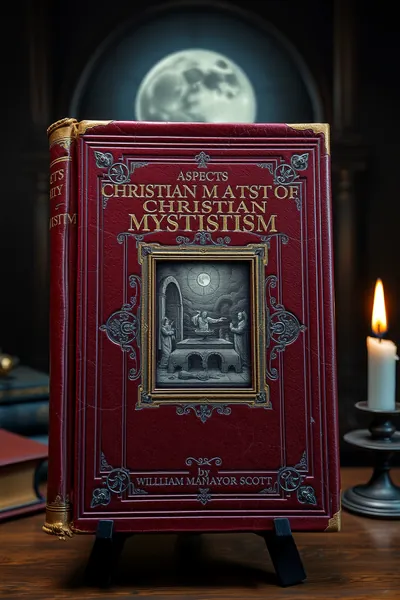
Mystical elements in Mohammed

 82
82

Mystical elements in Mohammed
Archer's "Mystical elements in Mohammed" is a precise, if somewhat dry, exploration of the spiritual underpinnings of Islam's foundational figure. The book's strength lies in its disciplined focus on the mystical aspects, presenting them with academic rigor rather than devotional fervor. Archer’s analysis of the prophetic experience, particularly the moments of divine reception, offers a valuable counterpoint to purely historical or theological readings. However, the prose can be dense, often requiring the reader to hold multiple academic disciplines in mind simultaneously. A particularly insightful section discusses the psychological interpretation of Muhammad's early revelations, a concept that Archer approaches with commendable caution. This is not a book for casual readers; it demands sustained attention and a willingness to engage with complex comparative religious thought. It serves as a solid academic resource for understanding the esoteric dimension of Islamic origins.
📝 Description
82
John Clark Archer's 1980 book examines the spiritual and esoteric dimensions of the Prophet Muhammad's life and teachings.
First published in 1980, John Clark Archer's "Mystical elements in Mohammed" offers a scholarly look at the spiritual and esoteric aspects of the Prophet Muhammad's life. The work goes beyond typical historical accounts to investigate the subtle mystical currents that influenced Islamic tradition from its beginning. Archer analyzes the psychological and spiritual experiences attributed to Muhammad, using comparative mysticism and religious phenomenology as his tools. The book's goal is to frame the prophetic experience not just as a historical event, but as a significant internal transformation with lasting spiritual impact.
This text is mainly for academics studying comparative religion, students of Islamic mysticism like Sufism, and serious practitioners interested in the esoteric origins of world religions. It appeals to those who analyze religious texts and figures with an open mind, looking for deeper psychological and spiritual foundations rather than just socio-political or legal elements. Readers familiar with mysticism or esotericism from other traditions may find Archer's comparative method especially helpful, highlighting connections and differences with concepts they already know.
Published in 1980, Archer's work appeared during a time of growing academic interest in the origins of religious experience and the comparative study of mystical traditions. The late 20th century saw more scholarly attention paid to the subjective aspects of prophecy and religious leadership, moving past purely historical or sociological viewpoints. Archer's book added to a wider academic discussion that aimed to understand figures like Muhammad not only as historical figures but as individuals undergoing intense spiritual states.
💡 Why Read This Book?
• Gain a nuanced understanding of prophetic experience by examining the spiritual states attributed to Muhammad, as detailed in Archer's analysis of his early revelations. • Explore the esoteric dimensions of Islam that often lie beneath the surface of historical accounts, with specific attention to the spiritual significance of locations like the Cave of Hira. • Develop a comparative framework for understanding mysticism by contrasting the esoteric currents within Islam with those of other traditions, as presented in Archer's scholarly approach.
⭐ Reader Reviews
Honest opinions from readers who have explored this book.
❓ Frequently Asked Questions
When was "Mystical elements in Mohammed" first published?
The book "Mystical elements in Mohammed" by John Clark Archer was first published in 1980, placing its academic inquiry within the late 20th-century landscape of religious studies.
What is the primary focus of John Clark Archer's "Mystical elements in Mohammed"?
The book focuses on the spiritual and esoteric dimensions within the life and teachings of the Prophet Muhammad, investigating mystical currents and prophetic experiences.
Does the book discuss Sufism?
Yes, while not exclusively about Sufism, Archer's work engages with the esoteric roots of Islamic tradition, which are central to Sufi thought and practice.
What kind of academic background is helpful for reading this book?
A background in comparative religion, Islamic studies, religious phenomenology, or esoteric traditions would be beneficial for fully appreciating Archer's nuanced arguments.
Are there specific locations mentioned regarding Muhammad's mystical experiences?
Yes, the book specifically discusses the spiritual significance of locations such as the Cave of Hira, where Muhammad is believed to have received early revelations.
Is "Mystical elements in Mohammed" a devotional text or an academic study?
It is primarily an academic study, offering a scholarly examination of mystical elements rather than a devotional or theological treatise.
🔮 Key Themes & Symbolism
Prophetic Revelation and Experience
Archer meticulously dissects the nature of divine revelation as experienced by Muhammad. He examines the spiritual states, visions, and internal transformations that characterized the prophetic call, moving beyond simple historical accounts. The work explores the psychological and phenomenological aspects of receiving divine messages, considering how these profound experiences were integrated into Muhammad's consciousness and articulated to his followers. This theme is central to understanding the genesis of Islam not just as a historical event but as a deeply personal spiritual encounter.
Esoteric Islam and Sufi Roots
The book investigates the subtle, esoteric currents within early Islam that laid the groundwork for later mystical traditions, particularly Sufism. Archer highlights aspects of Muhammad's life and teachings that suggest an inward, spiritual dimension distinct from outward observance. He examines how these foundational mystical elements provided the fertile ground for the development of Sufi thought, focusing on the pursuit of direct spiritual experience and inner purification as core tenets originating from the Prophet's example.
Comparative Mysticism
A significant aspect of Archer's work is its engagement with comparative mysticism. By analyzing Muhammad's spiritual experiences, the book implicitly or explicitly draws parallels and contrasts with mystical phenomena in other religious traditions. This approach allows readers to situate Islamic mysticism within a broader global context, understanding shared patterns of spiritual seeking, divine encounter, and the challenges of articulating ineffable experiences across different cultural and religious frameworks.
The Cave of Hira
The spiritual significance of the Cave of Hira is a recurring motif, representing a place of profound spiritual retreat, contemplation, and the initial reception of divine messages. Archer analyzes this location not merely as a geographical site but as a symbolic crucible for Muhammad's spiritual awakening. The isolation and introspection within the cave are presented as crucial elements in the development of his prophetic consciousness and the genesis of Islamic revelation.
💬 Memorable Quotes
Direct passages from the work, attributed to the author.
“The prophet's contemplative periods in the Cave of Hira were essential for his spiritual development.”
— This interpretation emphasizes the importance of solitude and deep introspection in the formation of Muhammad's prophetic identity and his receptivity to divine inspiration.
“Early Islam contained elements that pointed towards an inward spiritual path.”
— This suggests that beyond the outward legal and social structures of early Islam, there existed a nascent mystical or esoteric dimension focused on inner experience.
“The prophetic experience is distinct from ordinary human consciousness.”
— This points to the idea that the moments of receiving divine messages represent a qualitative difference in consciousness, setting the prophet apart from everyday human experience.
💡 Key Ideas
Editorial paraphrase of the work's core concepts — not direct quotes.
The initial revelations came to Muhammad in a state of inner disturbance and ecstacy.
This paraphrased concept highlights the intense, often disorienting, psychological and spiritual condition associated with the first divine encounters, suggesting prophecy involves profound personal upheaval.
Understanding Muhammad's spiritual states aids in comprehending the genesis of Islamic revelation.
This paraphrased concept frames the study of Muhammad's inner life as crucial for a complete grasp of how Islam as a religious message originated and developed.
🌙 Esoteric Significance
Tradition
Archer's work engages with the esoteric dimensions of Islam, particularly as they relate to the origins of Sufism. While not strictly a Sufi text, it explores the foundational mystical experiences and spiritual states of the Prophet Muhammad, which are considered the ultimate source for Sufi doctrine and practice. It fits within the broader esoteric study of Abrahamic religions, seeking to uncover the hidden spiritual currents that inform their outward forms, akin to how scholars examine Kabbalah within Judaism or Gnostic texts within Christianity.
Symbolism
Key symbols explored include the Cave of Hira, representing isolation, contemplation, and the crucible of divine reception. The concept of "wahi" (revelation) itself functions as a potent symbol of direct divine-human communication, transcending ordinary language. Muhammad's spiritual states, often described as ecstatic or overwhelming, symbolize the transformative power of divine encounter and the challenge of integrating such experiences into human life and community.
Modern Relevance
Contemporary scholars and practitioners interested in the deeper spiritual currents of Islam, particularly within Sufism and Islamic psychology, continue to draw on foundational analyses like Archer's. His work provides a historical and academic basis for understanding the esoteric lineage of Islamic thought. Thinkers exploring the phenomenology of religious experience or the comparative study of prophetic figures can find valuable insights. It also informs modern discussions on the balance between exoteric practice and esoteric understanding within religious traditions.
👥 Who Should Read This Book
• Students of comparative religion: To gain a deeper understanding of the esoteric dimensions within one of the world's major faiths and how they compare to other mystical traditions. • Aspiring scholars of Islamic studies: To explore a less common, yet significant, academic perspective that focuses on the spiritual and psychological aspects of Muhammad's prophethood. • Practitioners of esoteric traditions: To see how mystical concepts and prophetic experiences are analyzed within an Islamic context, offering cross-traditional insights.
📜 Historical Context
Published in 1980, John Clark Archer's "Mystical elements in Mohammed" emerged within a scholarly climate that was increasingly open to exploring the subjective and esoteric dimensions of religious traditions. The late 20th century saw a flourishing of comparative religion studies, with scholars like Huston Smith advocating for a deeper appreciation of the mystical core of world faiths. Archer's work contributed to this by examining the foundational figure of Islam through a lens that acknowledged spiritual experience, paralleling contemporary scholarship on figures like Plotinus and the Neoplatonic influences on Western esotericism. While mainstream Islamic scholarship often focused on historical and legal aspects, Archer's approach aligned with burgeoning interest in Sufism and the phenomenological study of religion, offering a counter-narrative to purely rationalistic interpretations.
📔 Journal Prompts
The spiritual significance of the Cave of Hira: Reflect on its role as a site of revelation.
Muhammad's initial experiences of divine inspiration: Consider the nature of ecstatic states.
The tension between outward observance and inward spiritual paths in early Islam.
Comparative analysis of prophetic consciousness across different traditions.
The psychological interpretation of mystical encounters as presented by Archer.
🗂️ Glossary
Wahi
Arabic term for divine revelation, specifically the revelations received by Muhammad that form the Quran. It signifies direct communication from God.
Prophetic experience
The subjective and objective phenomena associated with being a prophet, including visions, divine inspiration, and the reception of sacred messages.
Cave of Hira
A cave in the mountains near Mecca where Muhammad is said to have meditated and received his first revelations from God through the Angel Gabriel.
Ecstatic states
Altered states of consciousness characterized by intense emotion, spiritual rapture, or a perceived union with the divine, often associated with mystical experiences.
Esoteric Islam
The inner, mystical, or hidden dimensions of Islam, often associated with Sufism, focusing on direct spiritual experience and inner transformation.
Phenomenology of religion
The study of religious experiences and phenomena as they appear to consciousness, focusing on their structure and meaning without necessarily validating their truth claims.
Comparative mysticism
The study that compares mystical beliefs, practices, and experiences across different religious and cultural traditions.
🔮 Readers Also Liked
Browse all →







More Free Mysticism & Contemplation Books
View all →