Mystic in the Graveyard

 74
74

Mystic in the Graveyard
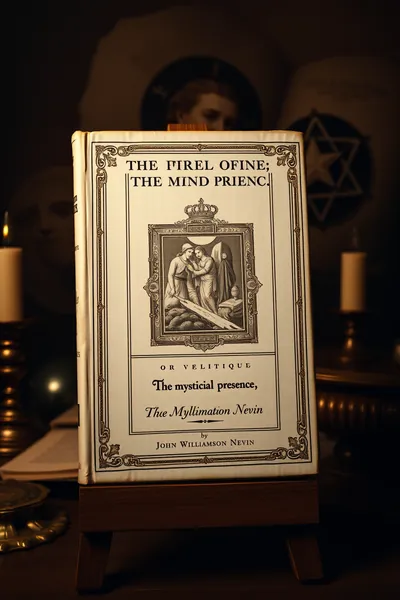
Peter Denbo Haskins’ Mystic in the Graveyard offers a peculiar and often compelling examination of liminal spaces and the entities that might inhabit them. The author’s strength lies in his ability to ground abstract spiritual concepts in tangible, albeit unsettling, imagery, particularly when discussing the energetic residue of human passing. A significant passage detailing the author's interpretation of graveyard symbolism as a nexus of earthly and ethereal energies is particularly striking. However, the work occasionally suffers from a somewhat dense prose style that can obscure the very clarity it seeks to impart. The first edition from 2006, while foundational, could benefit from a more robust index for easier reference to its numerous concepts. Ultimately, Haskins provides a unique, if sometimes challenging, perspective on the spectral and the sacred.
📝 Description
74
Peter Denbo Haskins's 2006 book, Mystic in the Graveyard, examines how energetic imprints shape existence.
Mystic in the Graveyard, by Peter Denbo Haskins, was first published in 2006. The book considers esoteric concepts and practices, looking at how material and spiritual worlds connect. Haskins draws on different mystical traditions to explain the hidden forces that influence life. The writing aims to make complex ideas clear for the reader.
This work is for people interested in occult philosophy, comparative religion, and deeper aspects of human consciousness. It suits those wanting to understand more than standard metaphysics and who want to decode the symbolic language of the sacred. Readers who like serious thought combined with spiritual seeking will find value in this text. It emerged in 2006, a time of renewed interest in esoteric studies, influenced by New Age ideas and wider access to spiritual teachings online. The early 21st century saw occultism become more specialized, with authors like Haskins contributing to a more scholarly approach. This period moved away from the general spiritualism of the late 20th century, requiring a closer look at older texts and traditions.
Published in 2006, Mystic in the Graveyard appeared during a period of increased attention to esoteric studies. This era followed the rise of New Age thought and the internet's ability to spread diverse spiritual information. The early 21st century saw occultism fragment into more specialized areas. Authors such as Haskins contributed to a more detailed, academic style of occult writing. This time marked a shift from the broader spiritualism common in the late 20th century, emphasizing a deeper study of historical texts and practices.
💡 Why Read This Book?
• Gain a practical framework for understanding the energetic signatures of significant locations, as explored through Haskins' analysis of graveyard phenomena. • Learn specific methods for intentional energetic engagement, drawing from the techniques detailed in the book for interacting with subtle realms. • Appreciate the symbolic depth of funerary landscapes, understanding them not just as places of rest but as intersections of the material and spiritual, as presented in the 2006 edition.
⭐ Reader Reviews
Honest opinions from readers who have explored this book.
❓ Frequently Asked Questions
What is the primary focus of Peter Denbo Haskins' "Mystic in the Graveyard"?
The book primarily focuses on the esoteric significance of graveyards and similar liminal spaces, exploring concepts of energetic imprints, spiritual entities, and the symbolic interplay between life and death within mystical traditions.
When was "Mystic in the Graveyard" first published?
The first edition of "Mystic in the Graveyard" by Peter Denbo Haskins was published in 2006.
Does the book offer practical exercises for readers?
Yes, the work includes guidance on practical applications of esoteric principles, focusing on intention and awareness for interacting with subtle dimensions and understanding energetic phenomena.
What kind of esoteric traditions does Haskins draw upon?
Haskins synthesizes ideas from various mystical traditions, examining concepts related to the energetic and spiritual aspects of existence, often touching upon themes of death, transition, and unseen forces.
Is "Mystic in the Graveyard" suitable for beginners in esoteric studies?
While accessible, the book delves into complex metaphysical ideas. Beginners might benefit from prior exposure to esoteric concepts, but those with a serious interest and a willingness to engage deeply will find it rewarding.
What makes the graveyard a significant setting in the book's exploration?
The graveyard is presented as a unique nexus point where the veil between the material and spiritual is considered thin, holding energetic residues and symbolic power related to transition and the afterlife.
🔮 Key Themes & Symbolism
Energetic Imprints and Residue
The book posits that significant events and strong emotions, particularly those associated with death and finality, leave distinct energetic imprints on physical locations like graveyards. Haskins explores how these residues can be perceived or interacted with, suggesting a form of spiritual ecology where the past actively influences the present environment. This concept extends to understanding how collective human experiences can saturate a place with a specific vibrational quality, accessible to those with developed sensitivity.
Liminality and Thresholds
Graveyards are presented as prime examples of liminal spaces – thresholds between worlds, states of being, and different phases of existence. Haskins examines how these 'in-between' places function as conduits for spiritual energies and entities, acting as natural portals. The work explores the symbolic architecture of cemeteries, from gates to tombs, as physical manifestations of these conceptual thresholds, inviting contemplation on transition and transformation.
The Symbolic Range of Death
Beyond mere physical burial sites, Haskins interprets graveyards as profound symbolic landscapes. They represent not just the end of physical life but also the ongoing processes of decay, regeneration, and the journey of the soul. The book analyzes common funerary symbols and practices through an esoteric lens, revealing deeper meanings related to mortality, legacy, and the cyclical nature of existence within various spiritual frameworks.
Consciousness and Perception
A central theme is the role of human consciousness in perceiving and interacting with the esoteric dimensions of graveyards. Haskins argues that focused intention, emotional state, and developed psychic sensitivity are crucial for experiencing the subtle energies and entities present. The book encourages a disciplined approach to awareness, suggesting that our internal state shapes our external spiritual encounters and understanding of these charged environments.
💬 Memorable Quotes
Direct passages from the work, attributed to the author.
“The stones themselves breathe with the weight of memory.”
— This phrase captures the essence of the book's exploration of energetic imprints, suggesting that inanimate objects in places of significance absorb and retain the emotional and psychic residue of past events and lives.
“Graveyards are not merely archives of the departed, but active conduits.”
— This interpretation highlights the book's central thesis that cemeteries are more than passive resting places; they are dynamic thresholds where spiritual energies and entities can flow and be accessed.
“Silence here is a language, spoken by the earth itself.”
— This conveys the idea that the profound quietude of a graveyard is not an absence of sound but a presence of a different kind of communication, one that speaks to the spiritual observer.
“The veil thins where life's ultimate threshold is marked.”
— This concept points to the belief that places associated with death, like cemeteries, are sites where the separation between the physical and spiritual realms is reduced, allowing for greater potential interaction.
“Intent shapes the encounter in these hallowed, haunted grounds.”
— This emphasizes the crucial role of the practitioner's own mental and spiritual state in determining the nature of their experiences within a graveyard setting.
🌙 Esoteric Significance
Tradition
The work draws implicitly from Western Hermeticism and broader animistic traditions, focusing on the concept of energetic imprints and the sentience of place. It departs from purely ritualistic approaches by emphasizing the inherent spiritual qualities of specific geographical locations, particularly those associated with death and transition. It aligns with traditions that view the physical world as imbued with subtle energies and spiritual presences, accessible through focused perception and intention.
Symbolism
Key symbols include the gravestone, representing finality and memory; the earth, as a medium for energetic residue and regeneration; and the gate, symbolizing transition between realms. The graveyard itself functions as a potent symbol of the liminal, a space where the boundaries between the living and the dead, the seen and unseen, are blurred, inviting contemplation on mortality and spiritual continuity.
Modern Relevance
Contemporary practitioners of psychogeography, paranormal investigation with a spiritual focus, and those exploring land-based spirituality often find resonance in Haskins' work. His ideas on energetic residue and the spiritual significance of place inform modern approaches to understanding haunted locations and sacred sites, connecting historical esoteric concepts to current interests in environmental consciousness and subtle energy fields.
👥 Who Should Read This Book
• Students of comparative religion and folklore seeking to understand the esoteric interpretations of funerary sites and death rituals. • Practicing occultists interested in exploring the energetic properties of specific locations and developing techniques for engaging with liminal spaces. • Individuals drawn to psychogeography and the study of place-based spirituality who wish to deepen their understanding of how environments hold spiritual significance.
📜 Historical Context
Published in 2006, Peter Denbo Haskins' "Mystic in the Graveyard" arrived at a time when esoteric studies were increasingly moving beyond generalized New Age spirituality towards more specialized and historically grounded explorations. The early 21st century saw a proliferation of online resources and communities dedicated to diverse occult traditions, fostering a climate where niche subjects like the spiritual ecology of burial sites could gain traction. Contemporaries such as Lon Milo DuQuette were exploring similar themes of the uncanny and the occult in everyday life, though often with a different stylistic approach. Haskins' work contributed to a growing academic interest in occultism, positioning it as a subject worthy of serious, albeit unconventional, inquiry. The book emerged in a landscape where popular occultism was both expanding and fragmenting, with authors like Haskins carving out specific analytical niches.
📔 Journal Prompts
The energetic imprints of specific locations like graveyards.
Symbolic interpretation of the graveyard's architecture.
Personal encounters with liminal spaces and their perceived inhabitants.
The role of intention in spiritual perception.
Connecting the symbolism of death and rebirth in esoteric traditions.
🗂️ Glossary
Energetic Imprint
The residual energetic or psychic signature left behind on a place or object due to significant events, strong emotions, or prolonged presence of living beings or entities.
Liminal Space
A transitional or in-between place or state, often characterized by ambiguity and a perceived thinning of the veil between different realities or dimensions, such as a graveyard.
Subtle Dimensions
Non-physical realms or planes of existence that coexist with the material world, often accessed through altered states of consciousness, focused intention, or spiritual practices.
Psychic Residue
Similar to energetic imprint, this term refers to the lingering psychic energy or emotional elements of past events or individuals within a specific location.
Threshold
A point of entry or transition, both physically and metaphorically, representing a boundary between different states, places, or levels of consciousness.
Sentience of Place
The concept that certain locations possess a form of consciousness or awareness, often imbued with the history and energies of the beings and events associated with them.
Vibrational Quality
The characteristic energetic frequency or 'feel' of a place, person, or object, influenced by its history, composition, and the energies it has absorbed or emanates.
🔮 Readers Also Liked
Browse all →






More Free Mysticism & Contemplation Books
View all →