Morals and dogma of the Ancient and accepted Scottish rite of freemasonry

 72
72

Morals and dogma of the Ancient and accepted Scottish rite of freemasonry
Albert Pike's "Morals and Dogma" is an imposing edifice of Masonic philosophy, a dense compendium that attempts to unify a spectrum of ancient thought under the banner of the Scottish Rite. Its strength lies in the sheer breadth of its scholarship, drawing connections between disparate traditions with an earnest belief in a singular, underlying spiritual truth. Pike's detailed explication of the 14th degree's "Perfect Architect" concept, for instance, reveals a sophisticated engagement with symbolism. However, the book's primary limitation is its exhaustive density; it can feel less like a guide and more like a lecture delivered from a vast, sometimes overwhelming, library. The prose, while learned, often requires significant effort to parse. For the dedicated Mason or scholar of esotericism, it offers unparalleled depth, but its accessibility remains a significant hurdle. It is an essential, albeit challenging, reference for understanding the philosophical architecture of the Scottish Rite.
📝 Description
72
Albert Pike published 'Morals and Dogma' in 1905, detailing the Scottish Rite's philosophical teachings.
Albert Pike's "Morals and Dogma" serves as a thorough explanation of the moral, ethical, and philosophical ideas within the Ancient and Accepted Scottish Rite of Freemasonry's degrees. Published in 1905, it is not a guide to rituals but a detailed commentary on the symbolic language and allegorical narratives of the Rite. Pike drew from a wide range of philosophical traditions, ancient religions, and esoteric thought to create a cohesive framework.
The book is mainly for Master Masons interested in the higher degrees of the Scottish Rite. However, its extensive coverage also makes it useful for students of comparative religion, Western esotericism, and philosophical ethics. Readers who enjoy close textual analysis and want to understand the historical roots of Masonic thought will find value here. A background in philosophy or religious studies is helpful for fully appreciating its complex arguments.
Published in 1905, "Morals and Dogma" reflects the late 19th-century interest in Orientalism, Neoplatonism, and Gnosticism. Pike integrated these influences with other esoteric traditions to build a philosophical structure for Freemasonry. The work aimed to connect Masonic practices to a broader history of spiritual and philosophical inquiry. Its adoption within the Scottish Rite highlights its significance in formalizing the intellectual content of its higher degrees.
💡 Why Read This Book?
• Gain a comprehensive understanding of the philosophical underpinnings of the Scottish Rite's degrees, particularly the symbolism explored in the 14th degree, "Grand Elect Mason." • Explore Pike's synthesis of diverse ancient traditions, including Brahmanic and Kabbalistic thought, to grasp his unique interpretation of universal spiritual principles. • Analyze the moral and ethical frameworks presented for each degree, such as the concept of the "Grand Architect" as detailed throughout the text, to refine personal virtue and understanding.
⭐ Reader Reviews
Honest opinions from readers who have explored this book.
❓ Frequently Asked Questions
When was "Morals and Dogma of the Ancient and Accepted Scottish Rite of Freemasonry" first published?
Albert Pike's "Morals and Dogma" was first published in 1905. It was compiled based on his extensive writings and lectures related to the Scottish Rite degrees.
Is "Morals and Dogma" a book of Masonic rituals?
No, "Morals and Dogma" is not a ritual book. It serves as a philosophical and moral explication of the symbolic teachings and allegories found within the Scottish Rite degrees.
What philosophical traditions does Albert Pike draw upon in "Morals and Dogma"?
Pike synthesizes a wide range of traditions, including Neoplatonism, Hermeticism, Kabbalah, Gnosticism, Hinduism (Brahmanism), Buddhism, and Zoroastrianism, among others.
Who is the primary audience for "Morals and Dogma"?
The primary intended audience is Master Masons of the Scottish Rite. However, it is also valuable for students of esotericism, comparative religion, and Masonic philosophy.
Is "Morals and Dogma" available online for free?
Yes, due to its age and public domain status, "Morals and Dogma" by Albert Pike is widely available to read online for free through various archival and Masonic websites.
What does the concept of the 'Grand Architect' represent in Pike's work?
In "Morals and Dogma," the 'Grand Architect' represents the Supreme Being or Creator, a universal concept of divinity that Pike draws from various religious and philosophical traditions to unify Masonic thought.
🔮 Key Themes & Symbolism
Symbolism of Ascent
The work meticulously decodes the symbolic language of the Scottish Rite degrees, portraying them as stages in a spiritual and intellectual ascent. Pike interprets symbols like the ladder, the compass, and the square not merely as tools but as allegorical representations of moral development and the pursuit of divine knowledge. This symbolic journey mirrors ancient initiatory traditions, guiding the aspirant from material understanding towards a more profound comprehension of universal truths and the divine order.
Universalism in Masonry
Pike champions a view of Freemasonry as a repository of universal wisdom, drawing parallels between its teachings and the core tenets of numerous world religions and philosophical systems. He demonstrates how concepts like brotherhood, justice, and the search for truth are echoed in Brahmanic scriptures, Buddhist doctrines, and Kabbalistic mysticism. This approach positions the Scottish Rite not as a singular religion, but as a framework for understanding the common spiritual heritage of humanity.
Moral and Ethical Development
Central to "Morals and Dogma" is the emphasis on personal virtue and moral cultivation. Pike expounds upon the ethical responsibilities of Masons, linking Masonic degrees to the development of character, the subjugation of base passions, and the active practice of benevolence. The work presents a structured approach to self-improvement, where each degree offers lessons designed to refine the aspirant's moral compass and prepare them for a life of service and wisdom.
The Nature of Divinity
Pike extensively explores the concept of the Grand Architect of the Universe, synthesizing various theological and philosophical interpretations of the divine. He moves beyond anthropomorphic conceptions to discuss the abstract principles of a supreme, intelligent force that governs creation. This exploration draws from Gnostic ideas of emanation and Kabbalistic concepts of the Godhead, seeking to present a complex understanding of the ultimate source of all existence.
💬 Memorable Quotes
Direct passages from the work, attributed to the author.
“Masonry, brooded over and religio-philosophically examined, is the universal dogma, the symbol of the human race.”
— This statement captures Pike's belief that Masonic principles are not exclusive but represent a fundamental, shared human understanding of morality, spirituality, and the cosmos, accessible across cultures and time.
“The Book of the Law is the first symbol of the truth of Masonry.”
— Pike suggests that the sacred texts and allegorical narratives within Masonry, such as the Volume of the Sacred Law, serve as foundational allegories that guide Masons toward understanding deeper spiritual and ethical truths.
“To be a Mason is to be a philosopher.”
— This highlights the intellectual and philosophical nature of Freemasonry as Pike understood it, emphasizing the pursuit of wisdom, critical thinking, and understanding the underlying principles of existence as integral to the Masonic path.
“The symbols of Masonry are the language of the soul.”
— This interpretation suggests that the visual and ritualistic symbols used in Masonry are not mere decorations but convey profound spiritual and psychological meanings that communicate directly to the inner self.
“Every life is a page in the great book of the universe.”
— This poetic notion frames individual existence as a significant contribution to the cosmic narrative, implying that each life, with its experiences and lessons, adds to the grand unfolding of universal knowledge and purpose.
🌙 Esoteric Significance
Tradition
"Morals and Dogma" is deeply rooted in Western Esotericism, particularly drawing from Hermeticism, Neoplatonism, and Kabbalah, while also incorporating elements of Gnosticism and Eastern philosophies. Pike positions the Scottish Rite as a continuation of an ancient, perennial wisdom tradition, aiming to synthesize its teachings with these broader esoteric currents. The work seeks to reveal the underlying unity of spiritual truths found across diverse cultures and historical epochs, framing Masonic initiation as a path toward Gnosis.
Symbolism
Key symbols explicated include the Square and Compasses, representing the reconciliation of the material (square) and spiritual (compasses) realms, and the pursuit of moral rectitude. The Blazing Star (Pentagram) is explored as a symbol of the divine human, the microcosm reflecting the macrocosm, and a clear source of wisdom. The Double-Headed Eagle, prominent in the Scottish Rite, is interpreted through various lenses, often relating to duality, sovereignty, and the union of opposing forces necessary for spiritual advancement.
Modern Relevance
Contemporary esotericists and comparative religion scholars continue to engage with "Morals and Dogma." Modern Hermetic orders and Masonic study groups often use it as a primary text for understanding the philosophical dimensions of ritual. Thinkers exploring the concept of a perennial philosophy and the syncretic nature of Western esotericism frequently cite Pike's work as a significant historical attempt to codify and disseminate these ideas within a structured initiatory framework.
👥 Who Should Read This Book
• Master Masons seeking a deep philosophical and symbolic understanding of the Scottish Rite degrees beyond ritualistic performance. • Students of Western Esotericism interested in how figures like Albert Pike synthesized Neoplatonism, Kabbalah, and Hermeticism into initiatory systems. • Researchers of comparative religion and philosophy examining the historical connections drawn between Masonic teachings and ancient world traditions.
📜 Historical Context
Albert Pike's "Morals and Dogma," published in 1905, emerged at the zenith of late 19th-century esoteric revivalism. It was a period marked by widespread interest in comparative mythology, ancient religions, and occult philosophy, influenced by scholars like James George Frazer and esotericists like Helena Blavatsky. Pike, a prominent figure in American Freemasonry, sought to provide a comprehensive philosophical justification for the Scottish Rite, integrating diverse traditions. He drew heavily on Neoplatonism and Hermeticism, as well as Kabbalistic and Gnostic thought, attempting to demonstrate a continuity of ancient wisdom. While widely adopted, Pike's synthesis was not without its critics; some contemporaries found his interpretations overly speculative, and his extensive referencing of non-Masonic esoteric traditions sometimes overshadowed the Rite's own distinctiveness. The work represented a departure from earlier, more purely ritualistic interpretations of Masonic degrees.
📔 Journal Prompts
The concept of the "Grand Architect" as presented across different degrees prompts reflection on the nature of ultimate reality.
Reflection on the symbolism of the Blazing Star and its representation of divine human potential.
Consider the ethical frameworks presented for the 14th degree, "Grand Elect Mason," in relation to personal integrity.
The interpretation of Masonic symbols as a 'language of the soul' invites contemplation of inner intuitive understanding.
How does Pike's synthesis of Brahmanic and Kabbalistic ideas inform your perspective on universal spiritual truths?
🗂️ Glossary
Grand Architect of the Universe
A term used in Freemasonry to represent the Supreme Being or Creator, interpreted by Pike through various philosophical and religious traditions as the divine principle underlying all existence.
Neoplatonism
A philosophical school originating in the 3rd century CE, heavily influenced by Plato, emphasizing the existence of an ultimate, transcendent reality (the One) from which all existence emanates.
Kabbalah
A complex system of Jewish mysticism that explores the nature of God, the creation of the universe, and the relationship between the divine and the human through symbolic interpretation of scripture and esoteric doctrines.
Hermeticism
A philosophical and religious tradition based on writings attributed to Hermes Trismegistus, emphasizing the interconnectedness of all things, the correspondence between the microcosm and macrocosm, and the pursuit of divine knowledge (Gnosis).
Gnosticism
An ancient religious movement characterized by the belief that salvation is achieved through secret knowledge (gnosis) of the divine, often involving a dualistic worldview and complex cosmologies.
The Perennial Philosophy
The idea, popularized by Aldous Huxley, that all major religious traditions share a common, underlying spiritual truth or core doctrine, which Pike sought to demonstrate within Freemasonry.
Initiation
A process of formal admission into a group or society, often involving ritualistic ceremonies and the imparting of knowledge or status, particularly significant in esoteric and religious contexts.
🔮 Readers Also Liked
Browse all →


![The Freemasons' quarterly (magazine and) review [afterw.] The Freemasons ...](/img/thumb/the-freemasons-quarterly-magazine-and-review-afterw-the-freemasons-freemasons-magazine-ia.webp)



More by Albert Pike
All books →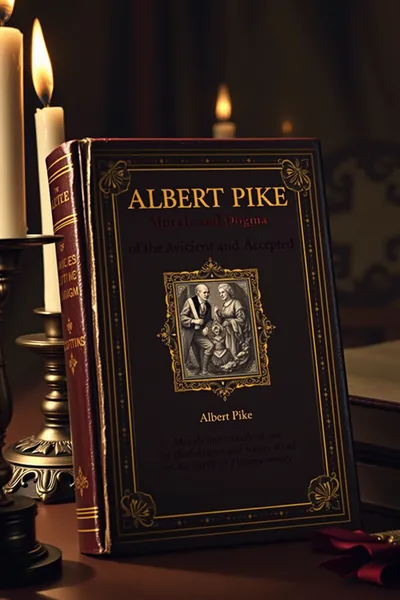





More Free Freemasonry & Secret Societies Books
View all →