Albert Pike
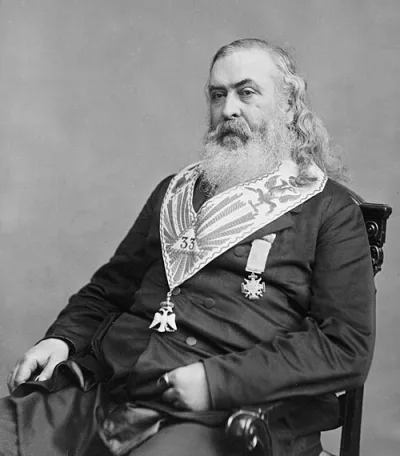
Albert Pike was a prolific American author, Confederate general, and influential Freemason known for his work in esoteric philosophy.
Albert Pike (1809-1891) was a multifaceted American figure, known for his roles as an author, poet, orator, lawyer, jurist, and a Confederate general during the Civil War. He held significant positions in Freemasonry, notably as the Sovereign Grand Commander of the Scottish Rite, Southern Jurisdiction, for over three decades. Pike's early life involved extensive self-education and travels, eventually leading him to settle in Arkansas where he established a career in law and journalism. He was a vocal proponent of states' rights and advocated for Native American tribes in legal claims. His military service included participation in the Mexican-American War and command in the Indian Territory during the Civil War, though he faced conflicts with superiors. Pike's literary contributions spanned poetry and legal writings, with his Masonic works, particularly 'Morals and Dogma,' becoming highly influential within the organization.
Literary and Legal Career
Albert Pike's early career involved teaching and journalism, where he wrote under the pseudonym 'Casca' for the Little Rock Arkansas Advocate, promoting the Whig Party. After marrying, he purchased the newspaper and later pursued law, being admitted to the bar in 1837. He became a respected lawyer, even gaining permission to practice before the U.S. Supreme Court. Pike also dedicated significant effort to representing Native American tribes, such as the Creek, Choctaw, and Chickasaw, in land claims against the federal government. His legal expertise extended to writing on various legal subjects, including 'The Arkansas Form Book,' a guide for lawyers. He also championed the idea of a transcontinental railroad, securing a charter for a project and moving to New Orleans to further this endeavor.
Freemasonry and Esoteric Influence
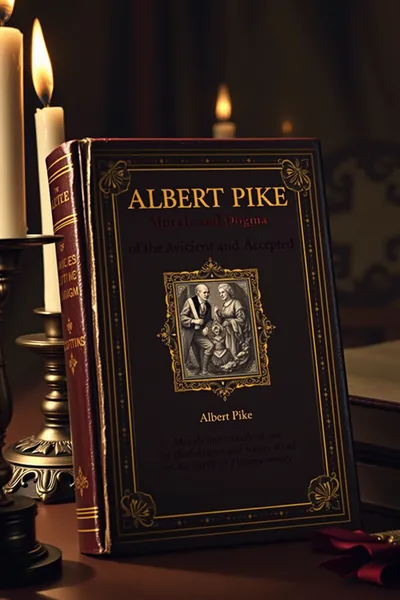
Pike became deeply involved in Freemasonry, joining in 1840 and rising to become the Sovereign Grand Commander of the Scottish Rite, Southern Jurisdiction, in 1859, a position he held until his death. He devoted considerable time to developing the order's rituals and authored 'Morals and Dogma of the Ancient and Accepted Scottish Rite of Freemasonry' in 1871, a foundational text that significantly contributed to the growth of the Scottish Rite in the 19th century. His scholarly pursuits also led him to research and write on topics like Indo-Aryan deities and worship, as evidenced in his treatise on the Rig-Veda. Pike is still regarded as a preeminent and influential figure within Freemasonry, particularly in the Southern Jurisdiction.
Military Service and Political Stance
During the Mexican-American War, Pike served as a captain in the Arkansas Mounted Infantry, participating in the Battle of Buena Vista. Post-war, he returned to law and moved to New Orleans, though he later returned to Arkansas. Politically, Pike was an early member of the Know Nothing Party but left when it failed to adopt a pro-slavery stance. He also signed a circular advocating for the expulsion of free Black individuals from Arkansas. His views on states' rights and secession were clearly articulated in his writings, including the pamphlet 'State or Province, Bond or Free?' During the American Civil War, he served as a Confederate brigadier general, negotiating treaties with Native American nations and commanding troops in the Indian Territory, though he experienced conflicts with his superior officers.
Key Ideas
- Advocacy for states' rights and Southern secession
- Development and codification of Scottish Rite Masonic rituals and philosophy
- Legal representation of Native American tribes
- Promotion of a transcontinental railroad
Books by Albert Pike
12 free public domain books · Read online or download