Modest Enquiry Into the Nature of Witchcraft
 83
83

Modest Enquiry Into the Nature of Witchcraft
Reverend John Hale's "Modest Enquiry Into the Nature of Witchcraft" is a crucial, if somber, primary source from the Salem Witch Trials. Unlike many contemporary accounts that sensationalize or rigidly adhere to theological dogma, Hale's work demonstrates a commendable, albeit late-stage, intellectual evolution. His eyewitness status grants the text an immediate authority, detailing the events and the people involved with a clarity that is both arresting and disturbing. The book's strength lies in Hale's attempt to reconcile his faith with the bewildering reality of the trials, moving towards a conclusion that Satan, not the accused women, was the primary architect of the chaos. A notable limitation is the inherent bias of a clergyman deeply embedded in the very system he is critiquing; while he shifts his focus, the underlying belief in diabolical influence remains firm. The passage where Hale reflects on his own prior participation, grappling with the notion that spectral evidence might be Satan's own deception, is particularly poignant. Hale's "Enquiry" offers a valuable, complex window into one man's struggle to comprehend and explain an unprecedented crisis of faith and justice.
📝 Description
83
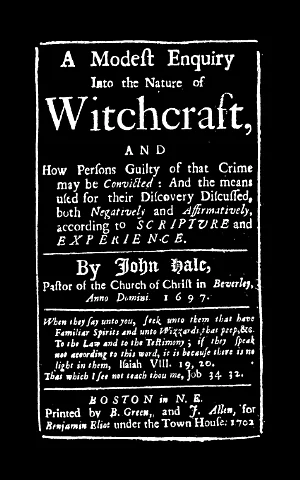
Reverend John Hale published 'A Modest Enquiry Into the Nature of Witchcraft' in 1702.
Originally printed in 1702, John Hale's "A Modest Enquiry Into the Nature of Witchcraft" is not a spellbook, but a firsthand account and theological interpretation of the Salem Village witchcraft trials. Hale, a minister who participated in the proceedings, shares his perspective on the events, the accused individuals, and those who claimed to be afflicted. He sought to identify the true source of the perceived malevolence during this tumultuous period.
The work directly addresses complex questions surrounding spectral evidence, the concept of diabolical influence, and the extent of human agency when confronted with perceived supernatural attacks. Hale's perspective offers insight into the mindset of a clergyman trying to reconcile his faith with the societal and spiritual upheaval of the time. It provides a primary source view from within one of early America's most infamous moral panics.
Published shortly after the 1692-1693 Salem Witch Trials, Hale's "Modest Enquiry" emerged from a climate of intense religious conviction and anxiety about supernatural threats in colonial New England. Unlike purely accusatory texts, Hale engaged with the widespread belief in witchcraft but reoriented the explanation. He argued that the afflictions stemmed from Satan's direct intervention rather than the inherent magical power of the accused. This theological framing situates his work within the broader historical discourse on demonology and the perceived spiritual warfare of the era, reflecting a specific Puritan understanding of the Devil's active role in the world.
💡 Why Read This Book?
• Gain direct insight into the Salem Witch Trials from a clergyman who witnessed them firsthand, understanding Reverend John Hale's evolving perspective on spectral evidence and diabolical influence. • Analyze the theological arguments of the late 17th century, specifically how Hale sought to differentiate Satan's direct actions from the alleged powers of the accused witches. • Examine the historical context of colonial Puritanism and its anxieties, learning how societal pressures and religious beliefs shaped the response to accusations of witchcraft in 1692.
⭐ Reader Reviews
Honest opinions from readers who have explored this book.
❓ Frequently Asked Questions
When was John Hale's "Modest Enquiry Into the Nature of Witchcraft" first published?
The original publication date for Reverend John Hale's "Modest Enquiry" was 1702. This edition allows readers to access his firsthand account and theological interpretation shortly after the events of the Salem Village witchcraft trials.
What was Reverend John Hale's role in the Salem Witch Trials?
Reverend John Hale was a minister in Beverly, Massachusetts, and a participant in the Salem Village witchcraft trials. He served as a magistrate and offered theological guidance during the proceedings, later writing his "Modest Enquiry" to reflect on the events.
What is the main argument of "Modest Enquiry Into the Nature of Witchcraft"?
Hale's central argument is that Satan, rather than the accused individuals, was the primary force manipulating objects and spectral evidence to afflict the accusers during the Salem trials. He sought to explain the events through diabolical influence.
Did John Hale believe in witchcraft?
Yes, John Hale firmly believed in the existence of witchcraft and the reality of demonic influence. However, his "Modest Enquiry" reflects a shift in his understanding, suggesting that the Devil was the true perpetrator using illusions, rather than the accused witches wielding inherent power.
Is "Modest Enquiry" a guide to performing witchcraft?
No, "Modest Enquiry" is not a grimoire or a guide to practicing witchcraft. It is a theological treatise and eyewitness account of the Salem Witch Trials, written by a clergyman attempting to understand and explain the perceived supernatural events.
What does the term 'spectral evidence' refer to in Hale's work?
Spectral evidence, as discussed by Hale, refers to testimony about visions or apparitions of the accused tormenting the accusers, often in dreams or visions. Hale grew skeptical of its reliability during the 1692 trials.
🔮 Key Themes & Symbolism
Diabolical Influence
Hale grapples extensively with the concept of diabolical influence, a central to Puritan theology. He argues that the afflictions seen in the Salem trials were not primarily the work of the accused witches, but rather the direct machinations of Satan. This theme explores how the Devil could manipulate both the physical world and human perception through spectral illusions and possession, aiming to sow discord and undermine the Puritan community. Hale's "Enquiry" attempts to delineate the boundaries of Satan's power and the nature of his deception in the context of the trials.
Spectral Evidence
A central concern in "Modest Enquiry" is the validity and theological implications of spectral evidence. This type of testimony, where accusers claimed to see the specter or apparition of the accused tormenting them, was a primary basis for many arrests and convictions in Salem. Reverend Hale, initially involved in accepting such evidence, later expresses profound doubts about its reliability. He questions whether Satan himself could be using these spectral visions as a tool of deception, thereby leading to the condemnation of innocent individuals. His evolving perspective on spectral evidence is a key element of his narrative.
Theological Interpretation
The work is fundamentally a theological interpretation of a societal crisis. Hale, as a minister, applies Puritan theological frameworks to understand the events of 1692. He seeks divine explanations for the perceived outbreak of witchcraft, ultimately concluding that it was a test of faith and a manifestation of spiritual warfare. His interpretation aims to reaffirm God's sovereignty while explaining the presence of evil through the lens of Satanic strategy and human fallibility. The "Enquiry" reflects a broader effort within the community to make sense of the trials within their religious worldview.
Eyewitness Testimony
As an eyewitness, Hale provides a rare, albeit subjective, firsthand account of the Salem Village witchcraft trials. His narrative offers details about the proceedings, the accusers, the accused, and the atmosphere of fear and suspicion that permeated the community. This theme underscores the importance of primary source material in understanding historical events. Hale's personal involvement and subsequent reflection lend a unique perspective, capturing the human element of the tragedy and the intellectual struggle to comprehend its causes and consequences.
💬 Memorable Quotes
Direct passages from the work, attributed to the author.
“I do not remember that ever I saw any of the accused Persons in Specter, or Vision, or Dream, and I have been often gazing at them, and looking on them.”
— This reflects Hale's growing skepticism towards spectral evidence, a key turning point in his thinking. He notes his personal lack of witnessing such phenomena, questioning the validity of accusers' claims about seeing the specters of the accused.
“The Devil hath power to torment and afflict God's people, but the witches have no power to do it.”
— This highlights Hale's attempt to differentiate between supernatural demonic power and the supposed abilities of witches. He maintains belief in Satan's active role while diminishing the agency of the accused, a crucial distinction for his argument.
“The Devil is cunning and doth use all means to deceive us.”
— This interpretation points to Hale's understanding of Satan as a manipulative entity. He views the entire affair as a potential deception orchestrated by the Devil, urging caution and a re-examination of the evidence presented during the trials.
“The work explores the psychological and societal pressures that contributed to the hysteria.”
— This is a conceptual summary of the book's broader implications. It suggests that beyond theological explanations, Hale's account implicitly touches upon the human factors like fear, suggestion, and social dynamics that fueled the events.
💡 Key Ideas
Editorial paraphrase of the work's core concepts — not direct quotes.
It was Satan's malice and policy, not any witchcraft of the persons accused, that was the true cause of the afflictions.
This paraphrased concept captures Hale's central thesis: he shifts blame from the accused individuals to the Devil, arguing that Satan orchestrated the events through deception and manipulation, rather than the accused possessing inherent magical power.
🌙 Esoteric Significance
Tradition
While not strictly an esoteric text in the vein of Hermeticism or Kabbalah, "Modest Enquiry" resides within the broader Western tradition of demonology and Christian occultism. It engages directly with the theological underpinnings of perceived supernatural malevolence, a subject that intersects with folk magic and early modern concepts of spiritual warfare. Its place is within the historical study of how religious belief systems interpreted and responded to perceived intrusions of the demonic into the mundane world, informing later occult traditions that explore the nature of spiritual entities and their influence.
Symbolism
The primary symbolic element in Hale's work is the 'specter' or 'apparition.' Within the context of the trials and Hale's analysis, these spectral visions symbolize deception and the insidious nature of Satanic influence. They represent the unreliability of sensory perception when manipulated by a higher, malevolent power. Another symbolic motif is the 'afflicted,' who become conduits or victims of this perceived spiritual attack, embodying the vulnerability of the community. The 'objects' mentioned by Hale could also carry symbolic weight, representing tangible points of connection for the Devil's influence.
Modern Relevance
Modern thinkers and practitioners in fields like comparative religion, religious studies, and critical psychology draw on "Modest Enquiry" to understand the historical roots of moral panics and mass hysteria. It serves as a vital primary source for examining the intersection of religious belief, legal proceedings, and social psychology in early America. Contemporary scholars of witchcraft studies also utilize Hale's text to analyze the evolution of beliefs about the demonic, the role of clergy in witch trials, and the specific arguments used to justify or critique such persecutions.
👥 Who Should Read This Book
• Historians and students of colonial America: Gain a primary source perspective on the social, religious, and legal climate of the 1690s, specifically concerning the Salem Witch Trials. • Scholars of demonology and religious persecution: Analyze Reverend John Hale's theological arguments regarding Satanic influence and spectral evidence from the period. • Readers interested in the psychology of mass hysteria: Understand how a clergyman involved in the events grappled with belief, evidence, and the societal forces at play during the 1692 trials.
📜 Historical Context
Reverend John Hale's "Modest Enquiry Into the Nature of Witchcraft" emerged in 1702, just a decade after the feverish events of the 1692-1693 Salem Witch Trials. This period in colonial Massachusetts was characterized by intense religious piety, anxieties about the wilderness encroaching on settlements, and fears of the Devil's active presence. Puritan theology provided a framework for understanding misfortune as divine punishment or demonic attack. Hale's work was part of a broader discourse on witchcraft that included contemporaries like Cotton Mather, whose "Wonders of the Invisible World" (1693) defended the trials. Unlike Mather's more staunch defense, Hale's "Enquiry" represents a more introspective and critical examination, particularly regarding the use of spectral evidence, which he came to doubt. The reception of Hale's work was not marked by major controversy; rather, it contributed to a gradual shift in colonial thinking away from the extreme measures taken in Salem, influencing later historical and theological interpretations of the trials.
📔 Journal Prompts
Reverend Hale's distinction between Satan's malice and the accused's witchcraft: How does this separation influence your understanding of agency in the trials?
The evolving perspective on spectral evidence: Reflect on the challenge of discerning truth when perception is potentially manipulated.
Hale's role as both participant and critic: Consider the internal conflict of grappling with one's own past actions in the face of new understanding.
The concept of diabolical influence: How did 17th-century beliefs about the Devil shape the interpretation of events in Salem Village?
The societal anxieties reflected in the "Modest Enquiry": Connect the fears of 1692 to contemporary societal concerns.
🗂️ Glossary
Afflicted
In the context of the Salem Witch Trials, 'the afflicted' refers to the individuals, primarily young women, who claimed to be suffering physical and psychological torment caused by witchcraft.
Specter/Vision
A supernatural apparition or hallucination, often claimed to be seen by the afflicted, appearing as the accused witch tormenting them. Hale discusses his doubts about the veracity of such claims.
Diabolical Influence
The belief that Satan or demons have the power to directly cause harm, possess individuals, or manipulate events and perceptions in the human world.
Spectral Evidence
Testimony concerning visions or apparitions of the accused afflicting the accusers. This was a highly controversial form of evidence used during the Salem Witch Trials.
Puritan Theology
The religious doctrines and beliefs of the Puritan movement in 17th-century England and colonial America, emphasizing divine sovereignty, predestination, and the constant struggle against Satan.
Witchcraft
In the context of the time, the practice of magic or sorcery, often believed to be carried out through a pact with the Devil, resulting in malevolent effects on others.
Magistrate
A civil officer or judge who can administer the law, often holding judicial and executive powers. Hale served in this capacity during the trials.
This book appears in 1 collection
🔮 Readers Also Liked
Browse all →









From the “Witchcraft” Collection
View all →







More Free Occult Philosophy Books
View all →