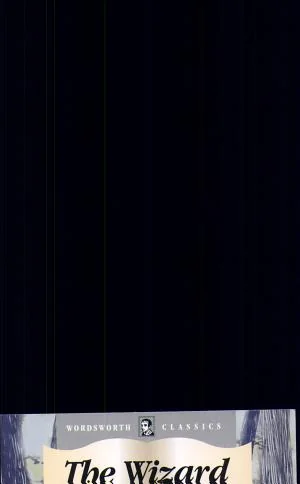
The Wizard of Oz
 75
75

The Wizard of Oz
Baum's creation of Oz offers a compelling departure from the often grim realities of turn-of-the-century Kansas. The initial displacement of Dorothy by the cyclone is a stark, almost violent, introduction to the magical world, immediately establishing a sense of urgency. While the Scarecrow's quest for a brain is particularly resonant, highlighting the idea that intelligence is often a matter of application rather than innate possession, the pacing occasionally falters in the latter half. The proliferation of minor characters and encounters, though whimsical, can sometimes dilute the central narrative thrust. Nevertheless, the book's enduring appeal lies in its imaginative world-building and the simple, powerful message that true fulfillment comes from recognizing one's own capabilities. It remains a foundational text for understanding American fantasy literature.
📝 Description
75
Lyman Frank Baum published 'The Wonderful Wizard of Oz' in 1900, a story that transcends simple fantasy.
Dorothy Gale, a young girl from Kansas, and her dog Toto are swept away by a cyclone to the Land of Oz. This land operates under its own rules of magic and is populated by diverse peoples. Dorothy's journey to find her way home involves meeting the Scarecrow, the Tin Woodman, and the Cowardly Lion, each seeking something they believe they lack: brains, a heart, and courage. They travel to the Emerald City to ask the Wizard for help, encountering obstacles and the Wicked Witch of the West.
The narrative, while seemingly a children's tale, contains layers of symbolism. Many critics have interpreted the story as an allegory for the political and economic conditions of late 19th-century America, including debates over industrialization and monetary policy. The characters' quests reflect a search for inner strength and self-reliance, suggesting that the qualities they desire are already present within them.
Published in 1900, 'The Wonderful Wizard of Oz' appeared during a time of widespread interest in spiritualism and the occult. Baum's fantastical creation of Oz, with its unique magical systems and sentient inhabitants, taps into this cultural fascination. While often read as a children's fantasy or political allegory, the book's construction of a hidden, magical world and its characters' quests for seemingly unattainable qualities can be seen as reflecting a broader cultural engagement with non-material realities and the search for hidden knowledge, common in esoteric traditions of the era.
💡 Why Read This Book?
• Gain insight into the Populist allegory of the 1890s, understanding how characters and symbols like the Scarecrow represent the agrarian class and the debate over the gold standard. • Experience the unique American mythology Baum crafted, distinct from European fairy tales, focusing on self-reliance and the discovery of inner potential. • Explore the symbolic journey to the Emerald City, a potent metaphor for the pursuit of external validation that ultimately reveals the power residing within the individual.
⭐ Reader Reviews
Honest opinions from readers who have explored this book.
❓ Frequently Asked Questions
When was 'The Wonderful Wizard of Oz' originally published?
Lyman Frank Baum's "The Wonderful Wizard of Oz" was first published on May 17, 1900, by the George M. Hill Company of Chicago.
What is the primary allegorical interpretation of 'The Wizard of Oz'?
Many scholars, like Henry Littlefield, interpret the book as an allegory for the Populist movement of the 1890s, with characters and settings representing economic and political figures and concepts of that era.
What are the main symbolic items Dorothy uses to return home?
Dorothy initially believes the Wizard holds the key to her return. However, it is revealed that the Silver Shoes (changed to Ruby Slippers in the 1939 film) possess the magical power to transport her back to Kansas.
Who are the main companions Dorothy meets on her journey?
Dorothy's primary companions are the Scarecrow, who seeks a brain; the Tin Woodman, who desires a heart; and the Cowardly Lion, who yearns for courage.
What does the Emerald City symbolize in the book?
The Emerald City is often interpreted as representing Washington D.C. or the allure of power and wealth, which upon closer inspection, proves to be less substantial than its dazzling exterior suggests.
How does the book differ from the famous 1939 film adaptation?
The book features Silver Shoes for Dorothy, not Ruby Slippers, and the Wizard is a more complex character who uses tricks. The ending also involves the Wizard flying Dorothy home in a balloon, which fails.
🔮 Key Themes & Symbolism
Self-Reliance and Inner Strength
The core of the narrative emphasizes that the qualities sought by Dorothy's companions – intelligence for the Scarecrow, a heart for the Tin Woodman, and courage for the Cowardly Lion – are not bestowed by an external authority like the Wizard. Instead, their journey reveals these attributes were present all along. The work suggests that true power and fulfillment come from within, a recurring motif in many esoteric traditions that focus on inner development and the realization of one's inherent potential rather than reliance on external gurus or systems.
The Nature of Illusion and Reality
Oz itself is a land built on artifice and illusion, most notably personified by the Wizard, who initially appears as a mighty sorcerer but is revealed to be a humbug from Omaha. This theme mirrors esoteric explorations of Maya, the concept of illusion that veils ultimate reality. The characters' reliance on the Wizard's perceived power over their own capabilities underscores the danger of mistaking outward appearances for true substance, urging a deeper discernment of what is real.
Critique of Industrialization and Urbanization
The stark contrast between the gray, industrialized Kansas and the vibrant, magical Land of Oz can be read as a commentary on the societal changes of the late 19th century. The Tin Woodman, whose original human form was cursed by a wicked witch, became a machine and lost his ability to feel, symbolizing the dehumanizing effects of industrial labor. This speaks to philosophical critiques of modernity that question the cost of technological advancement on the human spirit.
The Journey as Transformation
The physical journey along the Yellow Brick Road to the Emerald City is a classic archetypal quest. In esoteric thought, such journeys often represent an initiatory path, where trials and encounters serve to purify and transform the seeker. Dorothy and her friends face numerous obstacles, each designed to test their developing inner strengths. The path itself becomes the teacher, facilitating a profound psychological and spiritual evolution.
💬 Memorable Quotes
Direct passages from the work, attributed to the author.
““How can you get home again?” asked Dorothy; “and how can you have your brains taken out?” asked the Scarecrow. “I am going to ask the great Oz to help us,” she replied.”
— This exchange highlights the initial reliance on external saviors. Dorothy's hope is placed entirely on the Wizard, mirroring a common human tendency to seek solutions outside oneself before recognizing internal resources.
““I shall have to think about that,” the Scarecrow said. “That is a good idea,” said the Tin Woodman, “and we will all think about it.””
— This emphasizes the nascent intelligence of the Scarecrow and the collaborative problem-solving of the group. It suggests that thinking, even if uncertain, is the first step toward gaining wisdom and finding solutions.
““My heart has no muscles and can’t be broken,” he explained.”
— The Tin Woodman's statement reveals his literal lack of a physical heart, yet his actions consistently display compassion and empathy, questioning the necessity of a biological organ for emotional capacity.
““I have brains, and a heart, and courage,” said he. “There is no creature in the world who can do such wonderful things as I can do.””
— This declaration by Dorothy, after her companions have received their symbolic gifts, signifies the ultimate realization that their sought-after qualities were inherent all along, unlocked through their shared experiences.
“The Wizard of Oz was an old humbug.”
— This blunt assessment strips away the Wizard's facade, serving as a critical turning point. It underscores the theme that perceived authority figures can often be charlatans, urging individuals to rely on their own judgment and discernment.
🌙 Esoteric Significance
Tradition
While not overtly tied to a single esoteric lineage, "The Wizard of Oz" shares thematic resonance with Hermetic and New Thought principles. The emphasis on realizing inherent potential and the power of belief aligns with concepts like the law of attraction and the idea that one's mental state shapes reality. The journey can be seen as an alchemical process of transformation, where the seeker undergoes trials to purify and integrate disparate aspects of the self, culminating in self-mastery.
Symbolism
The Yellow Brick Road symbolizes the path of spiritual or personal development, fraught with challenges but leading toward enlightenment (the Emerald City). The Emerald City itself represents an idealized goal or a state of perceived perfection, which upon closer inspection, is revealed to be constructed and maintained through illusion. The Silver Shoes (in the book) are potent talismans of power, signifying the ability to transcend limitations and return to one's origin, a common theme in journeys of spiritual return.
Modern Relevance
Contemporary self-help and motivational speakers often draw parallels to the Oz narrative, particularly the idea that the qualities we seek are already within us. Concepts like manifestation and the power of positive thinking echo the book's core message. Furthermore, its allegorical depth continues to attract scholars of American studies and cultural critique, examining its enduring commentary on societal structures, the nature of leadership, and the construction of myth in the modern era.
👥 Who Should Read This Book
• Students of American cultural history and folklore seeking allegorical interpretations of late 19th-century socio-political movements. • Readers interested in the psychology of personal growth and self-discovery, particularly those drawn to narratives about overcoming perceived limitations. • Aspiring writers and artists exploring archetypal journeys and the creation of unique, symbolic worlds distinct from traditional European fantasy.
📜 Historical Context
Published in 1900, "The Wonderful Wizard of Oz" emerged in a United States grappling with rapid industrialization and socio-political shifts. The Populist movement, advocating for farmers and laborers against perceived corporate and financial power, was a significant force. Critics like Henry Littlefield later proposed that Baum's work served as a political allegory for this era, with the characters and events mirroring debates surrounding the gold standard and the struggles of the agrarian West. This context positions the book not merely as children's fantasy but as a cultural artifact reflecting American anxieties and aspirations. It arrived at a time when authors like L. Frank Baum were experimenting with distinctly American narratives, moving away from European fairy tale traditions, and engaging with contemporary issues through imaginative storytelling.
📔 Journal Prompts
The Scarecrow's desire for a brain, contrasted with his clever plans, prompts reflection on the nature of intelligence.
Dorothy's longing for Kansas, despite the wonders of Oz, invites contemplation on the concept of 'home'.
The Tin Woodman's quest for a heart raises questions about empathy and emotional capacity.
The Cowardly Lion's fearfulness alongside his protective actions highlights the complexities of courage.
The Wizard's revealed identity as 'a humbug' encourages an examination of perceived authority versus true substance.
🗂️ Glossary
Munchkins
The diminutive, blue-clad inhabitants of the Land of the East in Oz. They are the first people Dorothy encounters after her house lands in their territory, freeing them from the Wicked Witch of the East.
Emerald City
The capital city of Oz, renowned for its dazzling green architecture. It is the destination Dorothy and her companions seek to find the Great Wizard, hoping he can help them achieve their desires.
Yellow Brick Road
The principal pathway leading through the various countries of Oz to the Emerald City. Following this road is the central act of the protagonists' journey, symbolizing a path of trials and discovery.
Silver Shoes
Magical footwear belonging to the Wicked Witch of the East, later acquired by Dorothy. These shoes possess the power to transport the wearer anywhere, ultimately enabling Dorothy's return to Kansas.
The Wizard
A mysterious and powerful figure residing in the Emerald City. Initially believed to be a great sorcerer, he is later revealed to be an ordinary man from Omaha using trickery and illusions.
Humbug
A deceiver or fraud. This term is used to describe the Wizard of Oz once his true nature as an ordinary man employing tricks is revealed, highlighting the theme of illusion versus reality.
Populism
A political movement originating in the late 19th century in the United States, primarily representing farmers and laborers against corporate interests. The book is often interpreted as an allegory for this movement.
🔮 Readers Also Liked
Browse all →








More Free Occult Philosophy Books
View all →