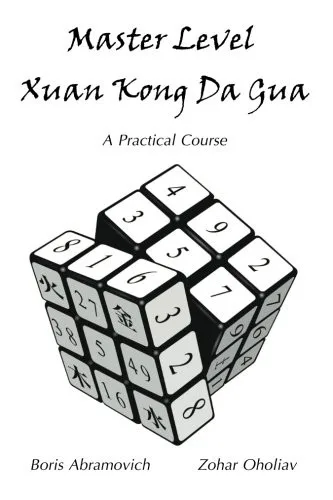
Master Level Xuan Kong Da Gua
 83
83

Master Level Xuan Kong Da Gua
Mr. Boris Abramovich and Mr. Zoahar Oholiav's "Master Level Xuan Kong Da Gua" tackles a notoriously intricate branch of Chinese metaphysics with considerable academic rigor. The authors eschew simplified explanations, instead plunging directly into the complex calculations and symbolic language that define this advanced system. Their strength lies in presenting a coherent framework for understanding the interplay between the I Ching hexagrams, the Heavenly Stems, and Earthly Branches as applied to both destiny analysis and Feng Shui. A notable section meticulously details the "12 Palaces" and their dynamic relationships, offering a clear, albeit dense, exposition. However, the book's primary limitation is its sheer density; it is not for the faint of heart or the casual student. The prose, while precise, can feel overly technical, demanding significant prior knowledge. The work's ultimate value hinges on the reader's commitment to deciphering its sophisticated methodologies. It is a demanding but potentially rewarding text for dedicated scholars.
📝 Description
83
Master Level Xuan Kong Da Gua (2021) teaches advanced applications of a complex Chinese metaphysical system.
This book addresses advanced techniques within Xuan Kong Da Gua, a sophisticated school of Chinese metaphysics. It moves beyond basic principles to focus on detailed applications and interpretations for practitioners seeking mastery. The text examines the interaction of time, space, and energy as understood within this specific approach to Feng Shui and destiny analysis.
The volume is for serious students and practitioners of Xuan Kong Da Gua who possess a firm grasp of its foundational concepts. It aims to enhance analytical skills, improve diagnostic accuracy, and foster a deeper understanding of the system's predictive and environmental uses. Individuals dedicated to the rigorous study of advanced Chinese metaphysics will find value here.
The Xuan Kong Da Gua system itself draws upon ancient Chinese cosmology, including the I Ching and the Lo Shu square. Its development as a distinct lineage within Feng Shui and Bazi is often linked to scholars of the Ming and Qing dynasties, though its precise origins remain a subject of discussion. The system's unique use of Eighty-Four Xuan Kong Da Gua hexagrams, derived from the sixty-four I Ching hexagrams, sets it apart from other classical Chinese métaphysics traditions.
The Xuan Kong Da Gua system is a specialized branch of Chinese metaphysics that builds upon classical foundations like the I Ching and the Lo Shu square. Its lineage is often traced to scholars active during the Ming and Qing dynasties. This system distinguishes itself by employing eighty-four specific hexagrams, derived from the sixty-four I Ching hexagrams, to analyze the interplay of time and space. It represents a particular method for understanding environmental energies and personal destiny within the broader context of classical Chinese cosmological theories.
💡 Why Read This Book?
• Gain an unparalleled understanding of the "12 Palaces" and their intricate connections within the Xuan Kong Da Gua system, a specific analytical framework not widely detailed elsewhere. • Master the application of the Eighty-Four Xuan Kong Da Gua hexagrams to both personal destiny charts and spatial analysis, as presented by Abramovich and Oholiav, offering a unique predictive tool. • Decipher the complex interactions between the Heavenly Stems, Earthly Branches, and the I Ching hexagrams within this specialized school of Chinese metaphysics, moving beyond general astrological principles.
⭐ Reader Reviews
Honest opinions from readers who have explored this book.
❓ Frequently Asked Questions
What is the primary focus of Master Level Xuan Kong Da Gua?
The book focuses on advanced applications and interpretations of the Xuan Kong Da Gua system, a sophisticated branch of Chinese metaphysics, moving beyond foundational principles into intricate analytical techniques.
Is this book suitable for beginners in Feng Shui?
No, this text is specifically designed for practitioners who already possess a strong understanding of basic Xuan Kong Da Gua principles and are seeking to achieve mastery.
What historical period does the Xuan Kong Da Gua system draw from?
The system draws from ancient Chinese cosmological theories, including the I Ching, with its development as a distinct school often linked to scholars during the Ming and Qing dynasties (1368–1912).
What are the "12 Palaces" mentioned in the book?
The "12 Palaces" are a specific organizational framework within the Xuan Kong Da Gua system, used to map out energetic influences and relationships in both time and space.
What is the relationship between Xuan Kong Da Gua and the I Ching?
Xuan Kong Da Gua utilizes a specific set of eighty-four hexagrams derived from the sixty-four I Ching hexagrams, applying them to a unique calendrical and spatial system.
Who are the authors of Master Level Xuan Kong Da Gua?
The book is authored by Mr. Boris Abramovich and Mr. Zoahar Oholiav, first published in 2011, presenting their advanced insights into the Xuan Kong Da Gua methodology.
🔮 Key Themes & Symbolism
Hexagramic Applications
The work thoroughly examines the application of the Eighty-Four Xuan Kong Da Gua hexagrams, which are derived from the foundational I Ching. It details how these specific hexagrammatic combinations are used to analyze both temporal cycles (personal destiny) and spatial arrangements (Feng Shui environments). The text likely provides methodologies for interpreting the energetic qualities and potential outcomes associated with different hexagrammatic configurations, offering a specialized lens for prediction and assessment beyond standard I Ching interpretations.
The 12 Palaces System
A central theme is the exploration of the "12 Palaces" within the Xuan Kong Da Gua framework. This system serves as a method for dividing and analyzing space and time, assigning specific energetic attributes to different sectors or periods. The book likely elucidates the construction and interpretation of these palaces, demonstrating how they interact with celestial and terrestrial influences to shape events and environments. Understanding this structure is crucial for advanced Da Gua analysis.
Stems and Branches Dynamics
The text explores the intricate interplay of the Heavenly Stems and Earthly Branches as they relate to the Xuan Kong Da Gua system. This involves understanding how these fundamental components of the Chinese calendar and cosmology influence the hexagrams and the "12 Palaces." The authors likely present methods for analyzing the dynamic relationships, clashes, and harmonies between these elements to gain deeper insights into destiny charts and Feng Shui assessments.
Advanced Feng Shui & Bazi
This book positions itself as a guide to the master-level application of Xuan Kong Da Gua, encompassing both Feng Shui (environmental analysis) and Bazi (Four Pillars of Destiny). It moves beyond general principles to address complex diagnostic and correlative techniques. The focus is on practical application for those seeking to refine their skills in interpreting the energetic signatures of both places and people with high precision.
💬 Memorable Quotes
Direct passages from the work, attributed to the author.
“The Eighty-Four Xuan Kong Da Gua hexagrams offer a unique mapping of cosmic energies.”
— This statement highlights the specialized nature of the Da Gua system, emphasizing its distinct set of symbolic representations derived from the I Ching, used for detailed analysis.
“Understanding the 12 Palaces is key to deciphering spatial influences.”
— This points to a core structural element of the Da Gua system, the "12 Palaces," presented as a critical tool for analyzing the energetic dynamics of physical environments.
“Mastery requires meticulous calculation and nuanced interpretation.”
— This emphasizes the demanding nature of advanced Da Gua study, suggesting that achieving proficiency involves both precise computational skills and a refined ability to interpret complex symbolic interactions.
“Spatial Qi is intricately linked to temporal cycles through the Da Gua.”
— This captures the core principle of the system, illustrating how the energetic flow of space (Feng Shui) is seen as directly connected to the progression of time (destiny analysis) via the Da Gua methodology.
💡 Key Ideas
Editorial paraphrase of the work's core concepts — not direct quotes.
The interaction between Stems and Branches dictates the unfolding energetic patterns.
This paraphrased concept underscores the importance of the fundamental Chinese calendrical elements (Heavenly Stems and Earthly Branches) in determining the dynamic flow and expression of energies within the Da Gua framework.
🌙 Esoteric Significance
Tradition
This work belongs to the lineage of Chinese Metaphysics, specifically within the broader umbrella of Xuan Kong (Flying Stars) Feng Shui, but with a highly specialized application using the Da Gua system derived from the I Ching. It departs from simpler Feng Shui schools by its reliance on complex calendrical calculations and symbolic correlations, integrating principles of destiny analysis (Bazi) directly into spatial evaluations. It represents a sophisticated, scholarly branch of Taoist-influenced cosmological thought.
Symbolism
Key symbols include the I Ching hexagrams, which are reinterpreted and applied within the Da Gua framework to represent specific energetic configurations in time and space. The "12 Palaces" function as symbolic divisions of the energetic landscape, analogous to astrological houses but specific to this system. The Heavenly Stems and Earthly Branches are fundamental symbolic units representing cosmic forces that interact dynamically within the Da Gua structure.
Modern Relevance
Contemporary practitioners of advanced Feng Shui and Bazi often turn to texts like this to refine their skills, moving beyond introductory concepts. It is relevant to scholars of comparative cosmology and those interested in the mathematical and symbolic underpinnings of ancient Chinese systems. Thinkers exploring the intersection of temporal cycles and spatial energies in predictive sciences find value in its rigorous methodology.
👥 Who Should Read This Book
• Advanced Feng Shui practitioners seeking to integrate the complex Da Gua system into their environmental analysis for more precise diagnostics. • Dedicated students of Bazi (Four Pillars of Destiny) interested in understanding how hexagrammatic cycles influence personal fate alongside traditional stem-branch analysis. • Researchers of Chinese Metaphysics and cosmological systems looking for in-depth exploration of a less common but highly sophisticated analytical framework.
📜 Historical Context
The Xuan Kong Da Gua system, as explored in this text, represents a sophisticated development within classical Chinese metaphysics. While its precise origins are debated, its methodologies are deeply intertwined with the I Ching and cosmological principles that flourished during the Ming (1368–1644) and Qing (1644–1912) dynasties. This period saw significant advancements and diversification in the study of Feng Shui and Bazi. Xuan Kong Da Gua stands apart from other Feng Shui schools, such as the Form School or simpler Compass School methods, by its unique integration of hexagrammatic analysis and a specialized calendrical system. The meticulous calculations and symbolic correlations it employs reflect the intellectual currents of its time, which valued intricate systems of divination and environmental assessment. Its continued study today demonstrates its enduring relevance within esoteric traditions, though it faced periods where its complexity may have limited widespread adoption compared to more accessible systems.
📔 Journal Prompts
Analyze the relationship between the Heavenly Stems and Earthly Branches within a specific Da Gua hexagram.
Consider the energetic implications of the "12 Palaces" in a given spatial layout.
Reflect on how the I Ching hexagrams are transmuted into the Da Gua system.
Evaluate the predictive power of integrating Xuan Kong Da Gua with standard Bazi charts.
Examine the symbolic meaning of a particular Da Gua hexagram in both temporal and spatial contexts.
🗂️ Glossary
Xuan Kong Da Gua
An advanced system of Chinese metaphysics that uses a specialized set of eighty-four hexagrams derived from the I Ching, integrated with calendrical and spatial analysis for Feng Shui and destiny reading.
I Ching
The ancient Chinese classic text, also known as the Book of Changes, containing 64 hexagrams used for divination and philosophical insight, forming the basis for many Chinese metaphysical systems.
Heavenly Stems
The ten cyclical signs (Jia, Yi, Bing, Ding, Wu, Ji, Geng, Xin, Ren, Gui) that, along with Earthly Branches, form the Sexagenary Cycle used in the Chinese calendar and metaphysical calculations.
Earthly Branches
The twelve cyclical signs (Zi, Chou, Yin, Mao, Chen, Si, Wu, Wei, Shen, You, Xu, Hai), represented by animals of the Chinese zodiac, used in conjunction with Heavenly Stems.
12 Palaces
A specific organizational and analytical framework within the Xuan Kong Da Gua system, dividing time and space into twelve sectors to interpret energetic influences.
Bazi
Literally 'Eight Characters,' also known as the Four Pillars of Destiny, a Chinese astrological system that uses the year, month, day, and hour of birth to create a chart for analysis.
Qi
The fundamental concept of vital energy or life force that permeates the universe in Chinese philosophy, influencing all phenomena including health, environment, and destiny.
🔮 Readers Also Liked
Browse all →









More Free Divination & Tarot Books
View all →