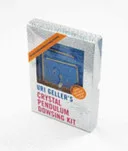
Uri Geller's Crystal Pendulum Dowsing Kit
 83
83

Uri Geller's Crystal Pendulum Dowsing Kit
Uri Geller's Crystal Pendulum Dowsing Kit offers a pragmatic entry point into the world of dowsing, a practice often shrouded in mystique. Geller’s core assertion – that dowsing is an accessible, innate human ability – is a valuable reframe, moving it away from esoteric elitism. The inclusion of both L-rods and a crystal pendulum provides versatility, catering to different user preferences and potential applications. However, the instructional booklet, while clear on the mechanics of rod and pendulum movement, could benefit from more extensive guidance on interpreting the nuances of the responses. A particularly effective section details how the body's micro-movements, imperceptible to conscious thought, can be amplified by the dowsing tools. While the kit provides the instruments, the deeper dive into interpreting subtle energetic shifts remains somewhat underdeveloped, relying heavily on the user's intuition. It is a functional introduction, but not a definitive guide to the art of divination.
📝 Description
83
Uri Geller's 2006 Crystal Pendulum Dowsing Kit teaches dowsing as an inherent human capacity.
This kit introduces the practice of dowsing using L-shaped divining rods and a crystal pendulum. Uri Geller, known for his psychic abilities, designed the tools and wrote the accompanying booklet. The aim is to present dowsing not as a mysterious art, but as a natural skill that anyone can develop through practice and understanding. It is for people curious about their own latent abilities and looking for practical ways to access subconscious information.
The kit appeals to beginners in dowsing, those interested in subtle energy responses, and fans of Geller's work. It can also help alternative healing practitioners integrate pendulum or rod dowsing into their methods. Dowsing, historically used to find water or minerals, has persisted for centuries despite ongoing debate about its effectiveness. Geller's kit connects this tradition to modern interest in psychical research and intuitive development.
Dowsing, or divining, has roots stretching back centuries, historically used to locate underground water and mineral deposits. While its practical application has been debated, the practice endured across cultures. Geller's kit places this ancient technique within a contemporary framework, linking it to modern research into psychical phenomena and personal intuition. It frames dowsing as an accessible, innate ability, suggesting that subtle bodily reactions indicate information processed beyond conscious thought.
💡 Why Read This Book?
• Learn to interpret subtle physical reactions, as explained in the kit's instruction manual, enabling you to access subconscious information that your conscious mind overlooks. • Discover dowsing as an innate ability, a concept Geller emphasizes, allowing you to potentially unlock a natural human capacity for sensing beyond the ordinary five senses. • Engage with a physical toolset—L-rods and a crystal pendulum—that Geller designed to amplify and make tangible the body's responses to unseen energies.
⭐ Reader Reviews
Honest opinions from readers who have explored this book.
❓ Frequently Asked Questions
What exactly is included in Uri Geller's Crystal Pendulum Dowsing Kit?
The kit contains a pair of L-shaped divining rods, a crystal pendulum, and an instructional booklet authored by Uri Geller himself, first published in 2006.
Is dowsing difficult to learn with this kit?
Geller posits that dowsing is an innate ability, suggesting it is learnable by everyone. The kit's manual is designed to guide users in interpreting their body's natural reactions through the provided tools.
What is the purpose of the crystal pendulum in the kit?
The crystal pendulum serves as a sensitive indicator, designed to move in response to subtle energies or answers to questions posed by the user, translating unconscious reactions into visible motion.
Can this dowsing kit be used to find things, like water or lost objects?
While the kit focuses on general dowsing principles, its tools can be applied to various searches, including locating underground resources, lost items, or even abstract answers, by tuning into subtle energetic responses.
Who was Uri Geller and why is he associated with dowsing?
Uri Geller is an Israeli-British psychic known for his televised demonstrations of psychokinesis, including spoon bending. His work often touches on psychic abilities, and this kit reflects his belief in accessible, intuitive practices like dowsing.
When was Uri Geller's Crystal Pendulum Dowsing Kit first published?
The kit and its accompanying book were first published in 2006, bringing Geller's approach to dowsing to a wider audience.
🔮 Key Themes & Symbolism
Innate Dowsing Ability
The central theme is that dowsing is not a learned skill but an inherent human capacity, akin to language. Geller emphasizes that our bodies react to information far beyond conscious processing. This kit provides the tools—L-rods and a crystal pendulum—to detect and interpret these subtle, subconscious reactions, making the invisible visible and accessible for personal insight and guidance.
Bridging Conscious and Subconscious
This work focuses on the interface between conscious thought and the vast subconscious mind. By using the dowsing tools, individuals can learn to 'read' their body's physical responses, which are influenced by deeper, non-conscious processing. The kit serves as a practical bridge, translating these subtle signals into understandable feedback, thereby enhancing self-awareness and intuition.
Practical Application of Psychic Tools
Geller presents dowsing not as a mystical ritual but as a practical technique. The kit is designed for straightforward use, enabling anyone to engage with their intuition. It explains the process, encouraging users to experiment with the L-rods and pendulum for various purposes, from finding resources to seeking personal clarity, grounded in the belief of accessible psychic phenomena.
The Body as an Instrument
A key concept is the body's role as a sensitive instrument for detecting subtle energies and information. The dowsing rods and pendulum act as amplifiers and indicators of these bodily reactions, which Geller suggests are involuntary responses to environmental or psychic stimuli. Learning to dowse, therefore, involves learning to pay attention to and interpret these physical cues.
💬 Memorable Quotes
Direct passages from the work, attributed to the author.
“Our incredible senses process far more information than ever breaks the surface of our minds...”
— This highlights the vastness of subconscious processing, suggesting that our awareness captures only a fraction of the data our senses gather, setting the stage for dowsing as a method to access this hidden information.
“...yet our bodies do react to this information, and by dowsing we can read those reactions.”
— This is the core premise: physical responses are indicators of subconscious reception. Dowsing, according to Geller, is the practice of learning to perceive and interpret these often minute, involuntary bodily reactions.
“Conscious thought is merely a tiny percentage of what our brains do.”
— This statement underscores the immense power and activity of the subconscious mind, framing dowsing as a tool to tap into this largely uncharted territory of mental and sensory processing.
“Everyone can dowse. Like language, it's an innate ability that reveals itself as we learn.”
— Geller asserts the universality and inherent nature of dowsing, comparing it to acquiring language, implying that with the right guidance and practice, anyone can develop this skill.
“This unique dowsing kit from Uri Geller consists of a pair of L-shaped divining rods, a crystal pendulum, and a book which tells you exactly how to use the”
— This describes the physical components of the kit, emphasizing its self-contained nature and direct instructional approach for learning the practice of dowsing.
🌙 Esoteric Significance
Tradition
While dowsing has roots in folk magic and practical applications, Geller's approach aligns with modern esoteric thought that emphasizes tapping into innate psychic abilities and subconscious intelligence. It doesn't strictly adhere to a single lineage like Hermeticism or Kabbalah but draws from a broader current of belief in accessible extrasensory perception and the power of intention, common in 20th and 21st-century metaphysical movements.
Symbolism
The crystal pendulum is a key symbol, representing clarity, focus, and the amplification of subtle energies. Crystals are often seen in esoteric traditions as conduits or storage devices for energy, and their use in a pendulum enhances the connection to intuitive guidance. The L-shaped rods symbolize directionality and sensitivity, acting as extensions of the user's own energetic field to detect external or internal influences.
Modern Relevance
Geller's kit remains relevant for contemporary practitioners of energy healing, intuitive development, and mindfulness. Its emphasis on practical, tool-assisted intuition speaks to modern approaches to biofeedback and somatic awareness. Thinkers and groups exploring somatic experiencing, quantum consciousness, and accessible psychic development continue to find value in dowsing as a method for self-discovery and connection to subtle information fields.
👥 Who Should Read This Book
• Individuals new to dowsing seeking a straightforward, tool-based introduction to sensing subtle energies. • Aspiring intuitives interested in practical methods to access subconscious information beyond ordinary awareness, as explained in Geller's 2006 guide. • Fans of Uri Geller looking to engage with his personal approach to psychic phenomena and intuitive development through a hands-on kit.
📜 Historical Context
Published in 2006, Uri Geller's Crystal Pendulum Dowsing Kit emerged during a period of sustained public interest in paranormal phenomena, psychical research, and self-help modalities that promised access to hidden potentials. Dowsing itself has a long, often contested history, dating back centuries and predominantly used for locating water. However, by the late 20th and early 21st centuries, its application expanded into areas of personal intuition and energy detection. Geller, already a globally recognized figure for his psychic demonstrations since the 1970s, lent his popular appeal to the practice. This work appeared in an era where New Age spirituality and practical applications of intuition were gaining mainstream traction, contrasting with more academic or skeptical approaches to parapsychology. While figures like J.Z. Knight were popularizing channeling, Geller focused on a more tangible, tool-based method of accessing psychic information, positioning dowsing as an everyday skill rather than an esoteric secret.
📔 Journal Prompts
The body's reactions as indicators of subconscious processing.
Interpreting subtle physical movements with the L-rods.
The role of the crystal pendulum in seeking answers.
Dowsing as an innate ability versus a learned skill.
Personal experiences with amplified sensory information.
🗂️ Glossary
Dowsing
A practice using tools like rods or pendulums to detect hidden substances (like water or minerals) or gain answers to questions by interpreting subtle physical movements.
L-shaped divining rods
Two L-shaped metal rods, typically held loosely, which are designed to move or indicate direction in response to subtle energies or subconscious cues.
Crystal pendulum
A weighted crystal, usually suspended from a string or chain, used as a dowsing tool to receive answers or indications through its swinging motion.
Innate ability
A skill or capacity that is present from birth, rather than acquired through learning or external influence.
Subconscious information
Data, thoughts, or feelings processed by the mind that are not currently within conscious awareness but can influence behavior and perception.
Psychic phenomena
Events or abilities that appear to transcend known physical laws, such as telepathy, clairvoyance, or psychokinesis, often studied in parapsychology.
Intuition
The ability to understand something immediately, without the need for conscious reasoning; often described as a 'gut feeling' or inner knowing.