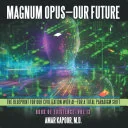
Magnum Opus—Our Future
 73
73

Magnum Opus—Our Future
Amar Kapoor M.D.'s Magnum Opus—Our Future offers a compelling, if somewhat optimistic, vision of technological determinism. The strength of the work lies in its clear articulation of how disparate technologies like AI and 3D printing might coalesce into a singular force for societal advancement. Kapoor's analysis of "Aspirational Realization" is particularly noteworthy, presenting a framework for understanding how future systems could align with human desires. However, the book tends to underemphasize potential dystopian outcomes or the friction inherent in such radical societal shifts. While Kapoor mentions the convergence of technologies, a deeper exploration of the ethical quandaries or the philosophical resistance to such a future would have added critical ballast. The discussion around AI integration, for instance, feels less a critique and more an enthusiastic embrace of its potential. Ultimately, Kapoor presents a future built on technological possibility, urging a proactive approach to its construction.
📝 Description
73
Amar Kapoor M.D.'s 2025 book, Magnum Opus—Our Future, argues technologies will reshape human civilization.
Magnum Opus—Our Future, published in 2025, by Amar Kapoor M.D., examines how emerging technologies like AI, 3D printing, autonomous systems, and immersive realities could fundamentally alter human society. Kapoor posits that the integration of these innovations moves beyond simple tools; they are the basis for a new era. The book suggests these advancements, when combined, can help humanity achieve its highest goals and overcome current limitations.
This work is aimed at futurists, technologists, and anyone interested in the direction of human development. It will appeal to readers who consider the connections between science, philosophy, and societal change. Those interested in speculative futures, the ethical questions posed by advanced technology, and the philosophical ideas behind progress will find significant content here.
Kapoor's concept of 'Magnum Opus' reinterprets the alchemical goal not as material transformation, but as the conscious, technology-assisted evolution of humanity and its collective awareness. This resonates with esoteric traditions that seek radical human betterment through specific disciplines or knowledge. The idea of 'Techno-Integration' mirrors esoteric pursuits that aim to synthesize disparate elements, whether philosophical, spiritual, or practical, into a unified, advanced state. 'Aspirational Realization' suggests a perfected human condition achievable through these integrated systems, a common theme in various esoteric paths focusing on human potential.
💡 Why Read This Book?
• Understand the foundational principles of "Techno-Integration," learning how AI, 3D printing, and VR could synergize beyond their individual applications, as detailed in Kapoor's 2025 publication. • Gain insight into "Aspirational Realization," a concept that describes a future state where technology helps fulfill humanity's highest potential, moving beyond the limitations explored in the book's initial chapters. • Grasp the historical lineage of radical technological futurism, placing Kapoor's ideas within the context of thinkers like Vernor Vinge and Ray Kurzweil, as discussed in the work's historical framing.
⭐ Reader Reviews
Honest opinions from readers who have explored this book.
❓ Frequently Asked Questions
When was Magnum Opus—Our Future first published?
Magnum Opus—Our Future was first published on September 9, 2025. This date places it within a contemporary context of rapid technological advancement.
What are the main technologies discussed in Kapoor's book?
The book centers on the convergence of artificial intelligence (AI), 3D printing, self-driving machines (autonomous systems), and augmented/virtual reality (AR/VR) with touch-based interfaces.
What does Kapoor mean by 'Magnum Opus' in this context?
Kapoor reinterprets the alchemical 'Magnum Opus' not as a physical transformation, but as the deliberate, technologically-driven evolution and betterment of human civilization and consciousness.
Is this book a technical manual for AI or 3D printing?
No, Magnum Opus—Our Future is not a technical manual. It's a philosophical and speculative exploration of how these technologies, when integrated, could shape humanity's future aspirations.
Who is Amar Kapoor M.D. and what is his background?
Amar Kapoor M.D. is the author of Magnum Opus—Our Future. While the book focuses on technological and societal futures, his medical background may inform his perspective on human potential and well-being.
What is the core argument regarding humanity's future in the book?
The core argument is that a confluence of radical technological breakthroughs, particularly AI integration, points towards a future where humanity can achieve its highest aspirations and overcome current limitations.
🔮 Key Themes & Symbolism
Techno-Integration Synergies
This theme examines how distinct advanced technologies, such as artificial intelligence and 3D printing, do not merely coexist but actively enhance one another. Kapoor posits that their combined effect transcends the sum of their parts, creating emergent properties that accelerate societal progress. The work illustrates this through hypothetical scenarios where AI optimizes 3D printing designs for complex medical implants or autonomous systems manage vast virtual environments, pushing the boundaries of what's technologically feasible and desirable for human advancement.
Aspirational Realization
Kapoor introduces 'Aspirational Realization' as the ultimate goal facilitated by advanced technology. This concept suggests a future state where societal structures and technological systems are designed to actively enable individuals and collectives to achieve their highest potentials and deepest desires. It moves beyond mere problem-solving to actively cultivating human flourishing, envisioning environments where creativity, learning, and well-being are systemically supported and amplified by integrated technologies.
The Evolving Human Condition
This theme addresses the philosophical implications of rapid technological change on what it means to be human. As machines become more intelligent and realities more immersive, Kapoor explores how our definitions of consciousness, identity, and purpose might shift. The book contemplates whether these advancements represent an evolution of the human condition or a departure from it, prompting readers to consider the ethical and existential questions arising from a future increasingly intertwined with sophisticated technology.
Radical Societal Transformation
Kapoor outlines a vision for a complete overhaul of existing societal paradigms, driven by technological innovation. This includes rethinking governance, economics, and social structures to align with the capabilities offered by AI, autonomous systems, and advanced fabrication. The 'Main work' of humanity, in this context, is the intentional design of a future society that is more efficient, equitable, and capable of addressing complex global challenges through intelligent technological integration.
💬 Memorable Quotes
Direct passages from the work, attributed to the author.
“Converging technologies, woven with artificial intelligence (AI) integration, 3D printing, self-driving machines, and augmented and virtual reality embedded with touch-based interfaces are leading humanity into a future that embodies our highest aspirations.”
— This foundational statement captures the book's central thesis, identifying specific technological threads that Kapoor believes will collectively steer humanity toward an idealized future, emphasizing synergy over individual impact.
“In recent years, humanity has been gifted with excellence in scientific research and innovative leaders who have produced, discovered, invented, and executed radical technological breakthroughs.”
— This sets the stage by acknowledging the current era's scientific prowess and leadership, framing the subsequent technological advancements as a deliberate and positive trajectory driven by human ingenuity.
“In a comprehensive presentation...”
— Although incomplete in the provided blurb, this phrase suggests Kapoor's intention to offer a thorough and detailed account of his vision, promising a systematic exploration of the future he foresees.
💡 Key Ideas
Editorial paraphrase of the work's core concepts — not direct quotes.
These remarkable converging technologies... are leading humanity into a future that embodies our highest aspirations.
This passage highlights the optimistic outlook of the work, suggesting that the confluence of innovations discussed is not merely progress, but a direct pathway to achieving humanity's loftiest goals and ideals.
The work explores how advancements in AI, 3D printing, autonomous systems, and immersive realities could reshape human civilization.
This paraphrased concept summarizes the book's core subject matter, indicating a focus on the transformative power of specific technological fields on the structure and function of human society.
🌙 Esoteric Significance
Tradition
While not explicitly tied to a single esoteric lineage like Hermeticism or Kabbalah, Main work—Our Future engages with a modern, techno-centric interpretation of transformative spiritual or philosophical quests. It mirrors the alchemical 'Great Work' (Main work) by proposing a deliberate, advanced process for elevating humanity, albeit through scientific means rather than traditional mystical practices. This aligns with certain strains of Theosophy or Integral Theory, which seek to synthesize spiritual, philosophical, and scientific understanding into a cohesive vision for human development.
Symbolism
The primary symbolic resonance lies in the title itself: 'Main work.' Traditionally representing the alchemical pursuit of gold or the elixir of life, Kapoor reappropriates it to signify the ultimate achievement in human evolution through technology. Other potential symbols include the 'convergence' of technologies, representing unity and integration, and 'Aspirational Realization,' symbolizing a perfected state of human potential facilitated by intelligent systems.
Modern Relevance
Kapoor's work is highly relevant to contemporary discussions in fields like Artificial General Intelligence (AGI) ethics, the philosophy of technology, and speculative design. Thinkers and practitioners in areas such as biohacking, digital consciousness research, and advanced AI alignment actively engage with the questions Kapoor raises about the future trajectory of human existence and the potential for technologically-mediated transcendence or transformation.
👥 Who Should Read This Book
• Futurists and speculative thinkers seeking frameworks for understanding the next stage of human development, particularly how integrated technologies might fulfill lofty societal goals. • Technologists and innovators interested in the philosophical underpinnings of their work, exploring the potential societal impact of AI, 3D printing, and immersive realities beyond immediate application. • Students of philosophy of technology and societal evolution, looking for contemporary perspectives on the relationship between scientific advancement and the human condition.
📜 Historical Context
Amar Kapoor M.D.'s Main work—Our Future emerged in 2025, a period characterized by the accelerating integration of digital technologies into nearly every facet of life. This era built upon the foundations laid by the personal computer revolution of the late 20th century and the subsequent rise of the internet. Kapoor's work can be seen as a contemporary extension of transhumanist thought, particularly influenced by figures like Ray Kurzweil, whose predictions on accelerating change gained significant traction throughout the early 21st century. The book also engages with speculative fiction's long-standing exploration of AI and virtual realities. While not a period of overt censorship regarding technological futurism, Kapoor's optimistic outlook might stand in contrast to more cautious or critical voices discussing the societal impacts of AI, such as those raised by philosophers like Nick Bostrom concerning existential risk.
📔 Journal Prompts
The concept of 'Aspirational Realization' as described by Kapoor.
Techno-Integration's potential to redefine human capabilities.
The ethical considerations of AI-driven societal design.
Mapping the future trajectory outlined in 'Main work—Our Future'.
The role of innovative leaders in achieving radical technological breakthroughs.
🗂️ Glossary
Main work
In Kapoor's context, this refers not to alchemical transmutation but to the deliberate, technologically-driven evolution and betterment of human civilization and consciousness.
Techno-Integration
The synergistic effect and mutual enhancement achieved when distinct advanced technologies, such as AI and 3D printing, are combined and operate in concert.
Aspirational Realization
A future state envisioned by Kapoor where societal structures and technological systems are optimized to help individuals and humanity achieve their highest potentials and deepest desires.
Converging Technologies
A term used by Kapoor to describe the phenomenon where multiple distinct technological advancements (AI, 3D printing, VR, etc.) develop and combine, leading to exponential progress.
Radical Technological Breakthroughs
Significant, transformative innovations in fields like AI, autonomous systems, and advanced manufacturing that fundamentally alter capabilities and societal possibilities.
Augmented and Virtual Reality (AR/VR)
Immersive digital environments, often enhanced with touch-based interfaces, that extend or replace physical reality, playing a key role in Kapoor's vision of future human experience.
Self-Driving Machines
Refers to autonomous systems and robotics capable of operating independently, forming a crucial component of the integrated technological future Kapoor describes.
This book appears in 1 collection
🔮 Readers Also Liked
Browse all →









From the “Magnum Opus” Collection
View all →








More Free Occult Philosophy Books
View all →