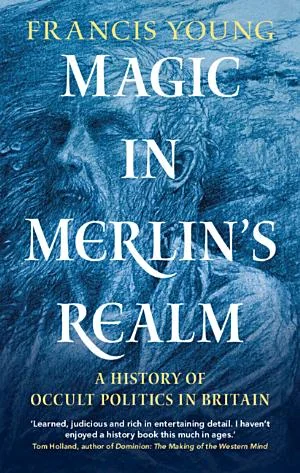
Magic in Merlin's Realm
 78
78

Magic in Merlin's Realm
Francis Young's "Magic in Merlin's Realm" boldly reframes magic not as a fringe phenomenon but as a consistent, culturally potent force in British history, often on par with religion. Young's strength lies in his meticulous research, demonstrating how magical beliefs permeated social and political structures from antiquity through the early modern period. He compellingly argues against viewing magic solely through the lens of superstition, highlighting its role in intellectual discourse and power dynamics. A limitation, however, is the sheer breadth of the historical sweep; while comprehensive, certain periods might feel more thoroughly explored than others. The discussion on figures like John Dee in the Elizabethan era, for instance, serves as a powerful example of how royal patronage and intellectual curiosity intertwined with occult practices. Young's work offers a vital corrective to historical narratives that sideline the persistent influence of magic. It is a scholarly examination that reasserts magic's historical significance.
📝 Description
78
Francis Young's Magic in Merlin's Realm argues that magic was integral to Britain's social and political fabric.
Francis Young's Magic in Merlin's Realm challenges the idea that magic in Britain was merely folklore or superstition. Instead, the book makes a case for its significant historical and cultural weight, suggesting magical beliefs and practices were woven into the nation's social and political life. Young examines the intersections of magic with religion, science, and power across different historical periods.
The analysis spans British history from ancient times to the early modern era. It highlights periods like the Renaissance, often viewed through the lens of scientific progress, as also being times when magical thinking held sway among intellectuals and rulers. The book contrasts the often overlooked influence of magic with that of established religion and emerging scientific ideas. Young's central argument is that magic functioned as a consistent and influential force, on par with religion in its historical significance.
This work engages with the history of Western esotericism by examining magical traditions not as fringe phenomena but as active forces within mainstream historical and intellectual currents. It connects with scholarly approaches that analyze the continuity and evolution of magical practices and their influence on societal structures. By situating magic within broader religious, scientific, and political developments, the book contributes to understanding the historical reality of esoteric thought and its impact on culture.
💡 Why Read This Book?
• Gain a new perspective on British history by understanding magic's influence as a force comparable to religion, as explored through the book's examination of figures like John Dee. • Understand the historical ebb and flow of magical beliefs and their societal impact, particularly how they were perceived and integrated or rejected during periods like the Renaissance. • Challenge conventional notions of superstition by learning how magical practices and philosophies were intertwined with intellectual discourse and political power across centuries.
⭐ Reader Reviews
Honest opinions from readers who have explored this book.
❓ Frequently Asked Questions
When was Magic in Merlin's Realm first published?
Magic in Merlin's Realm by Francis Young was first published on March 3, 2022. This recent publication date makes its historical analysis particularly relevant to contemporary scholarship.
What is the central argument of Magic in Merlin's Realm?
The book's central argument is that magic has historically held as much cultural and political significance in Britain as religion, challenging traditional historical narratives.
Does the book focus on folklore or actual historical practices?
The book focuses on actual historical practices and beliefs, examining how magic was understood, practiced, and integrated into the social, political, and intellectual life of Britain across different eras.
Who was John Dee and why is he relevant to this book?
John Dee was an influential Elizabethan mathematician, astronomer, and occultist. His involvement with magic and his service to Queen Elizabeth I are discussed as key examples of magic's political and intellectual significance.
Is Magic in Merlin's Realm suitable for beginners in occult studies?
While thoroughly researched, the book's academic tone and historical depth make it most suitable for readers with a serious interest in the history of magic and occultism, rather than complete beginners.
What historical periods does the book primarily cover?
The book covers a broad span of British history, from ancient times through to the early modern period, with particular attention paid to periods like the Renaissance and Elizabethan era.
🔮 Key Themes & Symbolism
Magic as Political Force
Young argues that magic was not merely a private pursuit but a factor in political maneuvering and statecraft throughout British history. The book examines instances where rulers and advisors utilized or were influenced by magical practitioners, suggesting a tangible impact on governance and power structures. This perspective shifts the understanding of magic from superstition to a recognized, albeit often hidden, element of political discourse and authority.
Magic and Religion Interplay
A core theme is the complex relationship between magic and religion. The work challenges the notion of a clear historical dichotomy, showing how magical beliefs often coexisted with, influenced, or were even sanctioned by religious institutions. It explores how figures straddled the lines between theologian and magician, and how societal anxieties about heresy and witchcraft were often intertwined with magical practices.
Evolution of Magical Thought
The book traces the evolution of magical concepts and practices across different historical periods. From ancient rituals to Renaissance hermeticism, Young demonstrates how these ideas were adapted, codified, and debated. It highlights how the perception and practice of magic changed in response to intellectual shifts, scientific discoveries, and societal changes, reflecting broader cultural transformations.
The Magician as Scholar
Young reframes the historical figure of the magician not as a charlatan but often as a learned individual engaged in rigorous intellectual inquiry. Figures like John Dee are presented as scholars who applied scientific methods to occult studies, blurring the lines between early science and magic. This theme emphasizes the intellectual respectability and pursuit of knowledge associated with magical traditions.
💬 Memorable Quotes
Direct passages from the work, attributed to the author.
“Magic has at times been as culturally and politically significant as religion.”
— This foundational statement captures the book's primary thesis, asserting that magical beliefs and practices held a weight comparable to established religious doctrines in shaping British society and its power dynamics.
“The Elizabethan court provides fertile ground for examining the intersection of occultism and power.”
— This highlights a specific historical context where figures like John Dee served royalty, illustrating how magical knowledge was sought and utilized within the highest echelons of political influence.
“Interpreting magical texts required scholarly rigor akin to biblical exegesis.”
— This suggests that the study of magic was not a casual or ignorant pursuit but a serious intellectual discipline, demanding sophisticated analytical skills and deep learning from its practitioners.
“Anxieties surrounding witchcraft reveal societal fears about the misuse of hidden knowledge.”
— This points to the social implications of magic, where accusations of witchcraft often reflected deeper cultural anxieties about power, control, and the perceived threats posed by individuals possessing esoteric knowledge.
“The Renaissance saw magic integrated into a broader intellectual landscape.”
— This frames the Renaissance not just as an age of scientific awakening but also as a period where magical philosophies were actively studied and incorporated into the prevailing intellectual currents.
🌙 Esoteric Significance
Tradition
The work engages with the Western Esoteric Tradition, particularly its manifestations in Britain. It positions magical practices not as isolated phenomena but as integral components of historical intellectual currents, including Hermeticism, Neoplatonism, and early forms of ceremonial magic. Young's analysis fits within a lineage of scholarship that seeks to understand these traditions as legitimate fields of study, distinct from but often intertwined with mainstream religious and philosophical thought.
Symbolism
Key symbols explored implicitly include the magician's staff and astrological charts, representing authority and cosmic order respectively. The act of scrying, or divination through reflective surfaces, symbolizes the quest for hidden knowledge and divine insight. These symbols are contextualized not as mere superstitious objects but as tools and representations within a complex system of understanding the universe and humanity's place within it.
Modern Relevance
Contemporary esoteric practitioners and historians of religion find value in Young's work for its nuanced portrayal of historical magic. Modern occultists can draw connections between historical practices and contemporary traditions, while academics use it to inform studies on belief, ritual, and the evolution of Western esotericism. Thinkers exploring the sociology of knowledge and the history of marginalized belief systems also reference its arguments for the enduring cultural relevance of magic.
👥 Who Should Read This Book
• Historians of British culture and religion seeking to understand the pervasive influence of magical thought beyond folklore. • Students of the Western Esoteric Tradition looking for scholarly context on historical magical practices and their intellectual underpinnings. • Skeptics and curious minds who wish to challenge simplistic narratives of superstition and explore the complex role of magic in shaping society and power.
📜 Historical Context
Published in 2022, Francis Young's "Magic in Merlin's Realm" entered a scholarly landscape increasingly open to reconsidering the history of magic, moving beyond simplistic dismissals of superstition. The work engaged with ongoing debates in the history of science and religion, particularly concerning the intellectual climate of the Renaissance and early modern periods. Young's argument that magic held parity with religion in cultural and political significance challenged traditional periodizations that often emphasized a sharp break between magical thinking and the rise of scientific rationalism. Key contemporaries in this field include scholars like Owen Davies and Brian Levack, who have also explored the historical realities of witchcraft and magic. While not facing direct censorship, the book's rigorous academic approach and its challenge to established narratives positioned it within a significant scholarly dialogue about belief systems and power in British history.
📔 Journal Prompts
The historical significance of magic as argued by Francis Young.
John Dee's role as a royal advisor and occultist.
The intersection of magic and religion in pre-modern Britain.
Societal anxieties reflected in witchcraft accusations.
The intellectual rigor required for studying historical magical texts.
🗂️ Glossary
Hermeticism
A religious, philosophical, and esoteric tradition based on writings attributed to Hermes Trismegistus. It emphasizes the interconnectedness of all things and the potential for human spiritual ascent through knowledge.
Neoplatonism
A philosophical system originating with the philosopher Plotinus, heavily influenced by Plato. It posits a hierarchy of reality descending from a supreme, ineffable 'One' and emphasizes mystical union with this divine principle.
Ceremonial Magic
A type of magic involving rituals, invocations, and the use of symbolic tools and attire, often aimed at invoking spiritual entities or achieving specific worldly or spiritual goals. It gained prominence during the Renaissance.
Scrying
A divination technique involving gazing into a reflective surface, such as a mirror or crystal ball, to receive visions or insights. It was practiced across various historical periods.
Elizabethan Era
The period of English history during the reign of Queen Elizabeth I, from 1558 to 1603. It was a time of significant cultural and political development, including the flourishing of the arts and exploration.
Renaissance
A period in European history, marking the transition from the Middle Ages to modernity, characterized by a revival of classical learning and art. It also saw significant developments in philosophy and the occult sciences.
Occultism
A broad category of esoteric beliefs and practices that are hidden, secret, or beyond the scope of normal understanding. It often includes magic, alchemy, astrology, and divination.
This book appears in 1 collection
🔮 Readers Also Liked
Browse all →








From the “Occultism” Collection
View all →




More Free Occult Philosophy Books
View all →