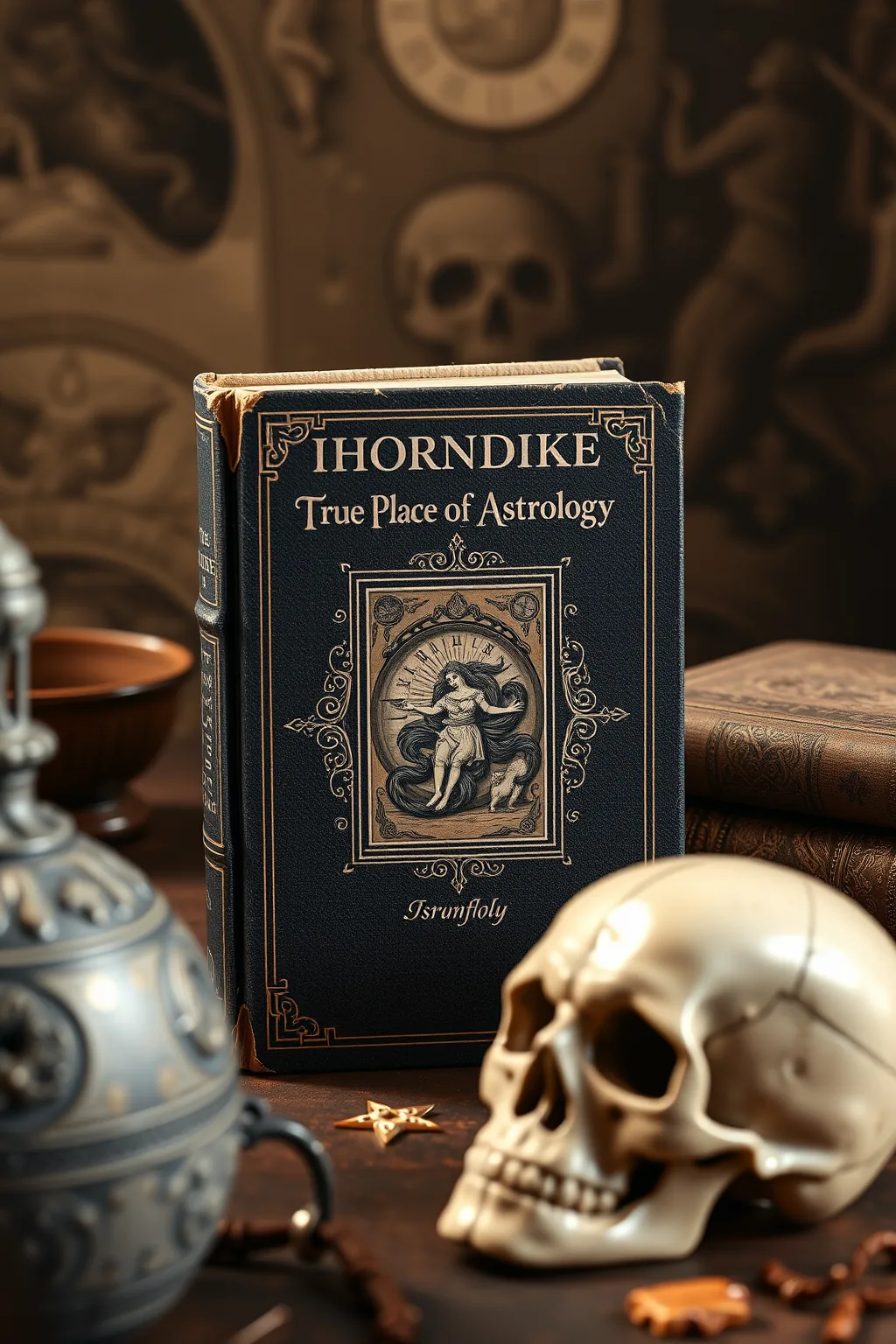
Thorndike 1955 True Place Of Astrology
 77
77

Thorndike 1955 True Place Of Astrology


Thorndike's 'The True Place of Astrology' is a seminal work for those interested in the esoteric roots of astrology. Published in 1955, the book offers a detailed exploration of astrology's historical significance before the advent of Newtonian physics. Thorndike's meticulous research and insightful analysis make this text a valuable resource for modern esoteric seekers. The book's strength lies in its ability to contextualize astrology within the broader framework of cosmology, demonstrating how celestial observations were integral to understanding the natural world. Thorndike's arguments are compelling and well-supported, making this text an essential read for anyone interested in the intersection of science and esotericism.
📝 Description
77
Published in 1955, 'The True Place of Astrology' argues astrology was once the universal scientific law.
This anonymous 1955 text asserts that astrology once held the status of a universal scientific law, a position it maintained until the rise of Newtonian physics. The author presents astrology as a system of celestial influence on earthly events, rich with symbolism and concealed knowledge. It aims to guide readers toward understanding this cosmic connection. The book fosters an atmosphere of deep thought and esoteric learning, encouraging an examination of the cosmos's mystical foundations. It speaks to those interested in occult knowledge, historical scientific thought, and astrological practice.
The work examines the relationship between celestial bodies and human life. It seeks to demystify the impact of stars and planets on existence. The author’s intent appears to be a restoration of astrology’s perceived former authority and scientific standing. The text is written for a reader prepared to engage with its unique perspective on cosmic order and terrestrial affairs.
Written in the mid-20th century, 'The True Place of Astrology' emerged during a period of renewed interest in occult and esoteric traditions. This era saw various authors and groups reinterpreting ancient texts and systems, often seeking to validate them against modern scientific or philosophical paradigms. The book's premise aligns with a strain of esoteric thought that views the cosmos as an ordered, interconnected whole, where celestial movements directly correlate with terrestrial phenomena and human destiny. It reflects a desire to reclaim or reaffirm the perceived scientific validity of older cosmological models.
💡 Why Read This Book?
Reading 'The True Place of Astrology' today offers a unique perspective on the historical and esoteric significance of astrology. The book provides a deep understanding of how astrology was once considered a universal scientific law, bridging the gap between celestial phenomena and human experience. Modern readers will gain insights into the enduring influence of astrological principles in contemporary esoteric practices and appreciate the rich history of astrological thought.
⭐ Reader Reviews
Honest opinions from readers who have explored this book.
❓ Frequently Asked Questions
What is the main focus of 'The True Place of Astrology'?
The main focus of the book is to explore the historical significance of astrology before the advent of Newtonian physics, presenting astrology as a universal scientific law.
Who should read this book?
This book is ideal for scholars, historians, and enthusiasts of esoteric studies, particularly those interested in the intersection of astrology and early scientific thought.
What historical period does the book cover?
The book covers the evolution of astrological thought from ancient civilizations through the Renaissance, highlighting key figures and their contributions.
🔮 Key Themes & Symbolism
Astrology as Universal Law
This theme studies the historical significance of astrology as the original scientific law, exploring its mystical underpinnings and celestial influences. It provides a deep dive into the philosophical and esoteric aspects of astrology, making it a core part of mystical literature.
Symbolism of the Cosmos
The book is rich in symbolism, exploring the meanings behind celestial bodies and their impact on human existence. This theme offers a profound understanding of the symbolic language of the stars, inviting readers to decipher the mysteries of the cosmos.
Philosophical Insights
The anonymous author presents a philosophical journey through the stars, unraveling the mysteries of celestial influences. This theme is ideal for seekers of hidden knowledge and scholars of ancient sciences, offering a unique perspective on the mystical arts.
💡 Key Ideas
Editorial paraphrase of the work's core concepts — not direct quotes.
The stars hold the secrets of the universe.
This line underscores the mystical significance of celestial bodies and their influence on human affairs.
Astrology is the original scientific law.
This quote highlights the historical role of astrology before the advent of modern physics, emphasizing its mystical roots.
The cosmos is a collection of symbols.
This passage invites readers to explore the symbolic language of the stars and their lasting impact on our lives.
Seek the hidden knowledge of the stars.
This line encourages seekers of esoteric wisdom to study the mysteries of astrology and its mystical underpinnings.
The celestial influences govern our existence.
This quote emphasizes the lasting impact of celestial bodies on human existence, making it a core part of mystical literature.
🌙 Esoteric Significance
Tradition
This book belongs to the Hermetic and Gnostic traditions, drawing from their principles to explore the mystical underpinnings of astrology. It offers a deep dive into the esoteric symbolism and philosophical insights that define these paths, making it a valuable resource for practitioners and seekers of mystical knowledge.
Symbolism
Key symbols in the book include celestial bodies and their meanings, as well as the symbolic language of the stars. These symbols invite readers to decipher the mysteries of the cosmos and understand the lasting impact of celestial influences on human existence.
Modern Relevance
This book remains relevant today, offering insights that are still valuable to contemporary astrologers and seekers of mystical knowledge. Modern practitioners can use its principles to deepen their understanding of astrology and its esoteric roots, making it an essential addition to any mystical library.
👥 Who Should Read This Book
Beginners in astrology will find a foundational understanding of its historical significance, making it accessible while offering deeper insights for experienced practitioners. Scholars of ancient sciences will appreciate the philosophical journey through the stars, while spiritual seekers will be drawn to the mystical underpinnings of the cosmos. Practitioners of astrology will benefit from the esoteric symbolism and hidden knowledge presented in the book, making it an invaluable resource for all levels of interest in the mystical arts.
📜 Historical Context
Published in 1955, 'The True Place of Astrology' emerges during a time when the boundaries between ancient wisdom and modern science were blurring. This era saw a resurgence of interest in esoteric and mystical traditions, with many seeking to understand the deeper meanings behind celestial phenomena. The book's influence lies in its ability to bridge these worlds, presenting astrology as the original scientific law before the advent of Newtonian physics. It offers a unique perspective on the mystical underpinnings of the cosmos, making it an indispensable resource for seekers of hidden knowledge and scholars of ancient sciences.
📔 Journal Prompts
Reflect on the historical significance of astrology as the original scientific law.
Explore the symbolism of celestial bodies and their meanings in your life.
Consider the philosophical insights offered by the anonymous author and how they relate to your spiritual journey.
Journal about the mystical underpinnings of the cosmos and their impact on human existence.
Study the esoteric traditions of Hermeticism and Gnosticism and their relevance to modern astrology.
🗂️ Glossary
Astrology
The study of the movements and relative positions of celestial bodies and their influence on human affairs.
Celestial Bodies
Objects in space such as stars, planets, and moons that are studied in astrology.
Esoteric Symbolism
Hidden meanings and symbols that are revealed through mystical and occult practices.
Hermetic Tradition
A philosophical and spiritual tradition based on the writings attributed to Hermes Trismegistus.
Gnosticism
An ancient religious movement that emphasized the acquisition of hidden knowledge as a means to salvation.
This book appears in 1 collection
🔮 Readers Also Liked
Browse all →![Animadversio astrologica: or, a discourse touching astrology. To which are added, these considerations, I. of the mutability of sublunary beings. ... IV. The causes of several phaenomena's [sic] ... By D. Irish, ... 1701](/img/thumb/animadversio-astrologica-or-a-discourse-touching-astrology-to-which-are-added-these-considerations-i-of-the-mutability-of-sublunary-beings-iv-the-causes-of-several-phaenomena-s-sic-by-d-irish-1701-iri.webp)









From the “Astrology” Collection
View all →








More Free Astrology & Cosmology Books
View all →