Lines from The auguries of innocence
 61
61

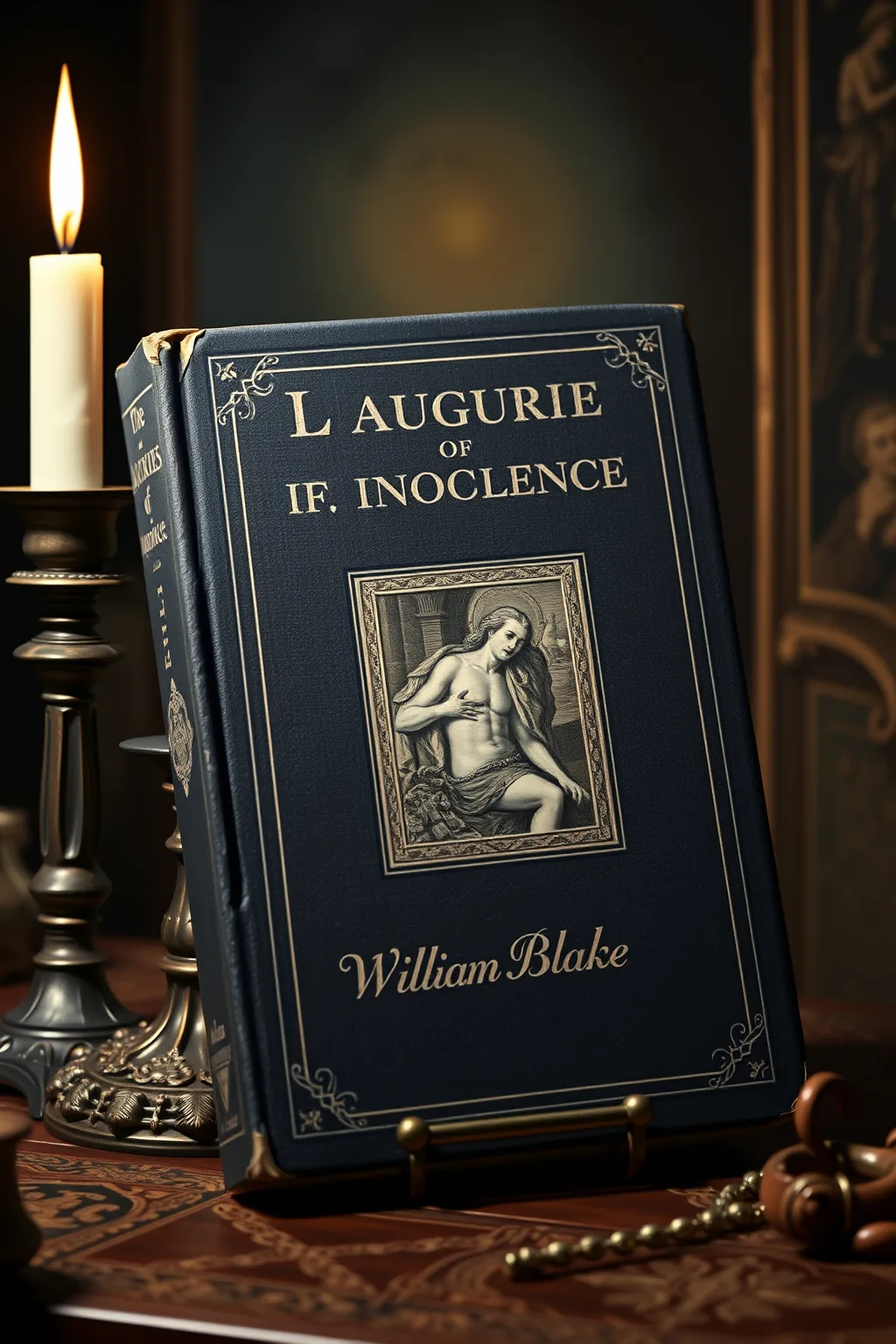
Lines from The auguries of innocence



Lorelei Sage, Contemplative Literature Editor: William Blake's 'Auguries of Innocence' is a cornerstone of visionary literature, offering profound esoteric insights into the fabric of reality. Sage’s masterful distillation of Blake’s complex symbolism reveals the interconnectedness of the microcosm and macrocosm, challenging readers to perceive divine order in apparent chaos. This work is essential for those seeking to understand Blake’s unique metaphysical system and its implications for spiritual awakening. Its strength lies in its dense, yet accessible, prophetic pronouncements that resonate across centuries, offering potent guidance for seekers of hidden knowledge and philosophical contemplation. An indispensable addition to any serious occult or metaphysical library, it rewards deep study and reflection.
📝 Description
61
William Blake wrote 'Auguries of Innocence' around 1803, a poem of 128 couplets.
Blake's 'Auguries of Innocence' presents a vision of the cosmos where minute details reflect universal laws. The poem connects the natural world, from insects to flowers, with spiritual and celestial events. Blake suggests that seeing a grain of sand can reveal the universe, and a wild flower can hold eternity. He contrasts the states of innocence and experience, arguing that a corrupted world obscures this fundamental connection. The work is not a simple lyric but a dense assertion of Blake's metaphysical ideas. It criticizes societal structures that blind individuals to deeper realities. The poem calls for a spiritual awakening to perceive the divine in all things.
This poem acts as a guide to understanding the underlying order of existence. Blake uses vivid imagery and paradox to challenge ordinary perception. He encourages readers to find spiritual truth in everyday observations. The work is an expression of Blake's unique philosophical and theological system. It invites contemplation on the relationship between the material and the spiritual. The verses aim to reveal hidden patterns that govern life and the universe.
William Blake's 'Auguries of Innocence' fits within the tradition of visionary poetry influenced by Gnosticism and Hermeticism. Like many esoteric thinkers, Blake sought to reveal hidden spiritual truths underlying the material world. His belief that 'every thing that lives is holy' echoes concepts of divine immanence found in various mystical traditions. The poem’s focus on seeing the divine in the mundane, such as in a grain of sand or a wild flower, aligns with the Hermetic principle of 'As Above, So Below.' Blake’s critique of corrupted perception can be seen as a rejection of materialistic philosophies that obscure spiritual reality, a common theme in esoteric thought.
💡 Why Read This Book?
This seminal work invites you to perceive the divine in the everyday, unveiling cosmic truths through Blake's potent visionary lens. It's a powerful catalyst for spiritual awakening, challenging conventional perception and revealing the interconnectedness of all existence. Ideal for seekers of hidden knowledge, scholars of esoteric traditions, and practitioners of deep contemplation who desire a profound connection to universal wisdom.
⭐ Reader Reviews
Honest opinions from readers who have explored this book.
❓ Frequently Asked Questions
What is the primary theme of 'Auguries of Innocence'?
The primary theme is the profound interconnectedness of all things, revealing divine order and spiritual truth within the seemingly mundane, urging readers to see the infinite in the finite.
Is this book suitable for beginners in esoteric studies?
While dense, its powerful imagery and direct pronouncements offer an accessible entry point for curious beginners drawn to Blake's unique visionary perspective and metaphysical concepts.
How does 'Auguries of Innocence' relate to divination?
Blake's poem functions as a form of spiritual divination, offering insights into universal laws and future possibilities by interpreting symbolic correspondences between the earthly and celestial realms.
What makes Blake's perspective unique?
Blake's unique perspective stems from his visionary experiences, allowing him to perceive a spiritual reality underlying the material world, expressed through a rich personal mythology and symbolism.
Can this book be interpreted through modern esoteric lenses?
Absolutely. Its themes of interconnectedness, spiritual awakening, and the power of perception align with contemporary esoteric thought, offering timeless wisdom applicable to modern spiritual practices.
🔮 Key Themes & Symbolism
The Infinite in the Finite
Blake posits that the smallest elements of existence—a grain of sand, a wild flower—contain the essence of the infinite. This theme challenges the materialist worldview, asserting that true understanding comes from perceiving the divine spark within all things. By observing these minute wonders with open eyes and a receptive spirit, one can glimpse the vastness of creation and the eternal principles that govern it. It’s an invitation to transcend superficial observation and engage with the profound mysteries embedded in the everyday, revealing the interconnectedness of the cosmos.
Spiritual Vision and Perception
This theme explores the transformative power of altered perception. Blake suggests that our ordinary sight is limited, clouded by societal conditioning and materialism. True spiritual vision, however, allows us to see the world as it truly is—a divine manifestation alive with energy and meaning. The 'Auguries' acts as a guide, urging readers to cultivate this inner sight, to look beyond the veil of illusion and recognize the spiritual reality that underpins all existence. It emphasizes that awakening is an internal process of shifting one's perspective.
The Interconnectedness of All Being
A core part of Blake's philosophy, this theme underscores the profound unity of the universe. Every element, from the smallest insect to the grandest star, is inextricably linked. Harm to one affects the whole, and the well-being of the universe is reflected in the state of its individual parts. This concept has deep resonance with modern ecological and spiritual thought, promoting a sense of universal responsibility and empathy. Blake encourages us to recognize ourselves in the 'other,' fostering a compassionate understanding of our shared cosmic journey.
💬 Memorable Quotes
Direct passages from the work, attributed to the author.
“To see a World in a Grain of Sand”
— This iconic line captures Blake's vision of perceiving the infinite within the finite, revealing divine universality in the smallest material forms.
“And a Heaven in a Wild Flower”
— Extending the idea of microcosm, this phrase highlights how profound spiritual truths and celestial beauty can be found through mindful observation of nature's simple wonders.
“Hold Infinity in the palm of your hand”
— A powerful metaphor for the inherent divine potential within each individual, suggesting that ultimate cosmic understanding and power are accessible through inner realization.
“For everything that lives is Holy”
— A foundational tenet of Blake's philosophy, asserting the sacredness of all life forms and the divine essence that animates every living being in the universe.
💡 Key Ideas
Editorial paraphrase of the work's core concepts — not direct quotes.
And Eternity in an hour
This quote speaks to the timeless nature of spiritual experience, implying that profound encounters with eternity are possible within the fleeting moments of ordinary human life.
🌙 Esoteric Significance
Tradition
Blake's work draws from a collection of esoteric traditions, including Gnosticism, Kabbalah, and Hermeticism, blended with his unique visionary interpretations of Christian scripture. He espoused a form of spiritual idealism, believing in a divine reality that underpins the material world and can be accessed through intuition and imagination rather than purely rational deduction. His 'Auguries' functions as a form of spiritual gnosis, offering hidden knowledge about the nature of creation, the human soul, and the interconnectedness of all things, aligning with the broader Hermetic principle of 'As Above, So Below.'
Symbolism
The symbolism in 'Auguries of Innocence' is dense and multi-layered, drawing from both biblical and natural imagery. The 'grain of sand,' 'wild flower,' and 'fly' represent the microcosm, containing profound truths about the macrocosm. The 'lamb' symbolizes innocence and divine love, while the 'tiger' represents the fierce, untamed energy of creation and experience. Light and darkness, fire and water, and celestial bodies all carry potent spiritual connotations. Blake uses these symbols not merely as metaphors, but as living embodiments of spiritual forces, revealing the divine architecture of the universe.
Modern Relevance
In an age often characterized by materialism, scientific reductionism, and environmental concerns, Blake's 'Auguries of Innocence' offers a vital antidote. Its emphasis on the interconnectedness of all life resonates deeply with contemporary ecological awareness and the growing interest in holistic and integral philosophies. The poem's call to spiritual perception and the recognition of the divine in the mundane speaks to individuals seeking deeper meaning and a connection to something larger than themselves, making it a timeless source of inspiration for spiritual seekers and contemplative practitioners.
👥 Who Should Read This Book
This profound collection is essential for seasoned practitioners of esoteric arts seeking to deepen their understanding of cosmic interconnectedness and symbolic language. Scholars of mystical poetry and philosophy will find it an invaluable text for exploring Blake's unique metaphysical system and its historical context. For the contemplative seeker, it offers a powerful tool for spiritual awakening, encouraging a shift in perception to reveal the divine in the everyday. Beginners drawn to the mysteries of existence will find its vivid imagery and direct pronouncements an inspiring, albeit challenging, introduction to visionary thought and the potential for seeing beyond the ordinary.
📜 Historical Context
Written around 1803 but not published until 1863, 'Auguries of Innocence' emerged from William Blake's deeply individualistic and visionary response to the tumultuous late 18th and early 19th centuries in England. This era was marked by the Enlightenment's rationalism, the Industrial Revolution's societal upheaval, and the French Revolution's radical political and philosophical shifts. Blake, an artist, poet, and mystic, stood apart from many of his contemporaries. While some embraced scientific progress and empirical reason, Blake sought a deeper, spiritual understanding of existence, heavily influenced by his personal mystical experiences and a reinterpretation of biblical narratives. His work often critiques the perceived limitations of reason alone and the dehumanizing effects of industrialization and societal strictures. 'Auguries of Innocence' can be seen as a poetic counter-response, a call to awaken to a divinely ordered, interconnected cosmos that transcends the material and the rationalistic. It reflects a mind grappling with the profound changes of his time, seeking eternal truths amidst earthly chaos.
📔 Journal Prompts
Reflect on a small, seemingly insignificant aspect of nature (e.g., an insect, a leaf). How might it hold a universe of meaning or divine truth, as Blake suggests?
Explore the concept of 'seeing the world in a grain of sand.' What limitations does our typical perception impose, and how can we cultivate a more profound, interconnected view of reality?
Consider the line 'For everything that lives is Holy.' How does this idea challenge or affirm your current beliefs about life and its inherent value?
Blake speaks of 'Eternity in an hour.' Describe a moment in your life where you felt a profound sense of timelessness or connection to something eternal.
How does the idea of 'innocence' and 'experience' play out in your understanding of the world and yourself, as hinted at in the title's implication?
🗂️ Glossary
Auguries
Omens or portents, especially those derived from the observation of natural phenomena or celestial events; prophetic interpretations of signs.
Microcosm
The human being or the world in miniature, seen as a reflection of the larger universe (macrocosm).
Macrocosm
The universe considered as a complex whole, in which the human being is mirrored; the greater world.
Gnosis
Knowledge of spiritual mysteries; intuitive or revealed understanding, particularly in Gnostic traditions, leading to salvation.
Visionary
Characterized by or relating to imaginative or prophetic visions; experiencing or expressing divine or supernatural insights.
This book appears in 1 collection
🔮 Readers Also Liked
Browse all →








More by William Blake
All books →





From the “Augury” Collection
View all →









More Free Divination & Tarot Books
View all →