William Blake
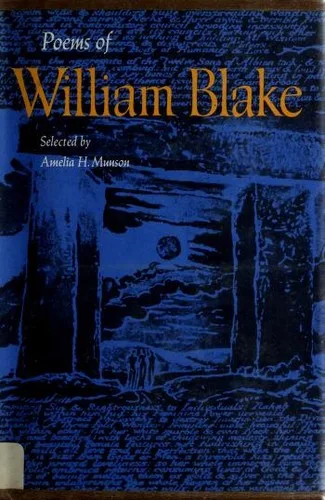
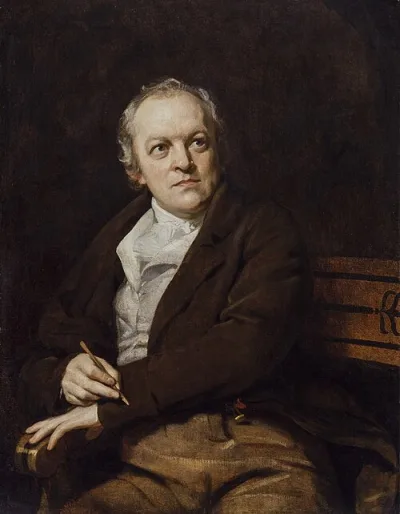
William Blake was an English poet and painter, a key figure of the Romantic Age, known for his visionary works and unique artistic style.
William Blake, born in London in 1757, was an English poet, painter, and printmaker whose work profoundly influenced the Romantic Age. Despite being largely unrecognized during his lifetime and considered eccentric by his contemporaries, Blake has since been acclaimed for his imaginative and creatively rich body of work. He embraced the imagination as fundamental to existence, a concept deeply embedded in his "prophetic works." His artistic and poetic output, while rooted in his lifelong residence in London with a brief period in Felpham, is characterized by its symbolic depth and philosophical undercurrents.
Blake's upbringing included early mystical religious experiences and a strong influence from the Bible. He received formal training in engraving, which shaped his artistic development. Although he held unconventional views, including skepticism towards organized religion, and was inspired by the revolutionary ideals of his time, his work remains distinct and difficult to categorize. His wife, Catherine Boucher, was a crucial collaborator, assisting him as an engraver and colorist, making their partnership integral to the realization of his numerous artistic projects.
Visionary Art and Mystical Thought
William Blake's artistic and poetic creations are marked by profound visionary experiences and a deep engagement with mystical thought. He viewed the imagination as the very essence of divinity and human existence, a core tenet that permeated his "prophetic works." These works, though often unappreciated during his life, are now recognized for their unique symbolic language and philosophical depth. Blake's unconventional perspectives led contemporaries to view him as eccentric, yet later critics have celebrated his expressiveness and creativity. His art and poetry are often associated with the Romantic movement, sometimes described as "Pre-Romantic," reflecting a unique blend of tradition and radical personal vision. Despite his spiritual inclinations, he was critical of established religious institutions, aligning instead with the revolutionary spirit of his era and influenced by thinkers like Emanuel Swedenborg.
Artistic Training and Influences
Blake's artistic journey began with an early aptitude for drawing and engraving, influenced by classical forms seen in the works of Raphael, Michelangelo, Dürer, and van Heemskerck. His formal apprenticeship under James Basire provided him with foundational skills in line-engraving, though this traditional style was considered old-fashioned. His experiences sketching in Gothic churches, particularly Westminster Abbey, significantly shaped his stylistic development, imbuing his work with the "living form" of Gothic art. Later, as a student at the Royal Academy, Blake developed a critical stance against prevailing artistic trends, notably challenging the principles of Joshua Reynolds, whom he accused of hypocrisy and an overemphasis on generalization at the expense of particularity. This period also saw him forge friendships with artists like John Flaxman, who shared his radical outlook.
Collaboration and Partnership
The creative output of William Blake was significantly facilitated by the dedicated collaboration of his wife, Catherine Boucher. Married in 1782, Catherine became an indispensable partner in both his personal life and artistic endeavors. She worked closely with Blake as an engraver and colorist, playing a vital role in bringing his complex illustrated books to fruition. Her contributions included mixing and applying colors, notably on works like the cover of "Europe: A Prophecy." The partnership was so integral that they jointly executed nearly every aspect of book production, from writing and designing to printing and engraving. This close working relationship, spanning nearly forty-five years, allowed Blake to realize numerous projects that would have been impossible without Catherine's artistic and technical assistance.
Key Ideas
- Imagination as the body of God / human existence itself
- Critique of organized religion and emphasis on individual spirituality
- Rejection of generalization in art in favor of particularity
- The symbolic and visionary nature of art as a spiritual practice
Notable Quotes
“To Generalize is to be an Idiot; To Particularize is the Alone Distinction of Merit”
Books by William Blake
7 free public domain books · Read online or download