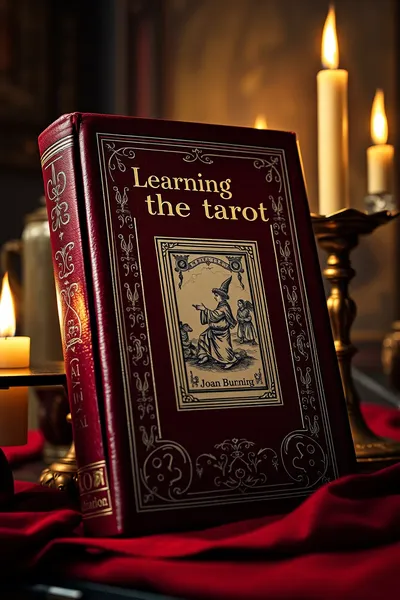
Learning the tarot
 72
72

Learning the tarot



Celeste Moreau, Divination & Symbolism Reviewer — Joan Bunning's 'Learning the Tarot' is an indispensable cornerstone for anyone seeking to truly understand the Tarot's mystical depths. Bunning elegantly demystifies the intricate symbolism, revealing the Tarot as a profound system of archetypal knowledge rather than a simplistic fortune-telling device. Her approach fosters a deep, intuitive connection with the cards, empowering readers to access their own inner wisdom. This work is particularly beneficial for those who approach the Tarot with a scholarly or spiritual inclination, eager to grasp its philosophical underpinnings and its role within Western esoteric traditions. An authoritative yet accessible guide, it illuminates the path for both neophytes and seasoned practitioners.
📝 Description
72
Joan Bunning's 'Learning the Tarot' was first published in 1997.
Joan Bunning's 'Learning the Tarot,' first released in 1997, approaches the tarot deck as a system for personal growth and spiritual understanding. It moves beyond simple divination meanings to examine the deeper symbolism and archetypal patterns within the Major and Minor Arcana. Bunning details the structure of the cards, their correspondences, and methods for intuitive interpretation. The book guides readers to see the tarot as a reflective tool, a map of consciousness rather than a fortune telling device.
This work aims to equip students with a solid framework for working with the cards. It covers the historical context and the philosophical underpinnings that inform tarot practice. Bunning's approach is structured and thorough, designed to build a strong foundation for those serious about understanding the tarot's symbolic language. The goal is to foster self-awareness and insight through diligent study of the deck.
This book sits within the Western esoteric tradition that views the tarot as a symbolic language connected to consciousness and spiritual development. It draws on traditions that see the cards as a mirror to the psyche and the cosmos, echoing hermetic principles and Jungian psychology. Unlike purely divinatory systems, Bunning's work emphasizes the tarot's capacity for introspection and understanding universal human experiences.
💡 Why Read This Book?
Embark on a profound journey into the heart of Tarot symbolism with Joan Bunning. This book is ideal for spiritual seekers yearning for deeper self-understanding, aspiring diviners seeking a robust foundation, and scholars interested in the esoteric and archetypal significance of the cards. 'Learning the Tarot' offers a pathway to unlocking hidden knowledge and cultivating intuitive insight, transforming a simple deck into a powerful tool for personal growth and spiritual exploration.
⭐ Reader Reviews
Honest opinions from readers who have explored this book.
❓ Frequently Asked Questions
Is 'Learning the Tarot' suitable for absolute beginners?
Absolutely. Joan Bunning's approach is renowned for its clarity and gradual progression, making it an ideal starting point for those with no prior Tarot experience. The book builds foundational knowledge step-by-step.
Does this book focus on predicting the future?
No, the emphasis is on self-discovery, understanding archetypal energies, and gaining insight into life's patterns. While it offers predictive potential, its core is philosophical and psychological exploration.
What makes this book different from other Tarot guides?
Bunning's work stands out for its depth of symbolic interpretation, its connection to Western esoteric traditions, and its focus on developing intuitive understanding rather than rote memorization.
Can I use any Tarot deck with this book?
Yes, while the book often references the Rider-Waite-Smith deck due to its widespread influence, the principles and interpretations can be applied to most traditional Tarot decks.
Does the book include practical exercises or spreads?
Yes, the book includes various practical exercises and recommended spreads designed to help readers integrate their learning and apply it to real-life situations.
🔮 Key Themes & Symbolism
The Archetypal Language of the Tarot
This theme explores how the Tarot serves as a universal language of archetypes, mirroring the fundamental patterns of human experience and the cosmos. Bunning guides readers to perceive the profound symbolism within each card, from the primal journey of the Fool to the ultimate integration represented by the World. Understanding these archetypes allows for a deeper comprehension of personal challenges, life transitions, and the underlying forces that shape our reality. It's about recognizing the sacred geometry and ancient wisdom embedded within the cards.
Tarot as a Mirror of the Psyche
Joan Bunning presents the Tarot not as an external oracle, but as an internal map of the human psyche. Each card reflects different facets of our consciousness, our emotions, our spiritual aspirations, and our shadow aspects. This theme emphasizes the Tarot's capacity for introspection and self-awareness, encouraging readers to use the cards as a tool for psychological exploration and personal growth. It highlights how the seemingly mystical imagery can illuminate our inner world, revealing hidden potentials and guiding us towards greater wholeness and integration.
The Esoteric Journey of Self-Discovery
This theme frames Tarot study as a profound spiritual quest. Bunning connects the Tarot to ancient esoteric traditions, revealing its roots in Hermeticism, Kabbalah, and other wisdom systems. The book encourages a devotional approach, viewing the Tarot as a sacred text that facilitates initiation into deeper spiritual truths. It's about understanding the symbolic journey through the Major Arcana as a metaphor for the soul's evolution, offering guidance on navigating life's trials and tribulations with wisdom and grace. The ultimate aim is transformation and awakening.
💬 Memorable Quotes
Direct passages from the work, attributed to the author.
“Each card is a doorway to a deeper understanding.”
— This emphasizes the potential for clear insights contained within each Tarot card, suggesting that with proper study, they unlock layers of meaning.
“The wisdom of the Tarot is ancient and eternal.”
— This highlights the timeless nature of Tarot symbolism and its connection to universal truths that transcend specific cultures or eras.
“Learn to listen to the whispers of the cards.”
— This encourages developing an intuitive connection with the Tarot, suggesting that the cards communicate on a subtle, almost telepathic level.
“The journey through the Tarot is a journey within.”
— This reinforces the book's central theme of the Tarot as a tool for internal exploration and spiritual development, rather than an external divinatory system.
💡 Key Ideas
Editorial paraphrase of the work's core concepts — not direct quotes.
The Tarot is a mirror that shows us our own souls.
This quote captures the book's core philosophy: the Tarot's primary function is not prediction, but introspection and self-awareness, reflecting our inner landscape.
🌙 Esoteric Significance
Tradition
This work is deeply rooted in the Western Esoteric Tradition, drawing heavily from Hermeticism, Kabbalah, and Jungian archetypal psychology. It positions the Tarot as a symbolic language that maps the journey of the soul and the intricate workings of the psyche. The book aligns with the Hermetic principle of 'As Above, So Below,' suggesting that the microcosm of the human mind reflects the macrocosm of the universe, with the Tarot acting as a bridge between the two.
Symbolism
The Tarot's symbolism is presented as a collection of archetypal imagery, drawing from mythology, astrology, and ancient wisdom. The Major Arcana represent universal life lessons and stages of spiritual development, while the Minor Arcana depict the everyday experiences and energies of life. Bunning meticulously unpacks the intricate details of each card, revealing their deeper meanings and connections to the Tree of Life and other esoteric frameworks.
Modern Relevance
In contemporary society, 'Learning the Tarot' offers a vital pathway to cultivating mindfulness, intuition, and self-awareness amidst constant external stimuli. It provides a framework for navigating life's complexities with greater wisdom and resilience. The book's emphasis on archetypal understanding appeals to modern psychological theories, making it a valuable tool for personal growth, creative expression, and spiritual exploration in an increasingly secularized world.
👥 Who Should Read This Book
This comprehensive guide is essential for a diverse audience. Beginners will find a clear, structured entry point into the profound world of Tarot, with easy-to-understand explanations and practical exercises. Scholars of esotericism and mythology will appreciate the depth of symbolic interpretation and the historical context provided. Spiritual seekers yearning for self-discovery and deeper insight will find the Tarot a powerful mirror for their inner journey. Practitioners looking to refine their skills and deepen their understanding of the cards will benefit from Bunning's insightful approach, transforming their readings from mere predictions to profound explorations.
📜 Historical Context
Joan Bunning's 'Learning the Tarot' emerged during a resurgence of interest in esoteric studies and divination in the late 20th century. This period saw a renewed appreciation for ancient wisdom traditions, including Hermeticism, Kabbalah, and Jungian psychology, all of which heavily influence modern Tarot interpretation. The book reflects a scholarly yet accessible approach, drawing from the strong symbolism established by the Rider-Waite-Smith deck, which itself was a groundbreaking synthesis of occult symbolism. Its publication contributed significantly to clarifying the Tarot for a wider audience, moving it beyond the field of mere parlor tricks into a respected tool for psychological insight and spiritual exploration. It stands as a proof of the enduring appeal of symbolic systems in understanding the human condition.
📔 Journal Prompts
Reflect on the archetype of the Fool in your own life. Where are you starting a new, uncertain path?
Choose a Minor Arcana card that appeals to your current emotions. What message does its imagery offer?
How does the concept of 'As Above, So Below' apply to a recent challenge you faced?
Consider the journey of a Major Arcana card (e.g., The High Priestess, The Hierophant) as a metaphor for your own spiritual development. Where are you on this path?
What hidden aspects of your psyche do the court cards (Page, Knight, Queen, King) represent for you?
🗂️ Glossary
Archetype
Universal, archaic patterns and images that derive from the collective unconscious and are the experiences of humanity.
Major Arcana
The 22 trump cards of the Tarot deck, representing significant life lessons, spiritual stages, and archetypal forces.
Minor Arcana
The 56 cards of the Tarot deck, divided into four suits, representing the everyday experiences, challenges, and circumstances of life.
Rider-Waite-Smith Deck
A highly influential Tarot deck created in 1909, known for its richly symbolic imagery and its systematic approach to the Minor Arcana.
Esotericism
Belief systems, spiritual practices, and philosophies that are concerned with the hidden or inner spiritual meaning or self-transformation.
This book appears in 3 collections
🔮 Readers Also Liked
Browse all →
More by Joan Bunning
All books →
From the “Tarot” Collection
View all →
More Free Divination & Tarot Books
View all →