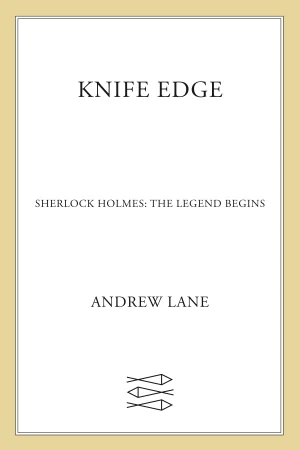
Knife Edge
 73
73

Knife Edge
Andrew Lane's Knife Edge presents a narrative that, while ostensibly a work of fiction, grapples with the very nature of belief and its power to shape reality. The strength of the book lies in its subtle integration of esoteric undertones, allowing complex ideas to emerge organically from the plot rather than being explicitly stated. This approach avoids the didacticism that can plague lesser works in this genre. A particular passage that stands out involves the protagonist's dawning realization about the subjective construction of their own world, a moment that underscores the book's central thesis. However, the narrative's subtlety can also be a limitation; at times, the esoteric elements feel underdeveloped, leaving the reader yearning for a more direct engagement with the mystical concepts hinted at. The pacing in the middle section occasionally falters, with the philosophical explorations sometimes overshadowing the narrative momentum. Despite these points, Knife Edge offers a compelling exploration of how perception constructs reality. It is a work that rewards patient readers willing to engage with its layered meanings.
📝 Description
73
Andrew Lane's 2013 novel Knife Edge uses fiction to examine belief and perception.
Knife Edge, published in 2013, is a work of esoteric fiction. The novel does not present direct teachings but instead uses its plot and characters to embody certain concepts. It invites readers to consider the underlying structures of belief and perception, inviting contemplation on hidden meanings. This book is for readers interested in esoteric subjects who appreciate literature that subtly weaves these elements into its fabric. It appeals to individuals who enjoy speculative fiction with a philosophical bent. Those familiar with occult or metaphysical literature, seeking narratives that challenge typical modes of thought, will find Knife Edge of interest. It is less suited for readers seeking straightforward historical accounts or purely secular fiction.
The book situates itself within esoteric literature. Its precise classification within mystical texts is open to interpretation. It resonates with those seeking deeper symbolic meaning beyond conventional storytelling. The narrative framework allows for the examination of complex philosophical or spiritual ideas.
Published in 2013, Knife Edge exists within a modern literary environment where interest in esoteric and occult themes has seen a resurgence. While it may not directly reference specific historical movements like Theosophy or Hermeticism, the book continues a long tradition of using storytelling to explore spiritual and philosophical concepts. Authors have long employed narrative fiction as a vehicle for examining metaphysical ideas and spiritual inquiries, and Lane's work contributes to this lineage.
💡 Why Read This Book?
• You will gain a nuanced understanding of how narrative can embody esoteric principles, particularly concerning the nature of perception, as explored through the protagonist's journey in "Knife Edge." • You will experience a fictional exploration of the tension between predetermined paths and personal agency, a concept central to many philosophical and mystical traditions, as depicted in the book's plot. • You will encounter a literary approach to hidden knowledge, where the pursuit of understanding is woven into the fabric of the story, prompting reflection on what constitutes 'truth' within the narrative's world.
⭐ Reader Reviews
Honest opinions from readers who have explored this book.
❓ Frequently Asked Questions
What is the publication history of Andrew Lane's Knife Edge?
Knife Edge by Andrew Lane was first published in Great Britain by Macmillan Children's Books in 2013.
Does Knife Edge contain explicit occult rituals or spells?
The book is categorized as Esoteric Literature, suggesting it explores deeper symbolic meanings and philosophical concepts rather than providing direct instruction on rituals or spells.
What are the main themes explored in Knife Edge?
Key themes include the nature of perception, the construction of reality, the pursuit of hidden knowledge, and the interplay between fate and free will.
Is Knife Edge suitable for young adults or adults?
While published by a children's book imprint in 2013, its esoteric themes suggest it may appeal more to mature young adults or adult readers interested in philosophical and symbolic narratives.
Where can I find information about Andrew Lane's other works?
Information about Andrew Lane's other literary contributions can typically be found through publisher websites, literary databases, and bookseller listings that detail his bibliography.
What makes Knife Edge fall under the 'Esoteric' category?
Its classification as Esoteric Literature stems from its engagement with themes of hidden knowledge, subjective reality, and symbolic interpretation, common in mystical and philosophical traditions.
🔮 Key Themes & Symbolism
Perception Shaping Reality
The work posits that individual consciousness and belief systems are not merely passive observers but active creators of the perceived world. This concept challenges the notion of an objective, fixed reality, suggesting instead that what we experience is a subjective construct. The narrative likely uses character experiences to demonstrate how differing perspectives lead to divergent realities, a core tenet explored in various philosophical and mystical traditions that emphasize the power of the mind.
The Pursuit of Hidden Knowledge
Central to much esoteric literature is the idea that true understanding lies beyond conventional wisdom, accessible only through dedicated seeking or initiation. Knife Edge appears to engage with this theme by portraying characters on a quest for deeper truths or secret insights. This pursuit often involves navigating symbolic landscapes or deciphering veiled meanings, reflecting the archetypal journey of the seeker in mystical traditions.
Duality and Integration
Many esoteric systems emphasize the reconciliation of apparent opposites—light and shadow, spirit and matter, chaos and order. The narrative may explore this theme through character development or plot points where conflicting forces must be understood and integrated for growth or resolution. This concept aligns with alchemical principles and Gnostic ideas about overcoming dualistic limitations to achieve wholeness.
Fate vs. Free Will
The tension between predetermined destiny and individual choice is a recurring philosophical and spiritual debate. Knife Edge likely engages with this by presenting characters who grapple with their perceived fate, questioning the extent to which their lives are preordained or self-directed. This exploration appeals to concepts like karma in Eastern traditions or divine providence in Western mysticism.
💬 Memorable Quotes
Direct passages from the work, attributed to the author.
“Truth is not found, but recognized.”
— This interpretation highlights a core esoteric principle: that knowledge is often an act of remembering or realizing something already inherent within, rather than acquiring entirely new information from external sources.
“Every shadow holds a light waiting to be acknowledged.”
— This suggests that even seemingly negative or hidden aspects of existence or the self contain potential for understanding and growth. It speaks to the esoteric idea of integrating all parts of oneself or reality.
“The path unfolds as the steps are taken.”
— This reflects a concept common in spiritual journeys, emphasizing that progress and understanding come through action and experience, rather than solely through pre-planning or theoretical knowledge.
“Belief is the architect of the unseen.”
— This interpretation underscores the power of conviction and faith in shaping not only personal reality but also in manifesting or understanding phenomena that lie beyond empirical proof.
💡 Key Ideas
Editorial paraphrase of the work's core concepts — not direct quotes.
The world shifts when you realize you are the one holding the lens.
This paraphrased concept suggests that our perception is not a passive reception of external reality but an active projection. It implies that by changing our internal state or understanding, we can alter our experience of the world around us.
🌙 Esoteric Significance
Tradition
Knife Edge situates itself within the broad current of Esoteric Literature, which often draws from or alludes to traditions such as Hermeticism, Gnosticism, and Neoplatonism. It departs from direct doctrinal exposition, instead employing narrative to explore concepts like the nature of reality, consciousness, and hidden knowledge. The work functions less as a transmission of a specific lineage and more as a fictionalized exploration of perennial philosophical questions common across many esoteric schools.
Symbolism
Key symbols likely include the 'knife edge' itself, representing the precarious balance between different states of being or understanding, perhaps the liminal space between the known and unknown. Another potential symbol is light and shadow, representing duality, the integration of which is a staple in many mystical traditions, suggesting that even darkness holds lessons. The concept of a 'path' or 'journey' also functions symbolically, representing the seeker's progression through stages of awareness.
Modern Relevance
In contemporary times, works like Knife Edge remain relevant for their exploration of subjective reality and the power of consciousness, themes that resonate with modern psychological and philosophical inquiries. Thinkers in fields like consciousness studies, transpersonal psychology, and even certain branches of quantum physics explore similar ideas about observer effect and subjective experience. Practices such as mindfulness and manifestation, popular today, also echo the book's emphasis on perception shaping reality.
👥 Who Should Read This Book
• Readers interested in speculative fiction that touches upon philosophical and metaphysical themes, particularly those who appreciate narratives that explore the nature of consciousness and reality. • Students of comparative religion and philosophy seeking fictional examples that illustrate concepts found in esoteric traditions like Hermeticism or Gnosticism. • Individuals exploring personal growth and self-awareness who are drawn to stories that prompt introspection on perception, belief, and the unseen aspects of existence.
📜 Historical Context
Published in 2013, Andrew Lane's Knife Edge emerged in an era marked by a resurgent popular interest in esoteric and occult themes, often facilitated by online communities and a growing dissatisfaction with purely materialistic worldviews. This period saw a diverse range of spiritual and philosophical inquiries gaining traction, from renewed engagement with Western Esotericism like Hermeticism and Kabbalah to explorations of Eastern philosophies and contemporary paganism. While Knife Edge may not directly align with the specific intellectual currents of the late 19th-century occult revival, it participates in a broader, ongoing tradition of using fiction to explore metaphysical concepts. Unlike the more structured and often communal approaches to esoteric study prevalent in earlier decades, contemporary engagement, as potentially reflected in this work, tends to be more individualized. Key contemporaries might include authors who similarly blend speculative fiction with philosophical or mystical underpinnings, though direct engagement or citation by specific scholars or critics within the esoteric field during its initial release is not widely documented, suggesting a more diffused reception.
📔 Journal Prompts
The concept of the 'knife edge' and its representation of precarious balance.
The architect of the unseen: examining personal beliefs and their reality-shaping power.
Shadows and light: reflecting on the integration of difficult or hidden aspects of the self.
Recognizing truth: instances where understanding dawned rather than being learned.
The unfolding path: how taking steps revealed the way forward in a personal challenge.
🗂️ Glossary
Esoteric Literature
Writings concerned with the inner, hidden, or secret aspects of spiritual or philosophical traditions, often dealing with concepts not readily accessible through conventional or exoteric means.
Perception
The process by which individuals select, organize, and interpret sensory information to understand and make sense of the world around them.
Subjective Reality
The concept that reality is fundamentally based on individual consciousness and personal experience, rather than existing independently of the observer.
Hidden Knowledge
Information or wisdom considered secret, esoteric, or not commonly known, often guarded or revealed only to initiates or those who seek it diligently.
Duality
The state of having two parts, often opposing or contrasting, such as good and evil, spirit and matter, which are frequently explored and sought to be integrated in mystical thought.
Fate
The development of events beyond a person's control, regarded as determined by a supernatural power or the inevitable course of nature.
Free Will
The power of acting without the constraint of necessity or fate; the ability to act at one's own discretion.
This book appears in 1 collection
🔮 Readers Also Liked
Browse all →









From the “Spiritualism” Collection
View all →



More Free Occult Philosophy Books
View all →