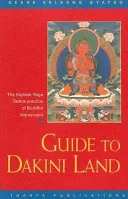
Guide to Dakini Land
 82
82

Guide to Dakini Land
Geshe Kelsang Gyatso's 'Guide to Dakini Land' offers a focused exposition on the visualization and contemplative practices central to the New Kadampa Tradition's understanding of Tantric Buddhism. Its strength lies in its systematic approach, breaking down complex meditations into actionable steps for dedicated practitioners. The book clearly outlines the specific visualizations and mantras associated with invoking and realizing the Dakini realm. However, its highly specialized nature and specific doctrinal framing may present a barrier for those outside the NKT lineage, as it assumes a considerable level of prior initiation and understanding. A particularly vivid passage describes the "pure land" as an internal experience, a mental construct of profound clarity rather than an external location. While valuable for its intended audience, its insular doctrinal presentation limits its broader appeal within the diverse field of Buddhist studies. It functions effectively as a practitioner's guide within its specific tradition, but less so as a comparative or introductory text.
📝 Description
82
Published in 1991, Guide to Dakini Land is a practical manual for Tantric Buddhist practitioners.
Guide to Dakini Land functions as a manual for understanding and practicing with Dakinis within Tantric Buddhism. Geshe Kelsang Gyatso wrote this text, first published in 1991, for individuals committed to the Vajrayana path. It details methods for transforming ordinary perception into the pure perception of a Buddha-field, focusing on the visionary aspects of Tantra. This work is intended for practitioners who have received necessary empowerments and teachings. It presumes a foundational understanding of Buddhist principles and a commitment to dedicated practice. The book is not a general introduction to Buddhism but a specific guide for those within the New Kadampa Tradition (NKT) exploring its unique lineages and methods.
The book emerged from Geshe Kelsang Gyatso's efforts to establish the NKT in the late 20th century. Its 1991 publication by Tharpa Publications was a significant moment for disseminating the NKT's presentation of Buddhist Tantra. This occurred during a period of global interest in Tibetan Buddhism. However, the NKT's approach, with its distinct lineage and interpretive framework, set it apart. The content is deeply rooted in the Gelug school, from which Gyatso originally hailed, but adapted for the NKT's specific system.
This text belongs to the Vajrayana tradition of Buddhism, specifically as presented within the New Kadampa Tradition (NKT). Vajrayana, often referred to as Tantric Buddhism, involves advanced practices and visualizations aimed at rapid spiritual development. The Dakinis are female figures in Tantric Buddhism, understood as wisdom-goddesses or manifestations of enlightened energy. Their practices, as detailed in this guide, are crucial for realizing the potential of Tantric methods to transform ordinary experience into enlightened awareness. The book emphasizes the visionary aspect of these practices, aligning with the NKT's focus on integrating these teachings into a practitioner's path.
💡 Why Read This Book?
• Learn the specific visualization techniques for cultivating a "pure perception" of reality as taught within the NKT, moving beyond ordinary sensory experience, as detailed in the sections on Dakini Land. • Understand the symbolic role of Dakinis not just as deities but as energetic principles of enlightened activity, offering a unique perspective on wisdom in Vajrayana Buddhism. • Gain insight into the practical application of Tantric meditations as presented by Geshe Kelsang Gyatso, providing a method for spiritual transformation rooted in the NKT's lineage and teachings.
⭐ Reader Reviews
Honest opinions from readers who have explored this book.
❓ Frequently Asked Questions
What is the primary purpose of 'Guide to Dakini Land'?
The book serves as a practical manual for practitioners of the New Kadampa Tradition, guiding them through the specific meditations and visualizations associated with Dakini Land, a pure realm within Tantric Buddhism.
Who is Geshe Kelsang Gyatso?
Geshe Kelsang Gyatso is the founder of the New Kadampa Tradition, a global Buddhist movement. He is a highly respected scholar and meditation master, having published numerous books on Buddhist philosophy and practice since the 1970s.
When was 'Guide to Dakini Land' first published?
The book was first published by Tharpa Publications in 1991. Subsequent reprints have made its teachings accessible to a wider audience within its tradition.
Does this book require prior Buddhist initiation?
Yes, the teachings in 'Guide to Dakini Land' are considered advanced Tantric practices and generally require the appropriate empowerments and foundational teachings within the Vajrayana path, particularly as understood by the NKT.
What is 'Dakini Land' in the context of this book?
Dakini Land refers to a pure realm or enlightened environment experienced through advanced Tantric meditation. It is a state of pure perception where all phenomena are seen as the manifestation of enlightened wisdom and activity.
Is this book suitable for beginners in Buddhism?
No, this book is not intended for beginners. It assumes a solid grounding in Buddhist philosophy and practice, especially within the Vajrayana tradition, and is designed for those committed to specific NKT Tantric methodologies.
🔮 Key Themes & Symbolism
Pure Perception Cultivation
The core of 'Guide to Dakini Land' lies in the practice of transforming ordinary perception into 'pure perception.' This involves seeing all phenomena not as inherently impure or flawed, but as the radiant display of enlightened mind. The book details specific meditative techniques, visualizations, and mantras designed to achieve this shift, presenting it as a direct method for realizing the nature of reality as taught within the New Kadampa Tradition's interpretation of Tantra.
The Nature of Dakinis
Dakinis are presented here not simply as mythological figures but as embodiments of wisdom and the dynamic energy of enlightenment. The text explores their role as guides and facilitators on the Tantric path, particularly in manifesting the experience of a pure realm or 'Dakini Land.' Understanding their symbolic and functional significance is crucial for engaging with the practices described in the book.
Vajrayana Practice Framework
This work is firmly situated within the Vajrayana Buddhist framework, specifically the Tantric path as transmitted through the lineage of Geshe Kelsang Gyatso. It emphasizes the importance of empowerments, the guidance of a qualified teacher, and the systematic application of advanced meditative techniques to achieve rapid spiritual realization and Buddhahood.
Enlightened Environments
The concept of 'Dakini Land' serves as a metaphor and a goal for practitioners. It represents an ideal spiritual environment free from ordinary suffering and delusion, a realm where enlightened beings reside and practice flourishes. The book guides the reader on how to mentally construct and experience this realm, both as a refuge and as a direct manifestation of their own developing wisdom.
💬 Memorable Quotes
Direct passages from the work, attributed to the author.
“The Dakini Land is the pure land of the Dakinis, a pure realm where ordinary appearances are completely purified.”
— This statement expresses the book's central theme: the transformation of mundane reality into an enlightened environment through specific Tantric practices, emphasizing purification and the realization of a higher state of being.
“By engaging in these practices, one can transform their ordinary mind and environment into a pure Buddha-field.”
— This highlights the transformative potential of the meditations described. It suggests that the external world is not immutable, but can be perceived and experienced differently through the development of one's internal, enlightened mind.
“Dakinis are essential guides and protectors on the Vajrayana path.”
— This emphasizes the active role of Dakinis in the practitioner's journey. They are not passive deities but potent forces that assist, protect, and guide individuals undertaking the rigorous path of Vajrayana Buddhism.
“The practice involves deep visualization and the recitation of mantras.”
— This points to the methodology employed in the book. It underscores that achieving the state of Dakini Land requires dedicated effort through both mental imagery and the use of sacred sounds or syllables.
“Realizing Dakini Land is realizing the ultimate nature of reality.”
— This connects the specific practice to a fundamental Buddhist goal. It suggests that the experience of this pure realm is synonymous with attaining clear insights into the true nature of existence.
🌙 Esoteric Significance
Tradition
This work belongs to the Vajrayana Buddhist tradition, specifically the Tantric path as interpreted and propagated by the New Kadampa Tradition (NKT). It draws heavily on the Gelugpa lineage's understanding of Highest Yoga Tantra but presents it through the specific organizational and pedagogical framework established by Geshe Kelsang Gyatso, emphasizing empowerment and systematic practice.
Symbolism
Key symbols include the Dakini, representing wisdom and enlightened activity, and the 'Dakini Land' itself, symbolizing a pure realm or the enlightened state of mind. Visualizations of mandalas and specific deities are also crucial, serving as focal points for meditation that help practitioners internalize the qualities of Buddhahood and transform their perception of reality.
Modern Relevance
Contemporary practitioners within the NKT find this book essential for their advanced sadhana (practice). It also informs discussions on Buddhist Tantra and its modern adaptations. Scholars studying the diversification of Tibetan Buddhism in the West may reference it as an example of lineage-specific textual development and transmission in the late 20th century.
👥 Who Should Read This Book
• Committed practitioners of the New Kadampa Tradition seeking to deepen their understanding and practice of Tantric meditations, particularly those related to Dakini visualizations. • Advanced students of Vajrayana Buddhism interested in comparative Tantric methodologies and how specific lineages interpret and transmit these profound teachings. • Scholars of religious studies focusing on the development and dissemination of Tibetan Buddhism in the West, and the formation of new Buddhist traditions like the NKT.
📜 Historical Context
Published in 1991 by Tharpa Publications, 'Guide to Dakini Land' by Geshe Kelsang Gyatso emerged during a period of significant expansion for the New Kadampa Tradition (NKT). Geshe Kelsang Gyatso, having left India for the UK in 1977, was actively establishing centers and disseminating his unique interpretation of Tibetan Buddhism. The NKT's approach, while rooted in the Gelug school, presented certain teachings, particularly concerning Tantra, in a manner distinct from mainstream Gelug institutions, such as those led by the Dalai Lama. This period saw a burgeoning Western interest in Tibetan Buddhism, with various schools and lineages competing for attention and adherents. The NKT's structured approach to practice and its prolific publication output, spearheaded by Tharpa Publications, positioned it as a significant, albeit sometimes controversial, force within the broader range of Western Buddhism. The book's content reflects this effort to codify and transmit specific Tantric lineages within the NKT framework.
📔 Journal Prompts
The concept of Dakini Land as a purified environment.
Transforming ordinary appearances into pure ones.
The role of Dakinis as energetic principles.
Methods for cultivating pure perception.
Integrating Tantric practices into daily life.
🗂️ Glossary
Dakini
In Vajrayana Buddhism, a female deity embodying wisdom and enlightened activity. They are often depicted in fierce forms and are considered essential guides and protectors on the Tantric path.
Dakini Land
A pure realm or enlightened environment accessible through advanced Tantric meditation. It represents a state of existence free from ordinary delusion and suffering, experienced as the manifestation of wisdom.
Tantra
A path within Buddhism, particularly Vajrayana, that utilizes specialized techniques, visualizations, and meditations to achieve enlightenment rapidly, often by transforming negative states into wisdom.
Vajrayana
The 'Diamond Vehicle' or 'Thunderbolt Vehicle,' the third of the three vehicles of Buddhism, characterized by its use of Tantric methods for rapid spiritual attainment.
Pure Perception
A state of mind in Tantric Buddhism where one sees all phenomena and beings not as inherently ordinary or impure, but as the beautiful and perfect display of enlightened mind.
Buddha-field
An enlightened realm created by a Buddha or advanced Bodhisattva, where beings can practice Dharma without obstacles and attain enlightenment easily.
Sadhana
A specific Tantric meditation practice, often involving visualization of deities, recitation of mantras, and contemplation, designed to achieve a particular spiritual realization.