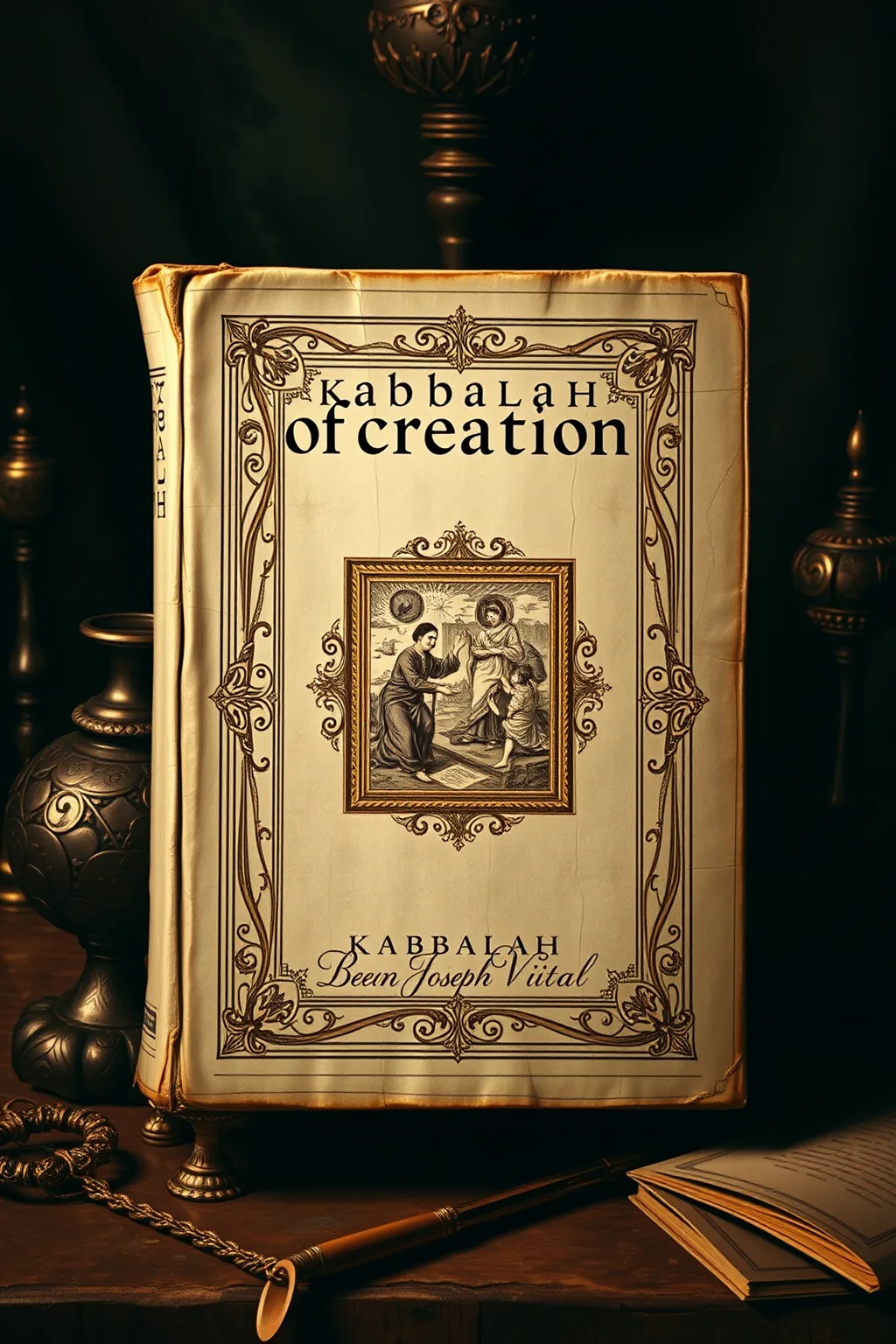
Kabbalah of creation
 62
62

Kabbalah of creation


Sophia Crane (Associate Editor) — "Kabbalah of Creation" by Ḥayyim ben Joseph Vital is an indispensable cornerstone for anyone seeking to grasp the profound depth of Lurianic Kabbalah. Vital masterfully elucidates the complex cosmological doctrines, transforming abstract concepts into accessible, albeit challenging, esoteric truths. This work excels in its systematic presentation of the emanatory process, offering unparalleled clarity on the Sefirot and their dynamic interactions. It’s a challenging but rewarding read, particularly for those already initiated into mystical thought or academic scholars dedicated to Jewish mysticism. Its enduring strength lies in its comprehensive scope and the spiritual gravity it imbues into the very fabric of creation.
📝 Description
62
Ḥayyim ben Joseph Vital's 16th-century Kabbalah of Creation explains divine emanation.
This work by Ḥayyim ben Joseph Vital details the esoteric processes of divine emanation and cosmic creation. As a student of Isaac Luria, Vital expounds on the structure of the Sefirot, from Keter down to the lower emanations, showing their connections and the divine will behind existence. The book discusses the significance of Hebrew letters and divine names in understanding these celestial mechanics.
Vital presents creation as a continuous, dynamic process driven by divine love and intent. This perspective offers insights into Jewish mysticism for serious students and scholars. The text aims to illuminate the underlying principles of reality, fostering a deeper understanding of the connection between the mundane and the divine.
Kabbalah of Creation is a key text within Lurianic Kabbalah, a school of Jewish mysticism that emerged in 16th-century Safed. It builds upon the teachings of Isaac Luria, focusing on concepts like divine contraction (Tzimtzum), the breaking of the vessels (Shevirat HaKelim), and the subsequent restoration (Tikkun). Vital, as Luria's primary scribe and interpreter, systematized and transmitted these complex cosmological and theological ideas, making them accessible to a wider audience within the Kabbalistic tradition.
💡 Why Read This Book?
This book is essential for understanding the foundational cosmology of Lurianic Kabbalah. It offers a profound, symbolic exploration of creation, revealing the hidden divine mechanisms behind existence. Ideal for students of Jewish mysticism, spiritual seekers yearning for deeper cosmic understanding, and practitioners seeking to integrate Kabbalistic principles into their contemplative practices. It provides a rare glimpse into the mind of a master mystic.
⭐ Reader Reviews
Honest opinions from readers who have explored this book.
❓ Frequently Asked Questions
What is the central focus of "Kabbalah of Creation"?
The book's central focus is the esoteric process of divine emanation, detailing how the universe was brought into being according to Lurianic Kabbalah, with a deep exploration of the Sefirot and divine names.
Who was Ḥayyim ben Joseph Vital?
Ḥayyim ben Joseph Vital (1543-1620) was a prominent Kabbalist and the primary disciple of Rabbi Isaac Luria. He is credited with preserving and disseminating Luria's teachings, making him a pivotal figure in Kabbalistic literature.
Is this book suitable for beginners?
While rich in detail, "Kabbalah of Creation" is best approached by those with some foundational knowledge of Kabbalah or Jewish mysticism. Beginners might find it more accessible after engaging with introductory texts.
What are the Sefirot?
The Sefirot are ten divine attributes or emanations through which God manifests and interacts with creation. They are central to Kabbalistic cosmology, representing stages of divine revelation and cosmic structure.
What is the significance of Hebrew letters in this work?
Hebrew letters are considered mystical tools and divine building blocks in Kabbalah. "Kabbalah of Creation" explores their role as carriers of divine energy and secrets, fundamental to the very structure of reality.
🔮 Key Themes & Symbolism
The Emanatory Process
This theme meticulously unpacks the concept of divine emanation, detailing how the Infinite (Ein Sof) progressively manifests into the finite cosmos. It explores the stages of creation, from the initial spark of Keter to the complex interplay of the Sefirot, revealing a universe not static but dynamically unfolding from a divine source. The intricate mechanics of this unfolding, including concepts like Tzimtzum (contraction) and Shevirat HaKelim (shattering of the vessels), are central to understanding the Kabbalistic view of existence and its inherent challenges.
The Sefirotic Tree of Life
At the heart of "Kabbalah of Creation" lies the profound symbolism of the Sefirot, often depicted as the Tree of Life. Vital elucidates each of the ten Sefirot—Keter, Chokhmah, Binah, Chesed, Gevurah, Tiferet, Netzach, Hod, Yesod, and Malkhut—as divine attributes and vessels that channel divine energy. Their arrangement, connections, and interactions form a divine blueprint, illustrating the pathways of spiritual ascent and the underlying order of all creation. Understanding this structure is key to comprehending the Kabbalistic map of consciousness and the cosmos.
Divine Names and Hebrew Letters
This theme examines the esoteric power attributed to the Hebrew language, particularly divine names and the mystical properties of individual letters. Vital reveals how Hebrew letters are not mere linguistic symbols but primordial forces, imbued with divine consciousness and capable of shaping reality. The book explores the intricate combinations and permutations of these letters, especially within divine names, as potent keys to unlocking the secrets of creation, divine will, and the pathways to spiritual communion.
💬 Memorable Quotes
Direct passages from the work, attributed to the author.
“The Sefirot are the channels of divine grace.”
— This highlights the functional role of the Sefirot as conduits through which divine energy, compassion, and will flow into the created realms, sustaining and animating all existence.
“In every letter lies a universe of meaning.”
— This emphasizes the profound symbolic and spiritual significance of the Hebrew alphabet, suggesting that each letter is a microcosm of divine thought and cosmic law, holding immense esoteric power.
“The purpose of creation is divine self-disclosure.”
— This points to the ultimate teleological aim of existence: for the Divine to reveal itself through the range of creation, allowing for conscious recognition and relationship.
“The soul mirrors the celestial architecture.”
— This suggests a fundamental correspondence between the human soul and the divine structure of the cosmos, implying that understanding the macrocosm unlocks insights into the inner workings of the self.
💡 Key Ideas
Editorial paraphrase of the work's core concepts — not direct quotes.
Creation is the unfolding of the hidden light.
This quote expresses the dynamic, emergent nature of existence in Kabbalah, suggesting that the universe is a continuous revelation of divine essence, moving from concealment to manifestation.
🌙 Esoteric Significance
Tradition
This work is a foundational text within the Lurianic school of Kabbalah, a highly influential branch of Jewish mysticism. It represents a sophisticated cosmological system that goes beyond earlier Kabbalistic thought, offering a detailed map of divine emanation and the mechanics of creation. Its esoteric significance lies in its attempt to provide a systematic, almost scientific, framework for understanding the relationship between the Infinite Divine and the finite physical world, a hallmark of esoteric inquiry.
Symbolism
The symbolism in "Kabbalah of Creation" is rich and multi-layered, revolving primarily around the Sefirot, often visualized as the Tree of Life. Other key symbols include divine names, Hebrew letters as cosmic building blocks, and concepts like light, vessels, and cosmic forces. These symbols are not mere metaphors but represent active, dynamic principles and energies that constitute the fabric of reality, offering a symbolic language for contemplating the ineffable nature of the Divine and its engagement with the world.
Modern Relevance
Despite its ancient origins, "Kabbalah of Creation" offers useful insights relevant today. Its exploration of cosmic interconnectedness, the dynamic nature of reality, and the search for meaning in a complex world resonates deeply. For contemporary spiritual seekers, it provides a framework for understanding consciousness, the universe, and one's place within it. Scholars continue to find its intricate philosophical and theological structures important for understanding the history of religious thought and esoteric traditions.
👥 Who Should Read This Book
This important work is a must-read for serious students of Kabbalah and Jewish mysticism, particularly those interested in the profound cosmology of Isaac Luria. Scholars of comparative religion and esoteric philosophy will find its detailed exploration of creation invaluable. Spiritual seekers yearning for a deeper, more structured understanding of the universe's origins and divine mechanics will find profound guidance. While challenging, practitioners seeking to deepen their contemplative practice with a robust theoretical framework will benefit immensely from Vital's meticulous exposition.
📜 Historical Context
Written in the late 16th and early 17th centuries by Ḥayyim ben Joseph Vital, "Kabbalah of Creation" emerges from the fervent intellectual and spiritual milieu of Safed, the Kabbalistic epicenter of the Ottoman Empire. This era followed the expulsion of Jews from Spain, a period of immense spiritual seeking and intellectual synthesis. Vital was the primary scribe and disciple of Rabbi Isaac Luria, the "Ari," whose revolutionary Kabbalistic system, known as Lurianic Kabbalah, profoundly reshaped Jewish mysticism. Vital's work is crucial for preserving and disseminating Luria's complex cosmological theories, including concepts like Tzimtzum, Shevirat HaKelim, and Tikkun, making them accessible to future generations. This period saw a surge in esoteric study, aiming to find meaning and spiritual renewal in the wake of historical upheaval.
📔 Journal Prompts
Reflect on the concept of divine emanation as described by Vital. How does this differ from your previous understanding of creation?
Meditate on one of the Sefirot discussed in the text. What qualities does it represent, and how do you see these qualities manifesting in your own life or the world around you?
Consider the role of Hebrew letters as described. What does it mean for letters to be 'cosmic building blocks'? How might this influence your perception of language?
How does Vital's depiction of the universe as a dynamic, ongoing process challenge or affirm your personal worldview?
Explore the idea of divine self-disclosure through creation. What does this imply about the purpose of existence and our role within it?
🗂️ Glossary
Ein Sof
The Kabbalistic term for the Infinite, Unknowable Divine Essence that exists beyond all comprehension and limitation, the ultimate source of all reality before any emanation.
Sefirot
Ten divine attributes or emanations that form the structure of the Kabbalistic Tree of Life, through which the Divine manifests and interacts with the created world.
Tzimtzum
A foundational concept in Lurianic Kabbalah, referring to the 'contraction' or 'withdrawal' of the Infinite Divine Light to make space for the creation of the finite world.
Shevirat HaKelim
Literally 'shattering of the vessels,' this refers to a catastrophic event in the process of creation where the vessels designed to contain divine light broke, leading to the intermingling of divine sparks with the lower realms.
Tikkun
The process of 'rectification' or 'restoration' aimed at gathering the scattered divine sparks and restoring cosmic harmony, a central spiritual task for humanity.
This book appears in 1 collection
🔮 Readers Also Liked
Browse all →








From the “Kabbalah” Collection
View all →









More Free Kabbalah & Jewish Mysticism Books
View all →