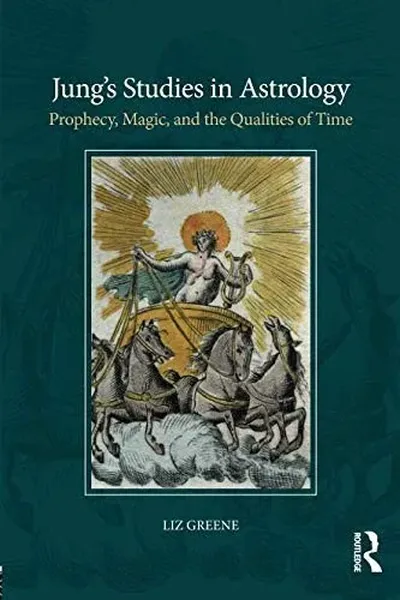
Jung's Studies in Astrology

 84
84

Jung's Studies in Astrology
Liz Greene's *Jung's Studies in Astrology* tackles the often-maligned field of astrology with the intellectual rigor it deserves, positioning it firmly within the framework of analytical psychology. Greene's strength lies in her ability to translate complex astrological symbolism into Jungian psychological terms, revealing the birth chart as a profound map of the psyche's inherent structures and developmental pathways. The book's examination of the planets as archetypal forces is particularly illuminating, offering a fresh perspective for those who see astrology as more than mere fortune-telling. A potential limitation for some readers might be the densely academic tone; it demands a foundational understanding of both Jungian psychology and astrological principles. The section discussing the Moon's nodes as representing a karmic trajectory towards individuation, framed through the lens of Jung's concepts of integration, is a standout example of Greene's insightful synthesis. This work serves as a valuable bridge between esoteric symbolism and modern psychological inquiry.
📝 Description
84
Liz Greene's 2018 book connects Jungian psychology with astrological symbolism.
Jung's Studies in Astrology by Liz Greene examines the psychological dimensions and symbolic language of astrology, particularly through the lens of Carl Jung's work. Published in 2018, the book treats astrology as a system of archetypal patterns contributing to psychological development, moving past simple horoscopes. Greene, an analytical psychologist and astrologer, shows how celestial arrangements can represent inner psychic dynamics. She draws parallels between astrological signs and Jungian concepts such as the collective unconscious and individuation.
This book is intended for students of psychology, comparative mythology, and esoteric thought. It appeals to those who view astrology as a complex language for comprehending the human psyche, rather than solely a predictive method. Readers interested in the overlap between archetypal psychology and ancient symbolic systems will find Greene's detailed analysis valuable. It suits individuals aiming to incorporate astrological ideas into a deeper self-understanding or those researching the history of thought influencing modern psychology.
This work is part of a 20th-century movement that integrated astrology with psychological theory. Following figures like Dane Rudhyar and influenced indirectly by Jung himself, this tradition viewed astrology as a symbolic map of the psyche. Greene builds on this foundation, placing astrological concepts within a post-Jungian intellectual framework. The book addresses the historical exclusion of astrology from academic fields, arguing for its validity as a subject of serious psychological study.
💡 Why Read This Book?
• Gain an understanding of astrological archetypes as psychological potentials, moving beyond simplistic horoscopes to explore the symbolic language of the birth chart as detailed in the book's analysis of planetary meanings. • Explore the historical development of astrological thought as a symbolic system, particularly its integration with psychological theories in the 20th century, offering context not found in purely astrological texts. • Discover how concepts like the 'as above, so below' principle are interpreted through a Jungian lens, providing a framework for seeing correspondences between celestial phenomena and inner psychic life as presented in the book.
⭐ Reader Reviews
Honest opinions from readers who have explored this book.
❓ Frequently Asked Questions
What is Liz Greene's background in relation to Jungian psychology?
Liz Greene is a renowned analytical psychologist and astrologer, trained in the Jungian tradition. Her work consistently integrates Jungian concepts with astrological symbolism, drawing upon her extensive clinical experience and academic study.
How does *Jung's Studies in Astrology* differ from popular astrology books?
Unlike popular guides, this book approaches astrology as a symbolic language for psychological exploration, focusing on archetypal patterns and individuation rather than predictive techniques. It is grounded in rigorous psychological theory.
When was *Jung's Studies in Astrology* first published?
The book *Jung's Studies in Astrology* by Liz Greene was first published in 2018, making it a contemporary exploration of the subject.
What is the 'birth chart' according to this book?
In *Jung's Studies in Astrology*, the birth chart is presented as a symbolic map of an individual's psyche, illustrating innate potentials, challenges, and the blueprint for psychological development and individuation.
Does the book discuss specific astrological techniques?
While it uses astrological elements, the focus is on their symbolic and psychological meaning. It explores core concepts like planets, signs, and houses as archetypal energies rather than detailing predictive methods.
What is the significance of 'archetypes' in this context?
Archetypes, as explored in the book through an astrological lens, are universal, inherited patterns of thought or imagery derived from the collective unconscious, influencing human behavior and perception.
🔮 Key Themes & Symbolism
Astrology as Symbolic Language
The work posits astrology not as a deterministic system, but as a complex symbolic language that mirrors the dynamics of the human psyche. Greene elucidates how planetary placements and aspects within a birth chart can be interpreted as expressions of archetypal energies and potentials, akin to symbols in dreams or myths. This perspective aligns with Jung's emphasis on the psyche's inherent symbolic nature and its quest for wholeness. The book provides frameworks for understanding these symbols in relation to personal growth and psychological integration.
The Birth Chart and Individuation
A central theme is the birth chart's function as a blueprint for the individuation process—Jung's term for the lifelong journey of psychological development towards self-realization. Greene explores how the configuration of planets at the moment of birth represents a unique constellation of psychic forces, offering both inherent strengths and challenges to be integrated. The chart becomes a map that guides the individual in understanding their path toward becoming a more complete and differentiated self, aligning personal development with cosmic patterns.
Planets as Archetypal Forces
Greene examines each planet (and other celestial bodies) not merely as astronomical objects, but as potent symbols of universal psychic functions and archetypes. For instance, Mars might represent the archetypal warrior or assertive drive, while Venus symbolizes the principle of attraction and relationship. By analyzing these celestial bodies through a Jungian lens, the book offers a profound method for understanding the dynamic interplay of forces within the psyche, providing a rich symbolic vocabulary for psychological exploration.
Historical and Psychological Integration
The book situates astrological concepts within the historical development of both esoteric thought and modern psychology, particularly the school of Carl Jung. It bridges the gap between ancient wisdom traditions and contemporary psychological theory, demonstrating how astrological symbolism can be a valuable tool for understanding the human condition. This integration aims to legitimize astrology as a subject of serious study, moving it from the area of superstition to a sophisticated system of psychological insight.
💬 Memorable Quotes
Direct passages from the work, attributed to the author.
“The birth chart is a map of the psyche's potentials.”
— This highlights the book's core argument: that astrological configurations are not fixed destinies but symbolic representations of inherent psychological energies and developmental pathways.
“Planets act as symbols for archetypal forces within us.”
— This statement underscores the Jungian perspective applied to astrology, viewing celestial bodies as representations of universal psychic functions and patterns that manifest in human experience.
“The 'as above, so below' principle reflects psychic correspondence.”
— This interpretation suggests that the book views the Hermetic principle not as literal magic, but as a metaphor for the mirroring between cosmic order and the internal order of the human psyche.
💡 Key Ideas
Editorial paraphrase of the work's core concepts — not direct quotes.
Astrology offers a symbolic language for the unconscious.
This paraphrase emphasizes the book's approach to astrology as a system of symbols that can help us understand and communicate with the deeper, often unconscious, layers of the psyche.
Individuation is the process of integrating psychic opposites.
This quote, framed within the Jungian context, explains that personal growth involves consciously acknowledging and integrating conflicting aspects of one's personality, a process that astrology can illuminate.
🌙 Esoteric Significance
Tradition
This work is deeply rooted in the Western Esoteric tradition, specifically drawing from Hermetic philosophy and Jungian analytical psychology. It bridges the ancient practice of astrology with modern depth psychology, viewing astrological symbols not as predictive mechanisms but as expressions of archetypal forces inherent in the human psyche. Greene operates within a lineage that seeks to understand the cosmos as a reflection of inner reality, a core tenet of Hermeticism, while employing Jung's psychological framework to interpret these correspondences.
Symbolism
Key symbols explored include the planets, which are interpreted as archetypal energies (e.g., Mars as the warrior archetype, Venus as the principle of attraction). The zodiac signs are seen as distinct modes of expression for these archetypal energies. The birth chart itself functions as a central symbol, representing the blueprint of the individual psyche and its potential for individuation, mapping the dynamic interplay of these cosmic forces within a human life.
Modern Relevance
Contemporary thinkers in archetypal psychology, depth psychology, and modern esoteric studies frequently engage with Greene's work. Her approach provides a sophisticated lens for understanding the symbolic language of the psyche, influencing therapists, counselors, and individuals interested in personal growth. Schools of psychological astrology and researchers exploring consciousness continue to draw upon her insights for integrating ancient wisdom with modern psychological understanding.
👥 Who Should Read This Book
• Students of Jungian psychology seeking to understand the symbolic parallels between archetypes and astrological imagery. • Individuals interested in esoteric traditions who wish to approach astrology through a rigorous psychological and symbolic lens, moving beyond fortune-telling. • Comparative mythology and religion scholars looking for frameworks that connect celestial symbolism with universal human patterns and psychological development.
📜 Historical Context
Liz Greene's *Jung's Studies in Astrology* emerges from a rich intellectual milieu where psychology and esoteric traditions began to intersect significantly in the 20th century. Following Carl Jung's pioneering work on archetypes and the collective unconscious, a generation of thinkers sought to apply his theories to various symbolic systems. While Jung himself had a complex relationship with astrology, his ideas provided fertile ground for later scholars. In the post-World War II era, figures like Dane Rudhyar advocated for a psychological interpretation of astrology, shifting focus from prediction to self-understanding. Greene's work builds upon this foundation, contributing to a lineage that includes authors like Dane Rudhyar, who were active in the mid-20th century. This period also saw astrology grappling with its historical marginalization from scientific discourse, with proponents like Greene seeking to establish its validity as a symbolic framework for psychological exploration, often in contrast to purely materialistic or reductionist scientific paradigms.
📔 Journal Prompts
The archetypal meaning of the Sun in your birth chart.
Reflecting on the Moon's symbolism as the inner emotional landscape.
How the principle of 'as above, so below' manifests in your personal life.
The Mercury archetype and your communication style.
Interpreting the Mars archetype in relation to your drive and assertion.
🗂️ Glossary
Archetype
In Jungian psychology, a universal, inherited pattern of thought or imagery derived from the collective unconscious, influencing human behavior and perception. In astrology, these are often represented by planets and signs.
Individuation
The lifelong psychological process of differentiation of the self, involving the integration of conscious and unconscious elements to achieve a more complete and whole personality.
Birth Chart (Natal Chart)
A diagram representing the positions of the Sun, Moon, planets, and astrological aspects at the precise moment and location of a person's birth, viewed as a symbolic map of the psyche.
Collective Unconscious
A concept introduced by Carl Jung, referring to a deeper layer of the unconscious psyche that is shared by all humanity, containing archetypes and primal images.
Symbolic Language
A mode of communication that uses symbols to represent deeper meanings or abstract concepts, applied in this context to astrology as a means of understanding the psyche.
As Above, So Below
A Hermetic principle suggesting a correspondence or mirroring between the macrocosm (the universe) and the microcosm (the human being or individual psyche).
Psychic Forces
The dynamic energies and patterns within the human mind and personality, explored in the book as being symbolically reflected in astrological configurations.
🔮 Readers Also Liked
Browse all →







More by Liz Greene
All books →




More Free Astrology & Cosmology Books
View all →