Jung on Synchronicity and the Paranormal
 79
79

Jung on Synchronicity and the Paranormal
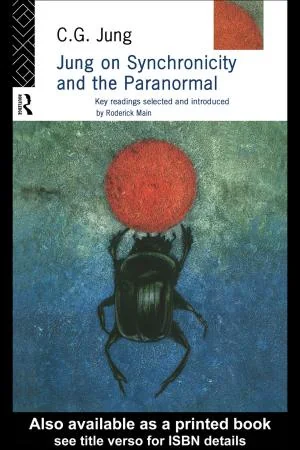
Roderick Main’s compilation, *Jung on Synchronicity and the Paranormal*, offers a necessary distillation of Carl Jung’s engagement with what he termed 'meaningful coincidences.' The selection is judicious, drawing from essays that define synchronicity and its relationship to the paranormal. Main’s introduction excels at clarifying Jung’s challenging theoretical framework, particularly his debt to Wolfgang Pauli and the concept of the *unus mundus*. However, the book's primary limitation lies in its inherent nature as a collection; while the pieces are essential, they do not always flow with the narrative coherence of a single, authored work. A standout element is Jung's discussion of the I Ching as an example of synchronistic divination, which Main effectively contextualizes. The volume ultimately serves as an indispensable, if dense, resource for those committed to understanding Jung's most enigmatic theories.
📝 Description
79
Published in 1997, this collection gathers Carl Gustav Jung's key texts on synchronicity and paranormal phenomena.
Roderick Main curated this volume of Carl Gustav Jung's writings on synchronicity and paranormal phenomena, originally published in 1997. The book collects the Swiss psychiatrist's important essays concerning acausal connecting principles and how they appear in human experience. It serves as a focused resource for understanding Jung's later theories, especially his efforts to connect the empirical world with the inner reality of psychic occurrences.
This work is for dedicated students of Jungian psychology, parapsychology, and the philosophy of mind. It appeals to those familiar with Jung's core ideas, like archetypes and the collective unconscious, who want to grasp his more debated theories. Readers interested in the connections between science, spirituality, and unexplained events will find ample material for thought and study. Jung's ideas on synchronicity, particularly from the mid-20th century, arose during a time of significant scientific and philosophical questioning about reality's nature. His work questioned standard mechanistic views by suggesting meaningful coincidences that causality alone could not explain.
Jung's work on synchronicity emerged from his engagement with early 20th-century psychology and his discussions with physicists like Wolfgang Pauli. He proposed a principle of meaningful coincidence that operated outside of causality, challenging the dominant scientific worldview. This collection places his ideas within that intellectual milieu, showing his attempts to understand subjective psychic events and their connection to the external world as expressions of a deeper, acausal order.
💡 Why Read This Book?
• Gain a precise understanding of Jung's theory of synchronicity, including its definition as an acausal connecting principle, as detailed in Roderick Main's introduction and Jung's own essays. • Explore Jung's specific examples of paranormal phenomena, such as his famous scarab beetle anecdote, to grasp how he linked subjective psychic states to objective events. • Grasp the historical and intellectual milieu of Jung's work, particularly his collaboration with physicist Wolfgang Pauli, to contextualize the development of his ideas in the mid-20th century.
⭐ Reader Reviews
Honest opinions from readers who have explored this book.
❓ Frequently Asked Questions
What is the primary definition of synchronicity according to Carl Jung?
Synchronicity, as defined by Carl Jung, is the acausal connecting principle. It describes a meaningful coincidence between an inner psychic state and an outer event, where causality does not apply but a significant parallel exists.
What paranormal phenomena does Jung discuss in this book?
This collection features Jung's discussions on various paranormal phenomena, including telepathy, precognition, clairvoyance, and apparitions, examining them as potential manifestations of psychic realities beyond conventional explanation.
Who curated and introduced this collection of Jung's writings?
The collection 'Jung on Synchronicity and the Paranormal' was curated and introduced by Roderick Main, a scholar specializing in Jungian psychology and the history of esotericism.
When were Carl Jung's original writings on these topics first published?
While this specific collection was first published in 1997, Carl Jung's foundational essays on synchronicity and related paranormal topics were written and published throughout the mid-20th century, notably his key work 'Synchronicity: An Acausal Connecting Principle' in 1952.
What is the relationship between synchronicity and the collective unconscious?
Jung posited that synchronicity arises from the activation of archetypes within the collective unconscious. These universal patterns can manifest simultaneously in the psyche and in external events, creating meaningful patterns.
Does this book offer practical exercises for experiencing synchronicity?
While the book focuses on theoretical exploration and analysis of paranormal phenomena, it provides the conceptual framework necessary for individuals to recognize and reflect upon synchronistic events in their own lives.
🔮 Key Themes & Symbolism
Acausal Connecting Principle
The central concept explored is synchronicity, which Jung defined not by cause and effect, but by meaningful coincidence. This theme examines how inner psychic states align with external events, challenging the dominance of causality in scientific and philosophical thought. It examines instances where subjective experience and objective reality appear interconnected through a principle of meaning, rather than physical force.
Paranormal Phenomena as Psychic Manifestations
Jung viewed phenomena such as telepathy, precognition, and clairvoyance not as mere superstition or delusion, but as potential evidence for the efficacy of the psyche beyond the confines of space and time. This theme investigates his analytical approach to these events, framing them as expressions of deeper psychic structures like the collective unconscious.
The Unus Mundus and Archetypal Patterns
This theme explores the underlying unity of all reality, the 'unus mundus' or one world, from which both psyche and matter arise. It connects synchronicity to the activation of archetypes – universal, primordial images and patterns residing in the collective unconscious. These archetypal energies, when constellated, can manifest outwardly in meaningful coincidences.
Jung's Scientific and Philosophical Dialogue
The collection highlights Jung's engagement with contemporary scientific and philosophical thought, particularly his collaborations with physicist Wolfgang Pauli. It addresses the challenges and reception of his ideas within academic circles, positioning his work as a bridge between psychology, physics, and esoteric traditions.
💬 Memorable Quotes
Direct passages from the work, attributed to the author.
“The concept of synchronicity… posits the existence of an organizing principle that is not based on causality.”
— This statement captures the revolutionary aspect of Jung's theory: the introduction of a non-causal, meaning-based connection between events. It suggests that not all significant correlations in the universe can be explained by traditional scientific models of cause and effect.
“Paranormal phenomena can be seen as projections of the unconscious psyche.”
— This interpretation suggests Jung's view that events perceived as paranormal might not be external intrusions but rather outward manifestations of internal psychological processes and unconscious contents.
“Archetypes act as organizing principles that can manifest in both the inner and outer worlds.”
— This highlights how Jung believed universal psychic patterns (archetypes) possess the power to influence not only our thoughts and feelings but also to seemingly orchestrate external events in a meaningful way.
💡 Key Ideas
Editorial paraphrase of the work's core concepts — not direct quotes.
Meaningful coincidence is a subjective experience that appears to transcend ordinary understanding.
This paraphrased concept emphasizes the personal and often inexplicable nature of synchronistic events. It points to the subjective interpretation of an event's significance, which is key to distinguishing it from mere random occurrence.
The psyche and matter are potentially aspects of a single, unified reality.
This paraphrased concept refers to the idea of the 'unus mundus,' suggesting a fundamental interconnectedness between the internal world of consciousness and the external world of physical reality, a concept central to understanding synchronicity.
🌙 Esoteric Significance
Tradition
Jung's work on synchronicity and the paranormal sits within the broader lineage of Western Esotericism, particularly drawing from Hermeticism, Neoplatonism, and alchemical symbolism. It attempts to provide a psychological framework for phenomena traditionally explored in mystical and occult traditions, bridging the empirical study of the psyche with subjective, meaningful experiences that defy conventional causality.
Symbolism
Key symbols include the mandala, representing psychic wholeness and the ordering of chaos, often appearing in conjunction with synchronistic events. The scarab beetle, famously appearing to a patient during a session discussing a dream, serves as a potent symbol of transformation and meaningful coincidence. Archetypes themselves function as symbolic motifs, representing universal patterns that bridge the unconscious and manifest in the world.
Modern Relevance
Contemporary thinkers in depth psychology, consciousness studies, and even quantum physics engage with Jung's synchronicity. It informs practices in transpersonal psychology and is referenced by authors exploring interconnectedness, intuition, and the limits of scientific materialism. Modern manifestations include discussions in popular psychology, self-help literature focused on 'flow' states, and online communities dedicated to synchronicity and meaningful coincidence.
👥 Who Should Read This Book
• Students of Jungian psychology seeking to understand his later, more controversial theories on acausal phenomena and the nature of psychic reality. • Researchers and practitioners in parapsychology and consciousness studies looking for theoretical frameworks that integrate subjective experience with empirical observation. • Philosophers and theologians interested in the intersection of science, spirituality, and the nature of meaning in a potentially interconnected universe.
📜 Historical Context
Carl Jung's exploration of synchronicity and the paranormal emerged during a period when psychoanalysis was solidifying its theoretical foundations, and physics was undergoing revolutionary changes. His seminal essay, 'Synchronicity: An Acausal Connecting Principle,' co-authored with physicist Wolfgang Pauli and published in 1952, placed his ideas at the intersection of psychology, quantum physics, and philosophy. This work challenged the prevailing mechanistic and purely causal worldview dominant in Western thought since the Enlightenment. While figures like Sigmund Freud focused primarily on repressed drives and Oedipal complexes, Jung expanded his scope to include collective psychic phenomena and the spiritual dimension. Jung's ideas on synchronicity were met with skepticism by many mainstream scientists, who viewed them as unprovable or pseudoscientific. However, they found resonance within esoteric circles and among thinkers exploring consciousness, parapsychology, and the limits of empirical knowledge, including contemporary authors like J.B. Rhine in parapsychology.
📔 Journal Prompts
The acausal connecting principle as observed in personal experience.
Synchronicity and the manifestation of archetypal patterns.
Paranormal phenomena as expressions of the collective unconscious.
The meaning derived from a personally experienced meaningful coincidence.
Jung's theoretical bridge between the psyche and the external world.
🗂️ Glossary
Synchronicity
A concept defined by Carl Jung as an acausal connecting principle, describing meaningful coincidences between psychic events (dreams, thoughts) and external occurrences.
Acausal
Not based on or related to causality; independent of cause and effect relationships, emphasizing meaningful connection rather than direct causation.
Collective Unconscious
A concept introduced by Jung, referring to a deeper layer of the unconscious psyche containing inherited, universal archetypes and instincts shared by all humanity.
Archetype
Universal, primordial patterns and images that derive from the collective unconscious and are the psychic conditions of any immediate conscious apprehension of the world.
Unus Mundus
Latin for 'one world'; a concept suggesting a unified underlying reality from which both psyche and matter originate, posited as the source of synchronistic events.
Telepathy
The purported direct communication of thoughts or feelings from one person to another without the use of the senses; a paranormal phenomenon discussed by Jung.
Precognition
The ability to see or know future events; another paranormal phenomenon that Jung explored as potentially linked to synchronicity and the collective unconscious.
🔮 Readers Also Liked
Browse all →








More Free Occult Philosophy Books
View all →