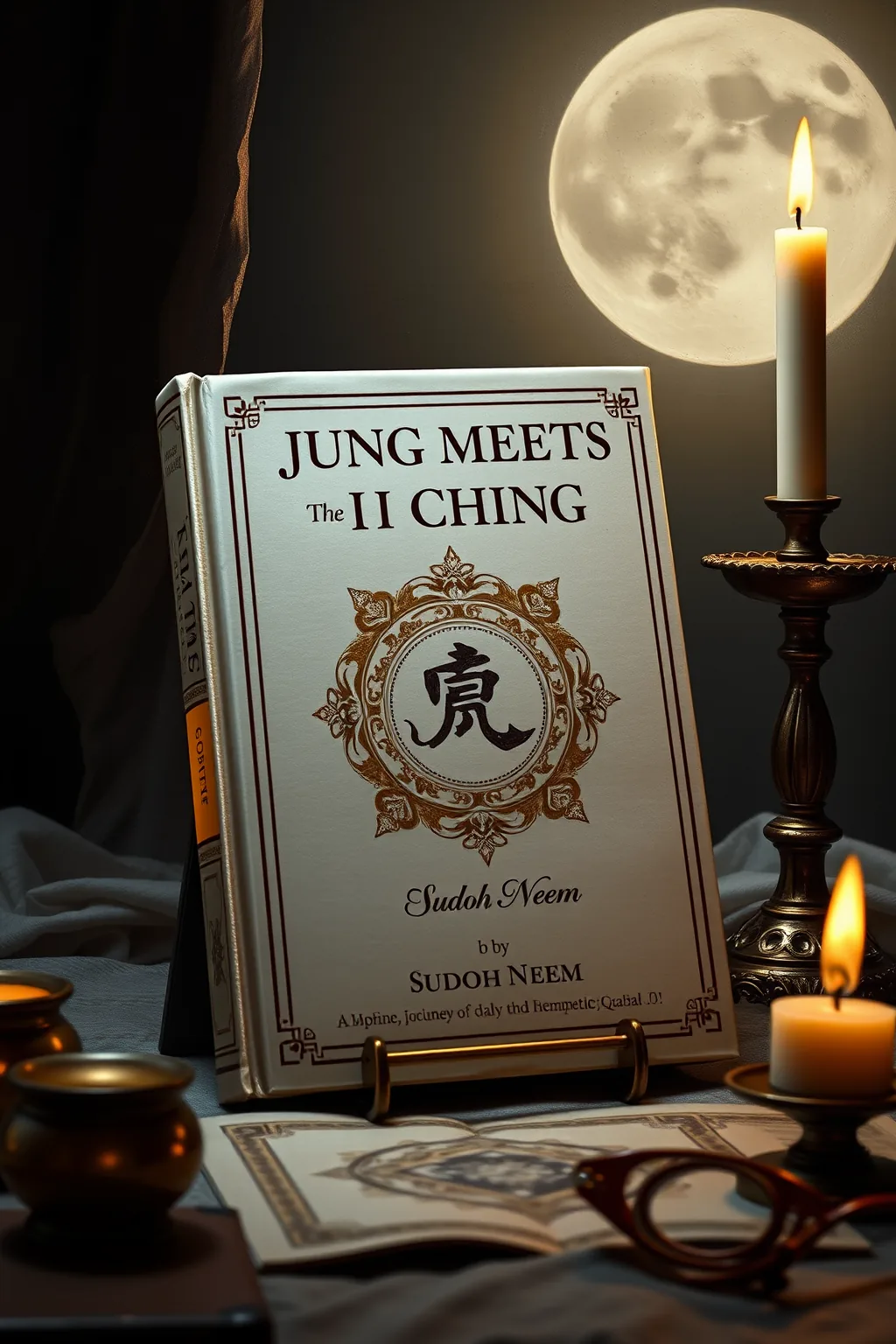
Jung Meets the I Ching and Hermetic Qabalah
 61
61

Jung Meets the I Ching and Hermetic Qabalah



Aurelia Blackwood (Occult Philosophy Critic) — Sudoh Neem's 'Jung Meets the I Ching and Hermetic Qabalah' is a revelation, an exquisite synthesis of disparate yet harmonizing esoteric streams. Neem navigates the complex interplay between Jungian individuation, the oracle of the I Ching, and the intricate Tree of Life with unparalleled clarity and depth. The book’s strength lies in its ability to demystify profound concepts, making them accessible to dedicated seekers while offering fresh perspectives for seasoned practitioners. It’s an indispensable resource for anyone drawn to the intersection of psychology and ancient divination, promising a richer understanding of self and cosmos.
📝 Description
61
Sudoh Neem's 2018 book connects Jungian psychology with the I Ching and Hermetic Qabalah.
This book examines the points of convergence between Carl Jung's analytical psychology, the ancient Chinese divination text the I Ching, and the esoteric system of Hermetic Qabalah. Sudoh Neem maps out how these distinct traditions can inform one another, particularly in understanding symbolic language and synchronicity.
The work aims to show how patterns found in these systems reflect a larger cosmic order and an inner psychological reality. It discusses the universe as a symbolic mirror of the human psyche. The author presents this as a framework for interpreting reality, connecting empirical observation with mystical experience. Readers can expect detailed comparisons of key concepts and symbols across the three traditions.
This work situates itself within contemporary esoteric thought, which often seeks to synthesize disparate mystical and psychological frameworks. By drawing on Jungian psychology, it acknowledges a modern academic interest in the symbolic and archetypal dimensions of human experience. The inclusion of the I Ching and Hermetic Qabalah places it in dialogue with established traditions of divination and occult philosophy. The book aims to demonstrate potential resonances between these systems, suggesting a unified underlying structure or pattern in esoteric knowledge.
💡 Why Read This Book?
Unravel the profound connections between Jungian archetypes, the I Ching's prophetic wisdom, and the Hermetic Qabalah's cosmic blueprint. This book offers a unique framework for self-discovery, synchronicity interpretation, and spiritual growth. Ideal for seekers of hidden knowledge, students of comparative esotericism, and practitioners aiming to deepen their divinatory and psychological insights. Discover the universal language of symbols that bridges the inner and outer worlds.
⭐ Reader Reviews
Honest opinions from readers who have explored this book.
❓ Frequently Asked Questions
What is the primary focus of this book?
The book primarily explores the synergistic relationship between Carl Jung's analytical psychology, the ancient Chinese oracle of the I Ching, and the mystical system of Hermetic Qabalah, offering a unified perspective on consciousness and cosmic order.
Is this book suitable for beginners in esoteric studies?
Yes, while rich in depth, the author provides clear explanations, making it accessible to earnest beginners eager to explore these profound subjects.
How does the I Ching complement Jungian psychology in this book?
The I Ching's hexagrams and evolving lines are presented as dynamic expressions of archetypal patterns, mirroring Jung's concept of the collective unconscious and providing a divinatory tool for understanding psychological processes.
What role does Hermetic Qabalah play in the synthesis?
Hermetic Qabalah provides a structured, symbolic framework (the Tree of Life) that maps psychic and cosmic energies, offering a lens through which to interpret the insights gained from Jung and the I Ching.
Can this book enhance my personal divination practice?
Absolutely. By integrating these traditions, the book offers a more nuanced and profound approach to divination, moving beyond simple fortune-telling to a deeper understanding of life's patterns and personal growth.
🔮 Key Themes & Symbolism
Jungian Archetypes and the I Ching
This theme explores the profound parallels between the universal archetypes identified by Carl Jung and the symbolic language of the I Ching. It explores how the hexagrams and their changing lines can be interpreted as manifestations of these primordial patterns of the collective unconscious, offering a unique psycho-divinatory approach to understanding human experience and the dynamics of transformation. The synergy reveals how ancient oracular wisdom can illuminate modern psychological insights.
Hermetic Qabalah as a Symbolic Map
The book positions Hermetic Qabalah, particularly the Tree of Life, as a comprehensive symbolic map of the cosmos and the human psyche. It demonstrates how the Sephiroth and their interconnected paths can be used to contextualize and integrate the insights derived from Jungian psychology and the I Ching. This framework provides a structured method for understanding the flow of divine energy, the stages of spiritual development, and the intricate web of correspondences that bind the macrocosm and the microcosm.
The Art of Synchronicity and Meaningful Coincidence
A central pillar of the work is the exploration of synchronicity, the meaningful coincidence of inner psychic states and outer events. The book argues that the I Ching, when consulted with intention, often provides answers that resonate deeply with the querent's psychological state, aligning with Jung's concept of acausal connecting principles. It guides readers in recognizing and interpreting these 'meaningful accidents' as pathways to self-awareness and spiritual guidance, fostering a more enchanted and purposeful engagement with reality.
💬 Memorable Quotes
Direct passages from the work, attributed to the author.
“Archetypes are the silent architects of our perceived reality.”
— This emphasizes the profound, often unconscious, influence of Jungian archetypes on how we experience and interpret the world around us, suggesting they are fundamental building blocks of consciousness.
“The Tree of Life is a ladder from shadow to light.”
— This succinctly describes the Qabalistic journey of spiritual ascent and self-realization, portraying the Tree of Life as a structured path for transformation and enlightenment.
“Synchronicity is the universe whispering its secrets.”
— This evocative statement frames meaningful coincidences as divine communication, encouraging readers to be attuned to these subtle messages from the cosmos for guidance and understanding.
“Within the hexagram lies the seed of transformation.”
— This points to the dynamic and evolving nature of the I Ching's wisdom, suggesting that each reading contains the inherent potential for personal change and growth.
💡 Key Ideas
Editorial paraphrase of the work's core concepts — not direct quotes.
The oracle speaks not of fate, but of potential.
This quote highlights the active, rather than passive, nature of divination as presented in the book. It suggests that the I Ching offers insights into possibilities and trajectories, empowering the individual to shape their destiny.
🌙 Esoteric Significance
Tradition
This book masterfully bridges three rich esoteric traditions: Jungian Psychology, the I Ching, and Hermetic Qabalah. It draws upon Jung's exploration of archetypes and the collective unconscious, the ancient Chinese system of divination and philosophical insight, and the Western mystical tradition of Qabalah with its symbolic Tree of Life. The synthesis aims to reveal universal patterns of consciousness and cosmic order that transcend individual cultural origins.
Symbolism
The core symbolism revolves around the archetypal imagery of the I Ching's hexagrams, the elemental and divine emanations of the Qabalistic Tree of Life, and the psychological archetypes described by Jung. These symbols are presented not as isolated icons, but as interconnected facets of a unified reality, offering a multi-layered language for understanding the self, the cosmos, and the divine.
Modern Relevance
In an age often characterized by fragmentation and a disconnect from deeper meaning, this book offers a profound path toward integration and wholeness. It provides practical tools for self-understanding, ethical guidance, and spiritual development by revealing the underlying order and interconnectedness of existence. The synthesized wisdom empowers individuals to navigate life's challenges with greater insight, resilience, and a sense of purposeful engagement.
👥 Who Should Read This Book
This book is a treasure for the dedicated spiritual seeker yearning to understand the deeper currents of existence. It is equally important for students of comparative esotericism, offering a rare and insightful synthesis of disparate traditions. Jungian psychology enthusiasts will find new applications for archetypal theory, while practitioners of the I Ching and Hermetic Qabalah will discover enriched perspectives and practical methods for deepening their practice. Beginners drawn to mystical knowledge will find a guiding light, and seasoned scholars will appreciate the nuanced scholarship and original contributions.
📜 Historical Context
Written in an era of burgeoning interest in Eastern philosophies and depth psychology, Sudoh Neem's work emerges from the late 20th or early 21st century, a period where the limitations of purely materialist paradigms were increasingly being questioned. This time saw a significant cross-pollination of ideas between Western esotericism, psychology, and Eastern spiritual traditions. Jung's own engagement with the I Ching in the mid-20th century laid crucial groundwork, but Neem's synthesis with Hermetic Qabalah offers a unique and comprehensive integration. The book reflects a broader cultural shift towards seeking holistic understanding, spiritual meaning, and practical tools for reading through the complexities of modern life, drawing upon ancient wisdom to address contemporary existential concerns.
📔 Journal Prompts
Reflect on a recent synchronistic event: how might the I Ching or a Jungian archetype offer a new interpretation of its meaning?
Consider a specific hexagram from the I Ching. How do its symbolic elements resonate with your current life situation or internal psychological state?
Map a specific Jungian archetype (e.g., the Shadow, the Anima/Animus) onto a Sephiroth or path on the Tree of Life. What insights emerge from this correlation?
If you were to consult the I Ching about a personal challenge, what initial hexagram would you anticipate, and why?
How can the principle of 'as above, so below' from Hermetic philosophy be observed in the interplay between the I Ching's wisdom and your own inner experiences?
🗂️ Glossary
Archetype
In Jungian psychology, a universal, archaic pattern and image that derives from the collective unconscious and is the psychic counterpart of an instinct. They are fundamental constituents of the human psyche.
I Ching (Book of Changes)
An ancient Chinese divination text and wisdom book, believed to be the oldest of the Chinese classics. It is used to understand the present and to forecast future developments.
Hermetic Qabalah
A Western esoteric tradition based on the Zohar and the writings of Moses Cordovero and Isaac Luria, synthesizing Jewish Kabbalah with Neoplatonism, alchemy, and Hermeticism.
Sephiroth
The ten divine emanations or attributes of God in Kabbalistic cosmology, represented on the Tree of Life, each symbolizing a stage in creation and a facet of divine consciousness.
Synchronicity
A concept first introduced by analytical psychologist Carl Jung to describe events that are 'meaningful coincidences' – occurrences that appear meaningfully related but lack a discernible causal connection.
This book appears in 9 collections
🔮 Readers Also Liked
Browse all →








From the “Kabbalah” Collection
View all →







More Free Divination & Tarot Books
View all →