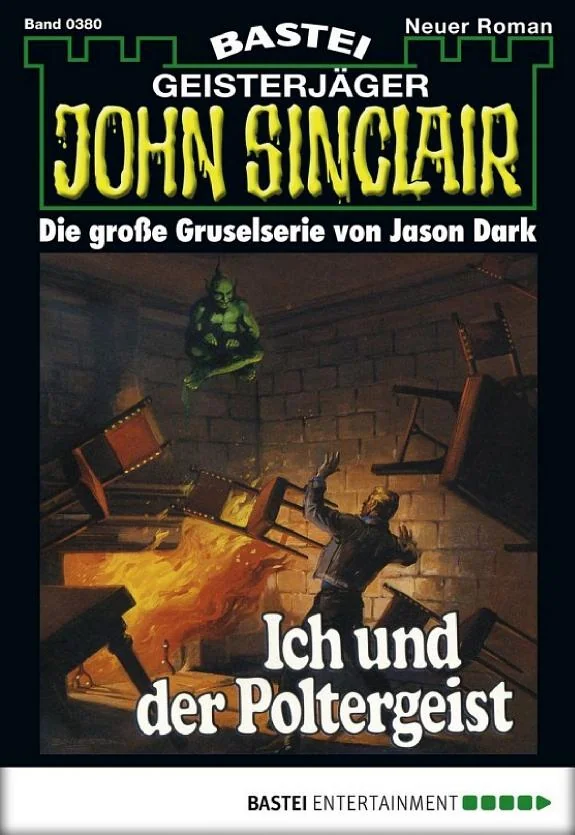
John Sinclair 380
 77
77

John Sinclair 380
The reappearance of John Sinclair in the "Ich und der Poltergeist" installment, now available as an e-book, offers a direct confrontation with a poltergeist, a classic trope in spectral hauntings. Jason Dark's handling of the confrontation, particularly the unexpected intervention of Sarah Goldwyn, highlights the series' enduring appeal: the blending of personal peril with a wider, often chaotic, supernatural ecosystem. Goldwyn’s character, described as feared by demons, injects a formidable presence and a hint of darker, more ancient powers at play beyond Sinclair's immediate struggle. The limitation here, as with many late-series entries, can be the potential for narrative familiarity; the core dynamic of Sinclair facing escalating threats, often with unexpected allies or antagonists, is well-trodden ground. However, the specific mention of the "Dämonenpeitsche" offers a concrete, albeit brief, glimpse into the series' unique bestiary and artifact lore. Ultimately, John Sinclair 380 delivers precisely what its long-time readership expects: a straightforward, action-oriented occult encounter.
📝 Description
77
John Sinclair 380, "Ich und der Poltergeist," published in 2015, details a direct confrontation with a poltergeist.
This 2015 installment of Jason Dark's John Sinclair series, "Ich und der Poltergeist," centers on the protagonist's struggle against a spectral entity. The story incorporates familiar elements from the long-running saga, including demonic forces and supporting characters with their own hidden motives and supernatural abilities. It continues the established mythology that began in 1980, maintaining the series' consistent tone. Readers familiar with John Sinclair's decades-long adventures will find this entry a continuation of his ongoing battles against otherworldly threats.
The narrative places the titular protagonist directly against a poltergeist, establishing a conflict rooted in spiritism and hauntology. This specific encounter is part of a larger arc within the series, which has consistently featured demon hunters and pacts with supernatural beings. The book is intended for established fans who appreciate classic pulp horror with a strong occult focus, a genre that maintained popularity in German-speaking countries throughout the late 20th century.
The John Sinclair series, originating in 1980, tapped into a persistent cultural fascination with the occult and demonology prevalent in German-speaking countries. Jason Dark's creation became an enduring example of pulp fiction success, featuring a lone hero confronting supernatural evil. This particular volume, "Ich und der Poltergeist," directly engages with themes of hauntology and spiritism, placing the protagonist in conflict with a spectral manifestation. The series as a whole reflects a tradition of occult detective fiction that blends action with explorations of the paranormal.
💡 Why Read This Book?
• Gain insight into the specific mechanics of poltergeist encounters as depicted within the John Sinclair universe, particularly relevant if you're studying spiritism in popular fiction. • Understand the role of specialized occult artifacts like the "Dämonenpeitsche" in confronting supernatural threats, offering a unique symbol of power within the series' lore. • Experience the narrative continuation of a pulp fiction phenomenon that began in 1980, examining how established series adapt to modern formats while retaining their core supernatural conflicts.
⭐ Reader Reviews
Honest opinions from readers who have explored this book.
❓ Frequently Asked Questions
When was John Sinclair 380 originally published?
John Sinclair 380, featuring the story "Ich und der Poltergeist," was first published as an e-book on July 22, 2015.
Who is the author behind the John Sinclair series?
The author of the John Sinclair series is Jason Dark, a pseudonym for Helmut Rellergerd.
What is the main conflict in "Ich und der Poltergeist"?
The central conflict involves John Sinclair battling a poltergeist, complicated by the involvement of Sarah Goldwyn, who has her own score to settle with the entity.
What is Sarah Goldwyn known for in the book?
Sarah Goldwyn is depicted as a formidable figure feared by demons and possesses a "Dämonenpeitsche" (demon whip), indicating her significant power in the supernatural realm.
Does this book require prior knowledge of the John Sinclair series?
While it can be enjoyed on its own, "Ich und der Poltergeist" is best appreciated by readers familiar with the John Sinclair series' established characters and overarching mythology, which began in 1980.
What genre does John Sinclair 380 fall under?
John Sinclair 380 belongs to the occult horror and supernatural adventure genre, continuing the pulp fiction style established by the series since its inception.
🔮 Key Themes & Symbolism
Protagonist vs. Poltergeist
The core theme revolves around John Sinclair's direct confrontation with a poltergeist, a manifestation of restless spirits or psychic energy. This is not merely a haunting but an active, personal battle. The work explores the nature of such entities within its fictional cosmology, where they are not just residual phenomena but often possess intent or are manipulated by greater forces, requiring the protagonist's direct intervention and combat prowess.
Demonic Forces and Artifacts
This installment examines the broader spectrum of demonic entities and the specialized tools used to combat them. Sarah Goldwyn's "Dämonenpeitsche" serves as a prime example of an occult artifact designed for supernatural warfare. The presence of characters feared by demons suggests a hierarchical structure within the infernal realm and highlights the series' consistent focus on the tangible, often violent, aspects of confronting evil.
Entangled Agendas
A recurring motif in the John Sinclair saga, and present here, is the idea that supernatural conflicts are rarely simple. The blurb indicates that Sarah Goldwyn has her own 'bill to settle' with Sinclair's poltergeist adversary. This suggests that the protagonist's battles often become entangled with pre-existing feuds or complex relationships among supernatural beings, adding layers of intrigue beyond the immediate threat.
Heroic Occultism
The series, including this volume, champions the archetype of the lone hero navigating a world teeming with unseen dangers. John Sinclair embodies this figure, tasked with protecting humanity from occult threats. The narrative emphasizes his bravery, his willingness to engage directly with terrifying entities, and his reliance on a mix of skill, determination, and sometimes specialized equipment or allies.
💬 Memorable Quotes
Direct passages from the work, attributed to the author.
“Eigenwillig wollte sie die Sache selbst in die Hand nehmen und trat mit ihrer Dämonenpeitsche gege”
— This snippet highlights Sarah Goldwyn's independent and proactive nature. Her decision to personally confront the adversary, armed with her 'demon whip,' underscores her formidable capabilities and willingness to engage directly in supernatural conflict, independent of Sinclair's plans.
“Eigentlich hatten der Poltergeist und ich die Sache unter uns ausmachen wollen”
— This opening line sets up a personal, direct confrontation between the protagonist and the poltergeist. It implies a desire for resolution on Sinclair's terms, before external factors or other characters complicate the situation, establishing the immediate stakes.
“Sarah Goldwyn, von Dämonen als Horror-Oma gefürchtet”
— This phrase emphasizes Sarah Goldwyn's terrifying reputation, even among demonic entities. Being feared as a 'horror grandma' by demons suggests a long history of formidable power and a deeply unsettling presence within the supernatural hierarchy.
💡 Key Ideas
Editorial paraphrase of the work's core concepts — not direct quotes.
von Dämonen als Horror-Oma gefürchtet, hatte mit meinem Gegner auch noch eine Rechnung zu begleichen.
This quote reveals a dual motivation for Sarah Goldwyn's involvement: her fearsome reputation and a personal vendetta against Sinclair's poltergeist opponent. It illustrates how supernatural conflicts in the series often involve multiple, intersecting personal histories and grudges.
Meine Bitte an sie, zur eigenen Sicherheit doch zu Hause zu bleiben, nutzte nichts.
This line illustrates the futility of trying to contain Sarah Goldwyn or protect her. It highlights her independent will and the inherent danger she poses or attracts, suggesting that attempts to keep her out of the fray are destined to fail due to her nature.
🌙 Esoteric Significance
Tradition
The John Sinclair series operates within a broad, popular interpretation of occultism and demonology, drawing loosely from Western esoteric traditions without adhering strictly to any single lineage like Hermeticism or Theosophy. It foregrounds a more action-oriented, pulp-fiction approach to supernatural battles, where demons and spirits are tangible adversaries. The work fits into a tradition of modern occult thrillers that prioritize narrative excitement and clear good-versus-evil dynamics over complex philosophical or theological exploration, making esoteric concepts accessible through dramatic conflict.
Symbolism
Key symbols include the "Dämonenpeitsche" (demon whip), representing specialized power and authority over infernal entities, perhaps a modern take on witch's tools or instruments of binding. Poltergeists themselves symbolize chaotic, often unresolved energies or spirits that disrupt the mundane world, requiring direct intervention. The recurring figure of John Sinclair acts as a symbol of the modern occult warrior, a solitary protector against encroaching darkness, embodying resilience and the fight against malevolent forces.
Modern Relevance
Contemporary urban fantasy and paranormal romance genres, which often feature protagonists battling supernatural entities with unique abilities or artifacts, owe a debt to the kind of accessible, action-driven occult narratives pioneered by series like John Sinclair. Thinkers exploring the evolution of popular demonology in media, or scholars of long-form serial fiction, might examine Sinclair as a case study in sustained narrative creation and audience engagement with supernatural themes. Its transition to e-book formats also reflects broader trends in media consumption.
👥 Who Should Read This Book
• Fans of vintage pulp horror and occult detective fiction seeking a direct, action-packed supernatural confrontation. • Readers interested in the evolution of serialized horror narratives, particularly those that began in the 1980s and continue to be published. • Enthusiasts of demonology and spiritism as depicted in popular culture, looking for straightforward portrayals of battling spectral entities and demonic forces.
📜 Historical Context
The John Sinclair series emerged in 1980, a period when German pulp fiction, particularly horror and occult detective genres, enjoyed robust popularity. Created by Helmut Rellergerd under the pseudonym Jason Dark, the series tapped into a cultural fascination with the supernatural, demonology, and the lone hero archetype battling unseen forces. This was an era where serialized fiction in pocketbook formats offered consistent, affordable escapism. While specific reception events for individual volumes like "Ich und der Poltergeist" are not widely documented, the series' remarkable longevity—spanning over 3000 issues and decades of publication—speaks to its significant cultural footprint. It existed alongside and competed with other popular horror and fantasy series of the time, but its mix of occult detective work and explicit supernatural combat carved out a distinct niche, solidifying its status as a long-running phenomenon.
📔 Journal Prompts
The nature of Sarah Goldwyn's "Dämonenpeitsche" and its symbolic representation of power.
Reflect on the protagonist's desire to settle the poltergeist conflict "under us."
Consider the narrative function of a character feared by demons, like Sarah Goldwyn.
Analyze the appeal of serialized occult detective stories initiated in the 1980s.
Explore the concept of a poltergeist as an active adversary rather than a passive haunting.
🗂️ Glossary
Poltergeist
In the context of John Sinclair, a poltergeist is an active supernatural entity or force that causes physical disturbances, often perceived as a direct antagonist requiring confrontation.
Dämonenpeitsche
Literally 'demon whip,' this is a specific occult artifact wielded by Sarah Goldwyn, designed to combat or control demonic entities, signifying specialized supernatural weaponry.
Horror-Oma
Translated as 'horror grandma,' this term describes Sarah Goldwyn's terrifying reputation, indicating her formidable and feared status even among demonic beings.
John Sinclair
The protagonist of the long-running horror series, depicted as a demon hunter or occult detective who battles supernatural threats.
Jason Dark
The pseudonym of Helmut Rellergerd, the prolific author behind the John Sinclair series, known for crafting decades of supernatural adventures.
Esoteric
Pertaining to hidden or secret knowledge, often related to mystical, spiritual, or occult practices and beliefs, as explored within the series' supernatural themes.
Pulp Fiction
A style of popular fiction characterized by sensational, action-packed, and often lurid content, typically published in inexpensive magazines or paperbacks, which defines the John Sinclair series' genre.
This book appears in 1 collection
🔮 Readers Also Liked
Browse all →









From the “Poltergeist” Collection
View all →






More Free Occult Philosophy Books
View all →