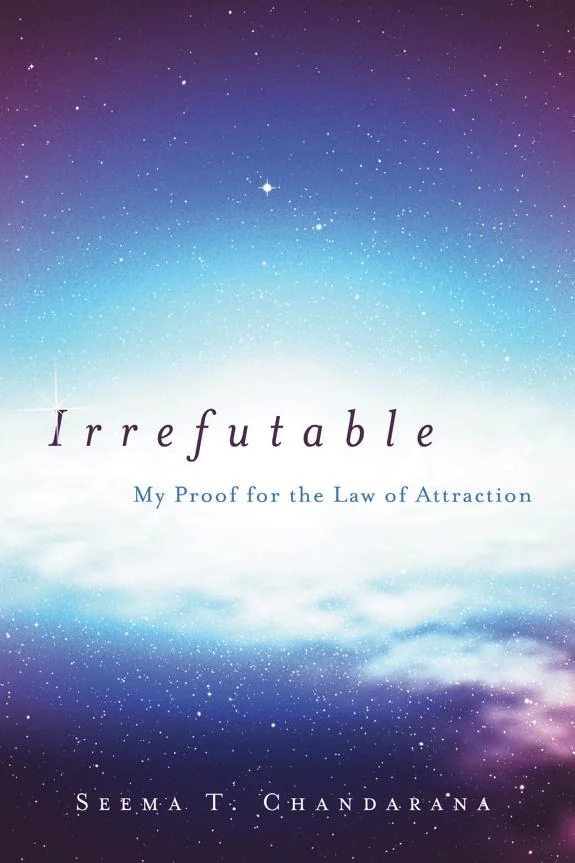
Irrefutable
 82
82

Irrefutable
Seema T. Chandarana’s *Irrefutable* offers a direct confrontation with the notion of subjective reality. The strength of the collection lies in its unwavering conviction; Chandarana presents her experiences not as theories but as irrefutable evidence of a fundamental law. The writing is earnest, urging readers to replicate her findings. However, this very earnestness can sometimes verge on the didactic, leaving little room for nuance or the exploration of the psychological complexities that might also shape perceived reality. A particularly striking aspect is the consistent theme of 'miracles' occurring as a direct result of belief alignment. While the author states, "I have confidence that you wont have to search too far back, as the Law is ineffable," this assertion, while bold, might feel unconvincing to skeptics. The book succeeds in its aim to inspire self-reflection on personal belief systems, even if its categorical assertions about universal law lack empirical backing. It is a confident, if somewhat singular, perspective on creation.
📝 Description
82
Seema T. Chandarana's 2013 book, Irrefutable, argues that individual beliefs shape perceived reality.
Irrefutable presents narratives that support the principle that a person's beliefs directly influence their experienced reality. Chandarana suggests that by consciously applying this idea, individuals can bring about desired outcomes and shape their own lives. The book encourages readers to look for evidence of this principle in their own experiences, pointing to its consistent and widespread operation. It is written for those interested in practical metaphysics, self-improvement, and personal growth. The work appeals to readers who want to understand how their thoughts and spiritual discipline affect their circumstances. It is for the individual who questions conventional ideas and seeks to actively participate in creating their own existence.
The central idea in Irrefutable is the Law of Belief. This law states that what a person internally holds to be true and expects will happen is reflected in their external world. This suggests a direct connection between the mind and the material world. Thoughts and beliefs are presented as having a causal effect on the circumstances one encounters. The book is for individuals open to the concept that consciousness plays an active role in how reality manifests and are willing to test these ideas personally.
Published in 2013, *Irrefutable* appeared during a revival of New Thought and Law of Attraction ideas. Its core concepts are similar to those of earlier writers like Florence Scovel Shinn and Neville Goddard, but Chandarana's work fits into a more recent trend of practical application and personal stories. The early 21st century saw many spiritual and metaphysical books distributed outside traditional publishing. Online discussions about manifestation principles also grew, creating a receptive audience for Chandarana's approach based on personal accounts.
💡 Why Read This Book?
• Learn to actively identify the Law of Belief in your own life, as exemplified in Chandarana's personal narratives, to gain agency over your experiences. • Understand the concept of 'ineffable' manifestation, as presented in the book, which suggests a consistent, exceptionless cosmic principle for creating your reality. • Gain practical encouragement to test Chandarana's assertions by examining your own stories, fostering a proactive approach to personal growth initiated in 2013.
⭐ Reader Reviews
Honest opinions from readers who have explored this book.
❓ Frequently Asked Questions
What is the core message of Seema T. Chandarana's 'Irrefutable'?
The core message is that your beliefs directly create your reality. The book argues that by understanding and consciously directing your beliefs, you can manifest desired outcomes and experience 'miracles' in your life, as evidenced by the author's own experiences since its 2013 publication.
Is 'Irrefutable' a self-help book or a collection of stories?
It functions as both. It presents a series of personal stories as evidence for the 'Law of Belief,' serving as case studies for the self-help principles of manifestation and reality creation.
Who is Seema T. Chandarana?
Seema T. Chandarana is the author of 'Irrefutable,' first published on May 23, 2013. She presents herself as someone who has successfully applied principles of belief and manifestation to shape her reality.
What does the author mean by 'ineffable' in relation to the Law?
The author uses 'ineffable' to describe the Law of Belief as being beyond ordinary description or comprehension, suggesting its fundamental, constant, and universally applicable nature, which cannot be easily articulated but can be observed in action.
Can 'Irrefutable' be considered a spiritual or metaphysical text?
Yes, 'Irrefutable' is considered a metaphysical text. It explores concepts related to consciousness, belief, and the creation of reality, aligning with principles found in New Thought and other spiritual traditions focused on the power of the mind.
What is the significance of the publication year 2013 for this book?
The 2013 publication date places 'Irrefutable' within a period of increased interest in Law of Attraction and manifestation principles, often amplified by online platforms and self-publishing, making it a contemporary contribution to the genre.
🔮 Key Themes & Symbolism
The Law of Belief
This is the foundational concept, positing that one's internal convictions are the primary drivers of external circumstances. Chandarana presents this not as a theory but as an observed, consistent principle. The book encourages readers to see their own lives as proof, highlighting how reality 'reflects back' one's beliefs. This theme challenges the notion of passive reception of fate, instead advocating for active participation in co-creating one's world through focused belief and expectation.
Personal Reality Creation
Central to the book's message is the idea that individuals possess the power to create their own reality. This is achieved through conscious awareness and alignment of one's thoughts, feelings, and beliefs with desired outcomes. Chandarana frames this as a 'miracle' that occurs when one truly understands and applies this creative power. The emphasis is on empirical evidence drawn from personal experience, urging readers to look for similar patterns in their own lives since the work's 2013 publication.
The Ineffable Nature of Universal Laws
Chandarana describes the Law of Belief as 'ineffable,' meaning it is beyond adequate description or articulation. This suggests a fundamental, pervasive force or principle that operates constantly and universally, often unseen or unacknowledged in its direct causal role. The author expresses strong confidence in its unshakeable operation, finding no exceptions in her extensive personal inquiry, positioning it as a core, albeit mysterious, aspect of existence.
Self-Observation and Evidence
A key practice advocated is rigorous self-observation. Readers are encouraged to examine their personal histories and daily experiences to find concrete examples of the Law at work. This involves looking for correlations between inner states (beliefs, expectations) and outer events. The book functions as a call to action, prompting readers to become detectives of their own lives, seeking the 'evidence' of their belief-driven reality.
💬 Memorable Quotes
Direct passages from the work, attributed to the author.
“Reality reflects back my beliefs, and I realize that a miracle has occurred: I have created my own reality.”
— This statement expresses the book's core thesis: the external world is a mirror of internal conviction. The author views this alignment not as coincidence but as a miraculous act of personal creation, achieved through focused belief.
“Don't take my word for it. Try it out for yourself!”
— This is a direct invitation to the reader, emphasizing the practical and experiential nature of the principles discussed. It encourages active engagement and personal verification rather than passive acceptance of the author's claims.
“I encourage you to look at your own stories to find evidence of the Law at work.”
— This highlights the book's method: using personal narrative as proof. It directs the reader's attention inward, prompting them to analyze their life events for patterns that support the central concept of belief manifestation.
“I have confidence that you wont have to search too far back, as the Law is ineffable.”
— This conveys the author's certainty in the universality and constant operation of the Law of Belief. The term 'ineffable' suggests its fundamental, mysterious, and pervasive nature, implying it's always present, even if not consciously recognized.
“In all my years of searching, I cannot find one example of an exception to the Law.”
— This statement underscores the author's absolute conviction in the Law of Belief's infallibility. It presents the principle as a universal constant, suggesting that apparent contradictions are merely misinterpretations or lack of deeper understanding.
🌙 Esoteric Significance
Tradition
The work aligns with the broad tradition of Western Esotericism, specifically the New Thought movement and its emphasis on mind-over-matter. It shares roots with metaphysical concepts found in Christian Science and Unity Church teachings, focusing on the power of divine mind and individual consciousness to shape physical reality. Unlike more complex systems like Kabbalah or Hermeticism, Chandarana's approach prioritizes direct, personal experience and simple application, making it accessible but less tied to specific symbolic or ritualistic frameworks.
Symbolism
While *Irrefutable* is less focused on overt symbolism than some esoteric texts, the concept of 'reality reflecting back beliefs' acts as a powerful metaphor for a mirror or a psychic echo. The 'miracle' itself can be seen as a symbol of divine intervention or the activation of latent creative potential within the individual. The 'Law' itself, described as 'ineffable,' functions symbolically as an unseen, fundamental force akin to gravity, governing the relationship between consciousness and form.
Modern Relevance
Chandarana's work speaks to contemporary self-help and manifestation coaching industries, which continue to explore belief systems and their impact on personal success and well-being. Thinkers and practitioners in fields like positive psychology, quantum consciousness, and even certain interpretations of modern spirituality draw parallels to the ideas presented. The emphasis on personal testimony and actionable advice aligns with the digital content creation prevalent today, making its core message relevant to online communities focused on personal growth and spiritual development.
👥 Who Should Read This Book
• Individuals new to metaphysical concepts seeking accessible narratives about reality creation and the power of belief. • Practitioners of the Law of Attraction looking for personal accounts that reinforce and potentially deepen their understanding since the book's 2013 publication. • Skeptics interested in exploring subjective reality and the psychological impact of belief, who are open to anecdotal evidence and personal experimentation.
📜 Historical Context
Seema T. Chandarana's *Irrefutable*, published in 2013, arrived during a period marked by the widespread popularization of Law of Attraction principles, heavily influenced by works like *The Secret* (2006). This era saw a surge in self-help literature and online courses dedicated to manifestation, often drawing from earlier New Thought movements originating in the late 19th and early 20th centuries, championed by figures like Wallace Wattles and James Allen. Chandarana's contribution fits within this contemporary landscape, offering personal testimonies as primary evidence. While the core concepts are not novel, the book's publication date places it firmly within the digital age, where such ideas could find immediate and broad distribution, often bypassing traditional publishing houses and academic scrutiny. It engaged with a public increasingly receptive to personalized spiritual and metaphysical frameworks, contrasting with more structured or theologically bound belief systems prevalent in earlier decades.
📔 Journal Prompts
The Law of Belief as a mirror: what reflections are most striking?
Examining 'miracles' created: identify a personal instance of reality manifestation.
The 'ineffable' nature of your own beliefs: how do they operate unseen?
Evidence within your stories: document one instance where reality matched your expectation.
Testing the Law: outline a small experiment to consciously shape an outcome.
🗂️ Glossary
The Law of Belief
The central principle articulated by Chandarana, asserting that an individual's deeply held beliefs directly influence and manifest their external reality. It suggests a causal link between thought and experience.
Created Reality
Refers to the external circumstances, events, and experiences of an individual's life, understood not as random occurrences but as direct results of their own beliefs and expectations.
Miracle
In the context of the book, a miracle signifies an event or outcome that seems extraordinary but is presented as a natural consequence of aligning one's beliefs with desired reality, as per the Law of Belief.
Ineffable
Describing the Law of Belief as beyond ordinary description or comprehension. It suggests the law is a fundamental, pervasive, and constant force that operates universally, often in subtle ways.
Evidence
Refers to concrete examples and personal experiences that serve as proof for the operation of the Law of Belief. The book encourages readers to find such evidence within their own life stories.
Reflection
The idea that external reality acts as a mirror, 'reflecting back' the internal beliefs and expectations of an individual. This highlights the responsive nature of the manifested world.
Searching
The author's process of examining her own life and experiences for proof of the Law of Belief. This implies an active, ongoing inquiry into the nature of reality and consciousness.
This book appears in 1 collection
🔮 Readers Also Liked
Browse all →









From the “Law of Attraction” Collection
View all →





More Free Occult Philosophy Books
View all →