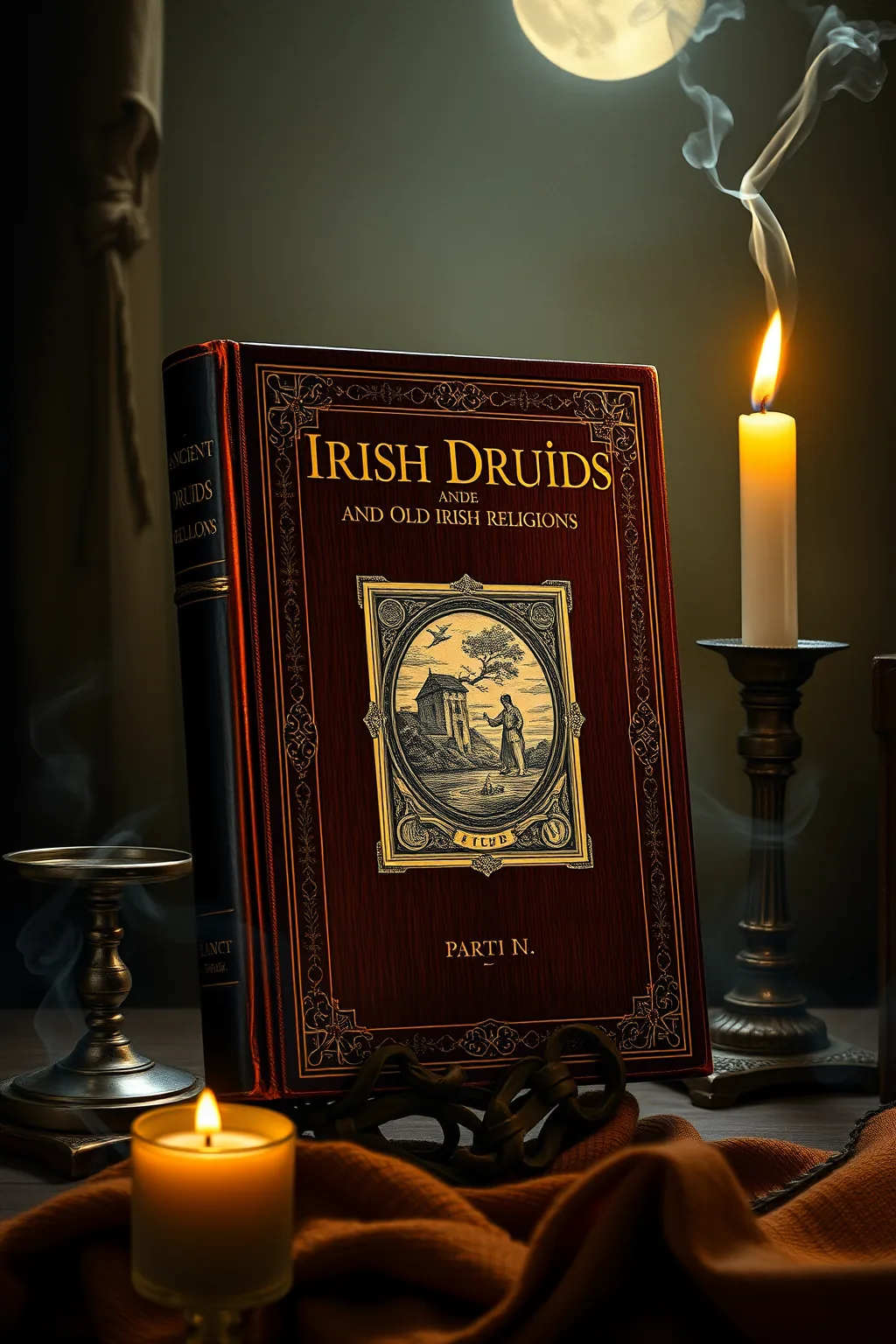
Irish Druids And Old Irish Religions
 75
75

Irish Druids And Old Irish Religions



Marcus Thorne (Esoteric Sciences Reviewer) — A seminal exploration into the foundational elements of Irish paganism, "Irish Druids And Old Irish Religions" offers a scholarly yet accessible compendium of knowledge. Part I. Irish Druids masterfully synthesizes late 19th-century research, providing invaluable context for understanding the roots of modern Celtic Neo-Paganism. Its strength lies in illuminating the conceptual seeds that would later inform Wiccan traditions, particularly concerning nature veneration and esoteric symbolism. This book is a vital resource for serious students of witchcraft, pagan history, and anyone seeking to connect with the ancient spiritual currents of Ireland. Its enduring relevance lies in its detailed, albeit historical, reconstruction of Druidic thought.
📝 Description
75
Published in the late 19th century, 'Irish Druids And Old Irish Religions' examines Celtic paganism.
This book delves into the spiritual heritage of Ireland, focusing on Druidic practices and beliefs from a historical perspective. It was compiled by an entity identified as Part I. Irish Druids, aiming to shed light on the cosmology and rituals of ancient Celtic peoples. The work appears to have been created during a period of renewed scholarly interest in Celtic paganism, bridging the gap between historical inquiry and the emergence of modern esoteric traditions. It discusses forgotten deities, ancient rites, and the core tenets of Druidic philosophy.
The text aims to illustrate a worldview centered on nature worship, a sense of cosmic unity, and the quest for secret knowledge. It provides insight into concepts that later influenced Neo-Paganism and Wicca. The book addresses the enduring appeal of Celtic magic, ancient archetypes, and the philosophical foundations of earth-based spiritualities.
This work is situated within the late 19th-century revival of interest in ancient European religions and mythologies. It reflects a scholarly engagement with pre-Christian Irish traditions, attempting to reconstruct or interpret Druidic beliefs and practices. This period saw a broader esoteric movement seeking alternative spiritual paths rooted in nature and ancient wisdom, often drawing from Celtic and other indigenous European sources.
💡 Why Read This Book?
Embark on a journey into the heart of ancient Irish spirituality. This book offers a scholarly yet accessible exploration of Druidic lore and Old Irish religions, illuminating the foundations of Celtic paganism. Discover concepts that influenced later Neopagan movements and connect with the profound wisdom of a civilization deeply attuned to nature and the cosmos. Ideal for seekers of esoteric knowledge, students of paganism, and practitioners looking to deepen their understanding of ancestral spiritual practices.
⭐ Reader Reviews
Honest opinions from readers who have explored this book.
❓ Frequently Asked Questions
What historical period does this book primarily focus on?
The book centers on the understanding of Irish Druids and Old Irish Religions as known at the end of the nineteenth century, drawing from scholarly research of that era.
How does this book relate to modern Paganism?
It delves into concepts that significantly influenced the development of modern Celtic Neo-Paganism and aspects of the Wiccan movement, offering historical context for contemporary practices.
Is this book suitable for beginners in Paganism?
Yes, while scholarly, it is written to be very readable, making it an excellent starting point for those new to the study of ancient Irish religions and Druidry.
What is the primary focus of the author's approach?
The author's approach is scholarly, aiming to present a comprehensive and accurate account of what was known about Druids and Irish paganism during the late 19th century.
Does the book discuss specific rituals or practices?
It discusses many of the concepts and beliefs that underpinned Druidic practices and Old Irish religions, providing context for rituals rather than detailed step-by-step guides.
🔮 Key Themes & Symbolism
The Esoteric Wisdom of the Druids
Look at the profound, often hidden, knowledge attributed to the ancient Druids of Ireland. This theme explores their understanding of the natural world as a sacred text, their connection to elemental forces, and their role as custodians of spiritual mysteries. The text illuminates their sophisticated cosmology, their understanding of life, death, and rebirth, and their philosophical underpinnings that sought harmony with the divine and the earth. It highlights how this ancient wisdom, though shrouded in time, continued to resonate and influence spiritual thought for centuries, offering seekers a path to deeper self-understanding and connection to the sacred.
The Roots of Celtic Neo-Paganism
This theme traces the lineage of ancient Irish religious concepts that would later be reinterpreted and revitalized in the formation of modern Celtic Neo-Paganism. It examines the specific ideas, symbols, and spiritual frameworks discussed in the text that were foundational for later traditions, including the Wiccan movement. By understanding the historical origins of these concepts – from nature veneration to the cyclical understanding of time – practitioners and scholars can gain a richer appreciation for the authentic wellsprings of contemporary pagan practice. It underscores the enduring power of these ancient beliefs to inspire spiritual renewal.
Symbolism and Sacred Landscapes
Explore the body of symbolism embedded within the ancient Irish religious landscape and its connection to Druidic practice. This theme investigates how natural elements, celestial bodies, and sacred sites served as potent symbols of spiritual truths and cosmic order. The text sheds light on the symbolic language used to communicate with the divine, to understand the cycles of life, and to work through the liminal spaces between worlds. Discover how the ancient Irish perceived the sacred not just in abstract thought, but as an immanent force woven into the very fabric of their environment, from standing stones to the flowing rivers.
💬 Memorable Quotes
Direct passages from the work, attributed to the author.
“In the whisper of the wind, they heard the voices of their ancestors.”
— This highlights the animistic and ancestral reverence inherent in ancient Irish spirituality, where natural phenomena were seen as conduits for communication with the spirit world and the wisdom of those who came before.
“The sacred fire burned not just in hearths, but in the heart of the land.”
— This evocative phrase suggests that sacredness was perceived as an inherent quality of the land itself, not merely confined to ritualistic settings, emphasizing a deep, immanent spiritual connection to the environment.
“They saw the dance of the stars as a reflection of the divine order.”
— This points to the astrological and cosmological understanding of the Druids, viewing celestial movements as a manifestation of a higher, divinely ordained pattern governing the universe.
💡 Key Ideas
Editorial paraphrase of the work's core concepts — not direct quotes.
The wisdom of the Druids was as deep as the earth and as vast as the sky.
This quote speaks to the comprehensive and profound nature of Druidic knowledge, encompassing both terrestrial and celestial realms, and suggesting a deep connection to the fundamental forces of existence.
From the seed grew the forest, and from the spirit grew the soul.
This quote draws a parallel between natural growth and spiritual development, implying a cyclical process of unfolding and transformation that applies to both the physical world and the inner life of the individual.
🌙 Esoteric Significance
Tradition
This work is intrinsically linked to the Western Esoteric Tradition, specifically its branches focused on Celtic and nature-based spiritualities. It acts as a historical bridge, useful the ancient roots of practices that would later inform Wicca, Neo-Paganism, and various forms of modern Druidry. By detailing the philosophical and cosmological underpinnings of Old Irish Religions, it offers insights into concepts like immanent divinity, cyclical time, and the sacredness of the natural world, which are central tenets in many esoteric paths seeking connection to earth-centered energies.
Symbolism
The book studies the strong symbolism of ancient Irish culture, where natural elements—trees, stones, rivers, celestial bodies—were imbued with profound spiritual meaning. It explores how these symbols served as a language for understanding the cosmos, the cycles of life and death, and the interconnectedness of all beings. The symbolism discussed often relates to fertility, transformation, elemental forces, and the journey of the soul, providing a framework for interpreting ancient rituals and beliefs, and offering potent archetypes for contemporary esoteric practice and contemplation.
Modern Relevance
Despite its historical origins, "Irish Druids And Old Irish Religions" holds significant modern relevance for seekers, scholars, and practitioners of esoteric traditions. It provides an invaluable historical lens through which to understand the conceptual ancestry of contemporary Celtic Neo-Paganism and Wicca. The book's exploration of nature veneration, cyclical time, and the inherent sacredness of the land resonates deeply with modern environmental and earth-centered spiritual movements. It offers a foundational understanding for those wishing to connect with the ancient wisdom of Ireland and integrate its profound spiritual insights into their present-day lives.
👥 Who Should Read This Book
This book is a treasure for a diverse range of readers. **Beginners** seeking an accessible yet scholarly introduction to the spiritual heart of ancient Ireland will find it useful. **Scholars** of comparative religion, Celtic studies, and Pagan history will appreciate its detailed synthesis of late 19th-century research. **Seekers** drawn to the mysteries of the natural world, ancestral wisdom, and earth-centered spirituality will find profound resonance. **Practitioners** of Wicca, Neo-Paganism, and modern Druidry will gain crucial historical context and a deeper understanding of the roots from which their traditions have sprung, enriching their personal spiritual journeys.
📜 Historical Context
Composed at the cusp of the twentieth century, "Irish Druids And Old Irish Religions" emerges from a period of fervent intellectual curiosity and a burgeoning interest in ancient European cultures. The late Victorian and Edwardian eras saw a rise in antiquarian studies, a romanticization of Celtic heritage, and a desire to reconstruct lost spiritual traditions. This book reflects that scholarly milieu, attempting to synthesize available historical accounts, archaeological findings, and folklore to present a coherent picture of a pre-Christian Ireland. It was a time when the foundations for modern Pagan and Neo-Pagan revivals were being laid, often through the reinterpretation of historical texts and the discovery of ancient symbolism. The work stands as a proof of the era's efforts to understand its spiritual ancestors and the enduring influence of these ancient beliefs.
📔 Journal Prompts
Reflect on a natural element (e.g., a tree, a river) that holds personal spiritual significance for you. How might the ancient Druids have perceived its essence?
Consider the concept of cyclical time versus linear time. How does your current life align with or diverge from a cyclical understanding of existence?
What ancient symbols or archetypes from Irish mythology or Druidic lore resonate most strongly with your inner landscape today?
Imagine yourself in a sacred grove in ancient Ireland. What feelings, insights, or messages might you seek from such a place?
How can the principle of nature veneration, as explored in this book, be integrated more deeply into your daily life and spiritual practice?
🗂️ Glossary
Druid
An ancient Celtic priest, magician, and scholar, who served as a religious leader, teacher, judge, and advisor in ancient Celtic societies, particularly in Ireland and Britain. They were custodians of sacred knowledge and spiritual traditions.
Paganism
A broad term referring to polytheistic or indigenous religions, especially those of ancient times, characterized by worship of multiple deities and often a strong connection to nature and the earth.
Cosmology
The study of the origin, evolution, and eventual fate of the universe. In ancient contexts, it refers to a society's understanding of the fundamental nature of the universe and humanity's place within it.
Neo-Paganism
A modern religious movement that draws inspiration from the pre-Christian religions of Europe, often incorporating nature worship, polytheism, and magical practices. Celtic Neo-Paganism specifically focuses on revitalizing ancient Celtic spiritual traditions.
Wicca
A modern Pagan religious movement that draws upon a wide range of ancient European pagan and 19th-century occult traditions. It typically involves nature worship, reverence for deities, and the practice of magic.
This book appears in 2 collections
🔮 Readers Also Liked
Browse all →









From the “Witchcraft” Collection
View all →







More Free Witchcraft & Paganism Books
View all →