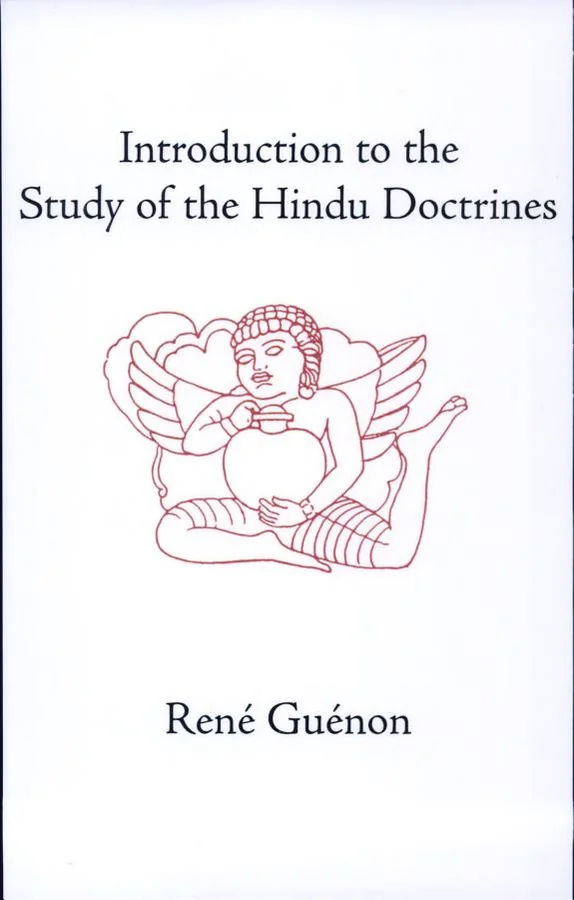
Introduction to the Study of the Hindu Doctrines
 72
72

Introduction to the Study of the Hindu Doctrines
René Guénon’s "Introduction to the Study of Hindu Doctrines" is not a casual read; it’s an intellectual immersion into the profound architecture of Hindu metaphysics. Guénon, writing with an authoritativeness that stems from his deep engagement with traditional sources, systematically deconstructs common Western misunderstandings. He effectively dismantles the 'Renaissance' prejudices that often framed Eastern thought as primitive or purely mythological. One particularly strong aspect is his rigorous differentiation between superficial philosophical speculation and the established doctrines rooted in ancient Revelation. However, the dense prose and reliance on specific terminology, while accurate, can present a steep learning curve for newcomers. A passage discussing the concept of the 'multiple states of being' illustrates the book's depth, but also its inherent challenge to readers accustomed to simpler frameworks. The work is a vital, if demanding, guide for those seeking a traditionalist understanding of India's spiritual heritage.
📝 Description
72
René Guénon's 1921 work aimed to present Hindu doctrines in their original, unadulterated form.
First published in 1921, René Guénon's "Introduction to the Study of the Hindu Doctrines" addresses core metaphysical concepts within traditional Hinduism. Guénon sought to separate authentic spiritual principles from later interpretations or accretions, structuring the book to build comprehension from fundamental ideas to their more complex implications. He wrote this during a period of growing Western interest in Eastern philosophies, often viewed through colonial or theosophical lenses. Guénon's objective was to counter prevailing Eurocentric biases and present Hindu teachings in their original state, positioning himself against purely historical or evolutionary religious studies.
This book is written for students of comparative religion, esotericism, and philosophy, especially those familiar with Guénon's other writings. It offers a rigorous exposition of Hindu metaphysics, aiming to be free of Orientalist perspectives. Readers looking for a clear explanation of Hindu traditions, stripped of modern distortions, will find this work valuable. It is intended for those who seek a non-polemical approach to these subjects.
Guénon's work on Hindu doctrines is situated within the Traditionalist School, an esoteric current that emphasizes the universal principles underlying all exoteric religions. This school, which Guénon helped found, posits a primordial Tradition from which all subsequent religious forms derive. His approach contrasts sharply with Orientalist scholarship of his time, which often treated Hinduism as a historical artifact or a primitive belief system. Guénon's aim was to reveal the metaphysical coherence and spiritual efficacy of Hindu thought, viewing it as a living tradition with direct access to eternal truths, not merely as a subject for academic study.
💡 Why Read This Book?
• Gain an unvarnished understanding of Hindu metaphysical principles, free from colonial or Orientalist distortions, as Guénon meticulously separates authentic doctrine from later interpretations, a clarity vital for serious study. • Grasp the traditionalist framework Guénon applies, enabling you to critically assess comparative religion studies and identify the core of spiritual teachings beyond mere cultural expression. • Understand the concept of 'Brahman' as the Absolute Principle, a cornerstone of Hindu metaphysics, and its relation to the individual Self (Atman), as explained in the work's foundational chapters.
⭐ Reader Reviews
Honest opinions from readers who have explored this book.
❓ Frequently Asked Questions
When was René Guénon's "Introduction to the Study of the Hindu Doctrines" first published?
René Guénon's "Introduction to the Study of the Hindu Doctrines" was first published in 2001, though the author's significant engagement with these ideas predates this considerably.
What is the primary focus of Guénon's "Introduction to the Study of the Hindu Doctrines"?
The book's primary focus is to present the core metaphysical doctrines of Hinduism in their traditional and esoteric sense, countering prevalent Western misunderstandings and biases.
Does this book explain Hindu rituals or social customs?
While it touches upon the context of these, the book's main emphasis is on the metaphysical and cosmological principles, rather than detailed descriptions of rituals or social structures.
Is this book suitable for absolute beginners to Hinduism?
It is best suited for those with some background in philosophy or esoteric studies, as Guénon assumes a certain intellectual rigor and familiarity with metaphysical discourse.
What does Guénon mean by 'traditional doctrines' in the context of Hinduism?
Guénon uses 'traditional doctrines' to refer to the teachings originating from a divine or primordial source, preserved through successive generations and forming the basis of a spiritual civilization.
How does this work relate to Guénon's other writings?
This book serves as a fundamental exposition of principles that underpin Guénon's later, more detailed works on metaphysics, symbolism, and specific traditions like Vedanta.
🔮 Key Themes & Symbolism
Metaphysical Principles
The work meticulously dissects the foundational metaphysical principles of Hinduism, focusing on the nature of Reality (Brahman) and the Self (Atman). Guénon distinguishes these core truths from later philosophical elaborations or cultural interpretations, emphasizing their universal and eternal character. He argues for an understanding of these concepts not as abstract ideas, but as keys to spiritual realization, forming the bedrock of the Hindu tradition's intellectual and spiritual edifice.
Esoteric vs. Exoteric
A central theme is the distinction between the exoteric (outward, popular) and esoteric (inward, initiatory) dimensions of religious and spiritual traditions. Guénon posits that Hindu doctrines, like those of other primordial traditions, possess a hidden, profound meaning accessible only through specific methods of study and spiritual discipline. This approach highlights the intellectual and spiritual hierarchy within traditional societies, where deeper knowledge is guarded and transmitted through specific lineages.
Rejection of Modernist Bias
Guénon actively counters what he perceives as the limitations and prejudices of modern Western thought, particularly those stemming from the Renaissance and Enlightenment. He critiques the tendency to view ancient traditions through a purely historical, evolutionary, or materialistic lens, arguing that such perspectives obscure the true spiritual and metaphysical significance of these doctrines. The book aims to re-establish the authority of tradition in understanding fundamental truths.
The Nature of Illusion (Maya)
The concept of Maya is explored not merely as 'illusion' in a simplistic sense, but as the principle of cosmic manifestation that veils the Absolute Reality. Guénon explains Maya as the creative power that generates the multiplicity of the phenomenal world, which, while real in its own order, is ultimately relative and contingent when compared to the unconditioned Brahman. Understanding Maya is presented as crucial for disengaging the spiritual aspirant from the limitations of the sensible world.
💬 Memorable Quotes
Direct passages from the work, attributed to the author.
“The 'Renaissance' initiated a deviation from tradition, replacing the notion of a spiritual authority with the primacy of the individual intellect.”
— This highlights Guénon's critique of historical periods that he believed led to a decline in spiritual understanding, emphasizing a shift from divinely revealed knowledge to humanistic reason.
“Hindu doctrines are not merely philosophical systems but represent a complete doctrine of the universe and of the human being.”
— This statement underscores Guénon's view that Hinduism offers a holistic worldview, encompassing cosmology, ontology, and soteriology, intended for the total realization of the individual.
“The distinction between Brahman and Atman is essential for comprehending the relationship between the Absolute and the individual soul.”
— Guénon stresses the importance of understanding these two fundamental concepts to grasp the Hindu path to liberation, where the individual self realizes its identity with the ultimate reality.
“The true understanding of any doctrine lies in its esoteric sense, which is its very essence.”
— This emphasizes Guénon's traditionalist perspective, suggesting that the deeper, hidden meaning of religious and spiritual teachings is more significant than their outward or literal interpretations.
“Maya is the principle of manifestation, the veil that separates the contingent world from the Absolute.”
— This concise explanation defines Maya as the creative force responsible for the world as we perceive it, and its role in obscuring the ultimate, unchanging reality.
🌙 Esoteric Significance
Tradition
This work is firmly rooted in the Traditionalist School of esotericism, championed by Guénon himself. It aligns with a lineage that seeks to understand and articulate universal metaphysical principles found across diverse religious and spiritual traditions. Guénon's approach to Hinduism is not that of a cultural anthropologist but of a metaphysician seeking the underlying 'Form' or divine truth within the specific cultural expressions of India.
Symbolism
While not solely focused on symbolism, the book implicitly engages with it by discussing concepts like Brahman (often symbolized by 'Om' or the infinite) and Maya (the veil of illusion). The cyclical nature of time (Yugas) also functions symbolically, representing cosmic epochs and the unfolding of manifestation. The ultimate goal of Moksha, or liberation, symbolizes the return to the unmanifested Principle.
Modern Relevance
Contemporary thinkers and movements within traditionalist, perennialist, and certain esoteric circles continue to draw heavily on Guénon's work. His rigorous analysis of Hindu doctrines provides a foundational text for those seeking to understand traditional metaphysics outside of academic or New Age frameworks. His critiques of modernity also resonate with contemporary concerns about secularization and the loss of spiritual grounding.
👥 Who Should Read This Book
• Students of comparative religion seeking to understand the metaphysical underpinnings of Hinduism beyond superficial descriptions, benefiting from Guénon's systematic exposition of core doctrines. • Practitioners of esoteric traditions interested in the universal principles of spiritual realization, as Guénon bridges specific doctrines to broader metaphysical truths applicable across traditions. • Scholars of philosophy and intellectual history who wish to engage with a significant 20th-century perspective on non-Western thought, understanding its historical context and influence.
📜 Historical Context
Written by René Guénon in the early 20th century, "Introduction to the Study of Hindu Doctrines" emerged during a period of intense Western fascination with Eastern philosophies, often distorted by colonial perspectives or the burgeoning Theosophical movement. Guénon's work sought to provide a corrective, presenting Hindu thought in its authentic traditional form, free from the subjective interpretations and biases that characterized much contemporary scholarship. He was reacting against the prevailing intellectual climate influenced by the Renaissance and Enlightenment, which often devalued non-Western traditions and prioritized empirical or rationalistic approaches over metaphysical understanding. His efforts to reassert the authority of tradition placed him in intellectual dialogue, often implicitly critical, with figures like Mircea Eliade, who later explored comparative mythology, and contrasted with the more scholarly, less metaphysical approaches of Orientalists of his time.
📔 Journal Prompts
The concept of Brahman as the Absolute Principle and its relation to Maya.
Distinguishing the esoteric meaning of Hindu doctrines from their exoteric presentation.
Guénon's critique of Renaissance intellectual biases impacting the study of Eastern traditions.
The significance of Atman as the individual Self in relation to the Universal Self.
Reflecting on the purpose of studying traditional doctrines in a modern context.
🗂️ Glossary
Brahman
In Hindu philosophy, the ultimate, unchanging reality, the Absolute Principle underlying all existence. It is considered the source and sum of all things, beyond all attributes and descriptions.
Atman
The Self, the true inner essence of an individual. In many Hindu schools, Atman is ultimately identical with Brahman, signifying the realization of unity between the individual soul and the Absolute.
Maya
A Sanskrit term often translated as 'illusion' or 'magic.' In Hindu metaphysics, it refers to the power of cosmic illusion that conceals the true nature of reality (Brahman) and creates the phenomenal world of multiplicity.
Vedanta
A major school of Hindu philosophy, literally meaning 'the end of the Vedas.' It primarily focuses on the Upanishads and deals with metaphysical questions concerning Brahman, Atman, and the nature of reality.
Exoteric
Pertaining to the outward, popular, or external aspects of a doctrine or teaching. This contrasts with the esoteric, which refers to the inner, hidden, or secret meaning.
Esoteric
Pertaining to the inner, secret, or hidden meaning of a doctrine, accessible only to a select few through initiation or specialized study. It focuses on spiritual and metaphysical truths.
Moksha
Liberation or release from the cycle of birth, death, and rebirth (samsara). It is the ultimate spiritual goal in Hinduism, achieved through various paths like knowledge, devotion, or action.
This book appears in 1 collection
🔮 Readers Also Liked
Browse all →









From the “Hinduism” Collection
View all →






More Free Occult Philosophy Books
View all →