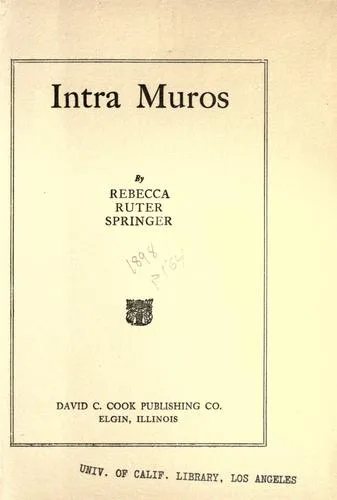
Intra Muros
 81
81

Intra Muros
Springer’s *Intra Muros* bypasses the common pitfalls of New Age literature by offering a structured, almost architectural, approach to inner exploration. The concept of the 'Seven Gates' is particularly compelling, presenting a clear, albeit challenging, framework for spiritual advancement. It avoids the vagaries that often plague discussions of the inner life, grounding them in a systematic progression. However, the text’s deliberate abstraction can sometimes feel detached; the human element, the lived experience of struggle and joy, is often implied rather than explicitly rendered. A passage detailing the purification required before passing through the 'Gate of Understanding' exemplifies this, focusing on the metaphysical necessity rather than the emotional labor involved. While offering a rigorous map, it occasionally lacks the warmth of a lived journey. It is a valuable guide for the serious seeker, but perhaps less so for those seeking emotional catharsis.
📝 Description
81
Rebecca Ruter Springer's Intra Muros was first published in 1985.
Rebecca Ruter Springer's Intra Muros, published in 1985, addresses spiritual interiority and the unseen dimensions of existence. It structures metaphysical concepts with a clarity that contrasts with their complexity. The book guides the reader toward spiritual development and understanding through an inner journey.
This text appeals to individuals seeking a deeper comprehension of consciousness, spiritual evolution, and the subtle energies that inform reality. It suits those desiring systematic knowledge in esoteric studies, moving beyond purely anecdotal accounts. Readers interested in comparative mysticism, the soul's nature, and inner discipline will find substantial material.
Published during a time of burgeoning New Age thought, Intra Muros presented a disciplined, less sensationalist approach to spiritual exploration. While earlier figures like Helena Blavatsky established groundwork in Theosophy, Springer's work offered a distinct perspective on the inner life, engaging with psychological and spiritual paradigms of its era.
Emerging in 1985, Intra Muros offered a more structured perspective on spiritual development than some of the more diffuse New Age literature of the period. It built upon earlier esoteric traditions that explored the soul's inner life, such as Theosophy. Springer's work focused on the systematic understanding of inner realities and spiritual progression, emphasizing inner discipline and perception.
💡 Why Read This Book?
• Gain a structured understanding of spiritual progression through the metaphor of the 'Seven Gates,' providing a clear map for inner development distinct from amorphous spiritual seeking. • Explore the concept of the 'Inner Kingdom,' offering a specific locus for spiritual realization that can be cultivated through disciplined inner work, as detailed in the text. • Learn about the 'Silent Watcher' as an internal divine principle, providing a concrete focus for meditation and self-awareness beyond generalized spiritual concepts.
⭐ Reader Reviews
Honest opinions from readers who have explored this book.
❓ Frequently Asked Questions
What is the primary focus of Rebecca Ruter Springer's 'Intra Muros'?
'Intra Muros' focuses on the exploration of the spiritual interior, guiding readers through the concept of an 'Inner Kingdom' or 'Inner Sanctum' accessible through dedicated inner work and stages of spiritual realization.
When was 'Intra Muros' first published?
The original publication date for Rebecca Ruter Springer's 'Intra Muros' is 1985, placing it within a period of significant interest in metaphysical and esoteric studies.
What are the 'Seven Gates' mentioned in 'Intra Muros'?
The 'Seven Gates' represent distinct stages or levels of spiritual realization and understanding that the soul must pass through on its journey towards enlightenment, as presented in the book.
Who is the intended audience for 'Intra Muros'?
This work is intended for individuals interested in systematic metaphysical study, spiritual development, comparative mysticism, and understanding the nature of consciousness and the soul.
Does 'Intra Muros' offer practical exercises for spiritual development?
While not a manual of practical exercises in the conventional sense, the book's structured approach to the 'Inner Kingdom' and the 'Seven Gates' implicitly guides the reader toward disciplined inner work and self-awareness.
What is the 'Silent Watcher' in the context of 'Intra Muros'?
The 'Silent Watcher' is a concept within 'Intra Muros' referring to an inner, divine presence or aspect of the self that observes and guides spiritual progress, representing a core element of inner realization.
🔮 Key Themes & Symbolism
The Inner Kingdom
Springer posits the existence of an 'Inner Kingdom,' a spiritual reality within each individual, distinct from the physical world. This kingdom is presented not as a vague ideal but as a structured domain, accessible through focused inner discipline and purification. The text emphasizes that true spiritual progress involves understanding and mastering this inner realm, which serves as the soul's ultimate dwelling place and the seat of divine consciousness.
The Seven Gates
Central to the book's methodology are the 'Seven Gates,' symbolic thresholds that represent progressive stages of spiritual enlightenment. Each gate requires a specific form of inner work, purification, or realization to be passed. These stages offer a systematic framework for the soul's journey, moving from initial awareness to profound spiritual union. The concept provides a map for working through the complexities of inner transformation.
The Silent Watcher
The 'Silent Watcher' is depicted as the divine aspect within, the eternal witness to the soul's journey. It is the indwelling presence that guides and observes without active intervention, yet its recognition is crucial for spiritual awakening. Cultivating awareness of the Silent Watcher is presented as a key practice for transcending the limitations of the personal ego and aligning with higher consciousness.
Spiritual Perception
Springer addresses the development of spiritual perception, the ability to discern the subtle realities of the Inner Kingdom. This involves purifying the mind and senses to perceive beyond the material. The text suggests that through adherence to the principles outlined and the passing of the Seven Gates, one's capacity for spiritual sight and understanding is progressively refined.
💬 Memorable Quotes
Direct passages from the work, attributed to the author.
“The Inner Kingdom is the soul's true home.”
— This statement captures the book's core thesis: that our essential reality and place of spiritual origin lie not in the external world, but within our own consciousness, a domain to be explored and inhabited.
“Each of the Seven Gates demands a specific purification.”
— This highlights the systematic and disciplined nature of spiritual advancement as presented in 'Intra Muros,' emphasizing that progress requires specific inner work tailored to each stage of realization.
“The Silent Watcher observes all, judges none.”
— This describes the nature of the divine presence within, a principle of pure awareness that witnesses our experiences without attachment or condemnation, serving as a model for non-judgmental consciousness.
“True perception transcends the senses.”
— This implies that spiritual insight and understanding are not derived from physical senses alone, but from a developed inner faculty capable of perceiving subtler realities.
💡 Key Ideas
Editorial paraphrase of the work's core concepts — not direct quotes.
To know thyself is to pass the first gate.
This paraphrase suggests that the initial step in spiritual realization, represented by the first of the Seven Gates, involves profound self-knowledge and introspection, a prerequisite for further progress.
🌙 Esoteric Significance
Tradition
The work aligns with Western Esoteric traditions, particularly those influenced by Hermeticism and Neoplatonism, emphasizing an inner spiritual journey and the microcosm reflecting the macrocosm. It shares thematic elements with Theosophy in its focus on spiritual evolution and inner planes, yet presents a more distilled and less complex system than some of Blavatsky's extensive writings. The structured progression through stages suggests an ordered cosmos and a mappable path to divine consciousness.
Symbolism
The 'Inner Kingdom' symbolizes the divine potential and true self residing within each individual, a sacred space of pure consciousness. The 'Seven Gates' function as archetypal symbols for the stages of spiritual purification and enlightenment, representing progressive mastery over lower aspects of the self to attain higher states. The 'Silent Watcher' embodies the divine spark or the eternal Self, the unchanging witness to all phenomenal experience.
Modern Relevance
Contemporary spiritual seekers interested in structured meditation, self-mastery, and the psychology of consciousness find resonance in Springer's work. Modern practitioners of mindfulness and contemplative prayer can draw parallels to the cultivation of inner awareness and the focus on the 'Silent Watcher.' The concept of distinct stages of spiritual development echoes in various modern self-help and spiritual growth methodologies.
👥 Who Should Read This Book
• Students of Western Esotericism seeking a structured map of spiritual progression, providing clear conceptual stages beyond general spiritual philosophies. • Individuals interested in the psychology of consciousness and self-realization who desire a metaphysical framework for inner transformation. • Comparative religion scholars examining the diverse articulations of the spiritual journey across different traditions and eras.
📜 Historical Context
When *Intra Muros* emerged in 1985, it entered a landscape significantly shaped by the New Age movement, which had gained momentum throughout the 1970s. This era saw widespread interest in Eastern philosophies, parapsychology, and alternative spiritualities, often popularized by figures like Shirley MacLaine. Springer’s work, however, offered a more structured, almost scholastic approach, drawing from earlier esoteric traditions but presenting them with a distinct clarity. Unlike the more eclectic or experiential nature of much contemporary New Age literature, *Intra Muros* provided a coherent, step-by-step framework for inner development. It can be seen as a bridge between late 19th-century Theosophy, with its intricate metaphysical systems, and the more individualized spiritual explorations of the late 20th century, offering a disciplined alternative to the sometimes diffuse spiritual seeking of the time.
📔 Journal Prompts
Reflect on the potential nature of your own Inner Kingdom.
Consider which of the Seven Gates you might be approaching and the purification required.
What does the concept of the Silent Watcher mean in your daily life?
How can the idea of spiritual perception alter your understanding of reality?
Map the inner disciplines that align with passing through the Seven Gates.
🗂️ Glossary
Inner Kingdom
The spiritual reality or true self residing within consciousness, considered the soul's ultimate dwelling place and the seat of divine presence.
Seven Gates
Symbolic stages or thresholds representing progressive levels of spiritual realization, understanding, and purification on the path to enlightenment.
Silent Watcher
The inner divine presence, the eternal witness, or the true Self that observes the soul's journey without judgment, guiding from within.
Spiritual Perception
The faculty of discerning subtle realities and higher truths, developed through inner work and purification, transcending ordinary sensory input.
Purification
The process of cleansing the mind, emotions, and will of lower desires and attachments to prepare the soul for higher spiritual states.
Soul
The essential spiritual entity or consciousness within an individual, capable of evolution and experiencing divine realities.
Consciousness
The state or quality of awareness, or of being aware of an external object or something within oneself; the subject of inner exploration.
🔮 Readers Also Liked
Browse all →









More by Rebecca Ruter Springer
All books →
More Free Occult Philosophy Books
View all →