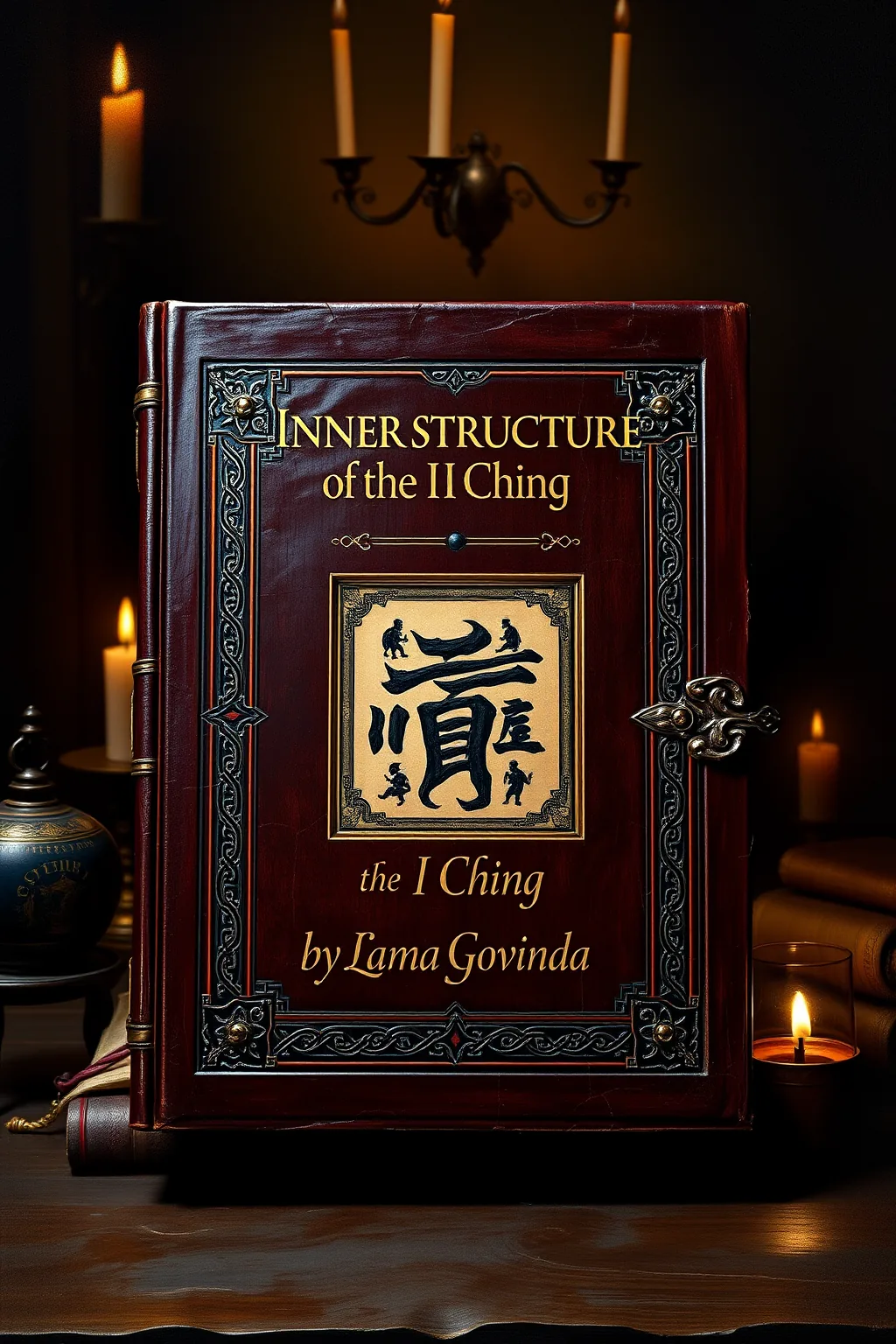
Inner Structure of the I Ching
 61
61

Inner Structure of the I Ching



Silas Hawthorne (Hermetic Studies Editor) — Lama Govinda’s 'Inner Structure of the I Ching' is a masterpiece of esoteric scholarship, offering a penetrating analysis of the ancient text. Govinda masterfully illuminates the I Ching not just as a divinatory tool, but as a profound philosophical and cosmological system. His insights into the symbolic matrices, the interplay of Yin and Yang, and the evolutionary patterns within the hexagrams are unparalleled. This work is a must-read for serious students of Eastern philosophy, hermeticism, and anyone seeking to grasp the deeper, often veiled, currents of wisdom embedded within this sacred oracle. It resonates with those who appreciate rigorous intellectual pursuit intertwined with spiritual depth.
📝 Description
61
Lama Govinda's 1977 book reveals the I Ching's structure as a cosmic blueprint.
Inner Structure of the I Ching by Lama Govinda examines the Book of Changes not just as a divinatory tool, but as a systematic representation of universal principles. Govinda, a scholar familiar with Buddhist and Tibetan traditions, approaches the hexagrams, trigrams, and their changing lines as components of a coherent symbolic system. He details how these elements articulate a philosophy of change and interconnectedness that he sees as fundamental to existence.
The book aims to clarify the underlying logic of the I Ching's structure, moving beyond simple interpretation to an understanding of its conceptual framework. Govinda presents the text as a map of cosmic processes and human experience, where each symbol and its transformation reflects deeper patterns. This perspective invites contemplation on the nature of reality and our place within its unfolding.
Lama Govinda places the I Ching within a broader esoteric framework, connecting its structure to principles found in traditions like Tibetan Buddhism. He views the Book of Changes as more than a Chinese divination system; it is a representation of universal laws governing change and manifestation. This interpretation aligns with esoteric thought that seeks underlying structures and correspondences across different traditions and phenomena. His work suggests that the I Ching's symbolic language can illuminate fundamental aspects of consciousness and the cosmos.
💡 Why Read This Book?
Embark on a profound exploration of the I Ching's hidden layers, moving beyond superficial interpretation to its philosophical and cosmic significance. Discover the archetypal patterns of change and transformation that govern all existence. Ideal for spiritual seekers, students of comparative religion, and practitioners of divination who desire a deeper, more integrated understanding of this ancient wisdom tradition.
⭐ Reader Reviews
Honest opinions from readers who have explored this book.
❓ Frequently Asked Questions
What is the primary focus of 'Inner Structure of the I Ching'?
The book focuses on the philosophical, symbolic, and mystical underpinnings of the I Ching, viewing it as a comprehensive system of cosmic order and change rather than solely a fortune-telling device.
Is this book suitable for beginners to the I Ching?
While it offers profound insights, its depth may be more suited for those with some foundational understanding or a strong academic interest in esoteric subjects.
What makes Lama Govinda's approach unique?
Govinda integrates his deep knowledge of Buddhist philosophy and Eastern mysticism with his interpretation, providing a unique perspective on the I Ching's universal principles.
How does this book differ from standard I Ching guides?
It delves into the esoteric symbolism and philosophical structures, aiming for a holistic understanding of the I Ching as a mirror of the cosmos and human consciousness.
Can the insights from this book be applied to daily life?
Absolutely. By understanding the underlying principles of change and balance, readers can gain profound insights for navigating personal challenges and opportunities.
🔮 Key Themes & Symbolism
The I Ching as a Cosmic Blueprint
Lama Govinda posits that the I Ching is not merely a book of divination but a profound representation of the fundamental laws governing the universe. He elucidates how the sixty-four hexagrams, with their dynamic interplay of Yin and Yang, encapsulate the cyclical nature of existence, the principles of transformation, and the underlying order of all phenomena. This perspective elevates the I Ching from a predictive tool to a philosophical map of reality, revealing the inherent interconnectedness of all things and the perpetual dance of creation and dissolution.
Symbolic Language of the Hexagrams
This work meticulously deciphers the rich symbolic language embedded within each hexagram. Govinda explores the archetypal imagery of the trigrams and their combinations, revealing how they represent universal forces, stages of development, and psychological states. He emphasizes that understanding these symbols unlocks a deeper comprehension of the I Ching's messages, allowing one to perceive the subtle energies and patterns influencing events and personal growth. The book serves as a key to unlocking the profound visual and conceptual vocabulary of this ancient oracle.
The Taoist and Buddhist Synthesis
A unique strength of Govinda's interpretation lies in its synthesis of Taoist principles with Buddhist philosophy. He demonstrates how the I Ching's concepts of duality, balance, and impermanence resonate deeply with Eastern spiritual traditions. This cross-cultural perspective enriches the understanding of the I Ching, highlighting its universal applicability and its role as a bridge between different wisdom systems. The book offers a holistic view, integrating the practical wisdom of the I Ching with profound metaphysical insights, fostering a balanced and integrated approach to self-discovery.
💬 Memorable Quotes
Direct passages from the work, attributed to the author.
“Change is the only constant, and the I Ching teaches us to embrace it.”
— This highlights the core message of the I Ching: the dynamic nature of reality. It suggests that true wisdom lies in understanding and adapting to continuous transformation, rather than resisting it.
“The lines of the hexagrams are not static symbols but living forces.”
— This interpretation points to the dynamic and energetic quality of the I Ching's components. It implies that each line and hexagram carries a palpable energy that influences events and consciousness.
“To understand the I Ching is to understand the universe within.”
— This profound statement links the external wisdom of the I Ching to the internal range of the individual. It suggests that the principles governing the cosmos are also present within our own being.
💡 Key Ideas
Editorial paraphrase of the work's core concepts — not direct quotes.
The I Ching is not a prophecy, but a mirror.
This quote emphasizes that the I Ching reflects the present situation and potential future based on current energies, rather than dictating a fixed destiny. It encourages introspection and active participation in shaping one's path.
Wisdom is found in the balance between opposites.
This quote captures the principle of duality and harmony central to the I Ching. It suggests that true understanding and effective action arise from recognizing and integrating seemingly opposing forces.
🌙 Esoteric Significance
Tradition
The book deeply engages with the esoteric traditions of Taoism and Mahayana Buddhism, particularly through its emphasis on the principles of Yin and Yang, the cyclical nature of change, and the concept of emptiness (sunyata) as a generative force. Govinda bridges these traditions, presenting the I Ching as a universal text that speaks to the core tenets of profound Eastern spiritual philosophies. It offers a framework for understanding the subtle energies and interconnectedness that underpin both the manifest and unmanifest realms.
Symbolism
The esoteric significance lies in its detailed exploration of the I Ching's symbolic architecture. Govinda illuminates how the trigrams (Heaven, Earth, Thunder, Wind, Water, Fire, Mountain, Lake) and their combinations into hexagrams are not arbitrary but represent fundamental archetypes and cosmic processes. He reveals the deeper meanings behind the imagery, suggesting that these symbols act as keys to unlocking the patterns of universal consciousness and the dynamics of personal transformation.
Modern Relevance
In an age often characterized by complexity and rapid change, the I Ching, as interpreted by Govinda, offers timeless wisdom for navigating uncertainty. Its principles of balance, adaptation, and understanding the flow of events provide practical guidance for personal growth, decision-making, and fostering inner resilience. The book's emphasis on the interconnectedness of all things encourages a more mindful and holistic approach to life, making its esoteric insights highly relevant for contemporary seekers of meaning and spiritual development.
👥 Who Should Read This Book
This profound work is ideally suited for dedicated students of esoteric philosophy, scholars of comparative religion, and serious practitioners of Eastern mystical traditions. For those who have moved beyond introductory texts on the I Ching and seek a deeper, more integrated understanding of its philosophical and cosmic dimensions, this book is invaluable. It will also resonate with seekers of wisdom interested in the underlying structures of reality and the symbolic language of the universe, offering a path to profound self-discovery and spiritual insight.
📜 Historical Context
Written during a period of burgeoning global interest in Eastern philosophies in the mid-20th century, 'Inner Structure of the I Ching' emerged from Lama Govinda's extensive scholarship and personal practice. This era saw a significant exchange of ideas between East and West, with thinkers and spiritual seekers studying ancient texts like the I Ching for deeper meaning and alternative perspectives. Govinda's work contributed to a more profound and scholarly understanding of the I Ching, moving it beyond its reputation as a mere tool for fortune-telling and positioning it as a sophisticated philosophical and cosmological system. His synthesis of Western academic rigor with Eastern esoteric traditions made the I Ching accessible to a wider, intellectually curious audience.
📔 Journal Prompts
Reflect on a recent period of significant change in your life. Which hexagram or lines from the I Ching, as described by Govinda, might have symbolized this transition, and what lessons did it hold?
Consider the concept of 'balance' as presented in the I Ching. How can you apply this principle to a current challenge or decision you are facing?
Govinda speaks of the I Ching as a mirror. In what ways can you use its symbolic language to gain a clearer reflection of your inner state and motivations?
Explore the interconnectedness of the trigrams. How might the energies of two specific trigrams be manifesting in your relationships or environment?
What does the idea of 'embracing change' mean to you personally, and how does the I Ching's framework, as illuminated by Govinda, encourage this acceptance?
🗂️ Glossary
Hexagram
A symbol composed of six stacked horizontal lines, each of which is either Yang (solid line) or Yin (broken line). There are 64 unique hexagrams in the I Ching, each representing a fundamental situation or stage of development.
Trigram
A symbol composed of three stacked horizontal lines (Yang or Yin). There are eight basic trigrams, which form the building blocks of the hexagrams.
Yin
The passive, feminine, dark, receptive, and yielding principle in Taoist philosophy, represented by a broken line (--) in the I Ching.
Yang
The active, masculine, light, creative, and assertive principle in Taoist philosophy, represented by a solid line (—) in the I Ching.
Tao
The fundamental principle of the universe in Taoism, often translated as 'the Way' or 'the Path.' It represents the natural order and flow of existence, which the I Ching seeks to elucidate.
This book appears in 3 collections
🔮 Readers Also Liked
Browse all →









From the “I Ching” Collection
View all →









More Free Divination & Tarot Books
View all →




![The revivication [sic] of young Joseph Taylor](/img/thumb/the-revivication-sic-of-young-joseph-taylor-joseph-taylor.webp)