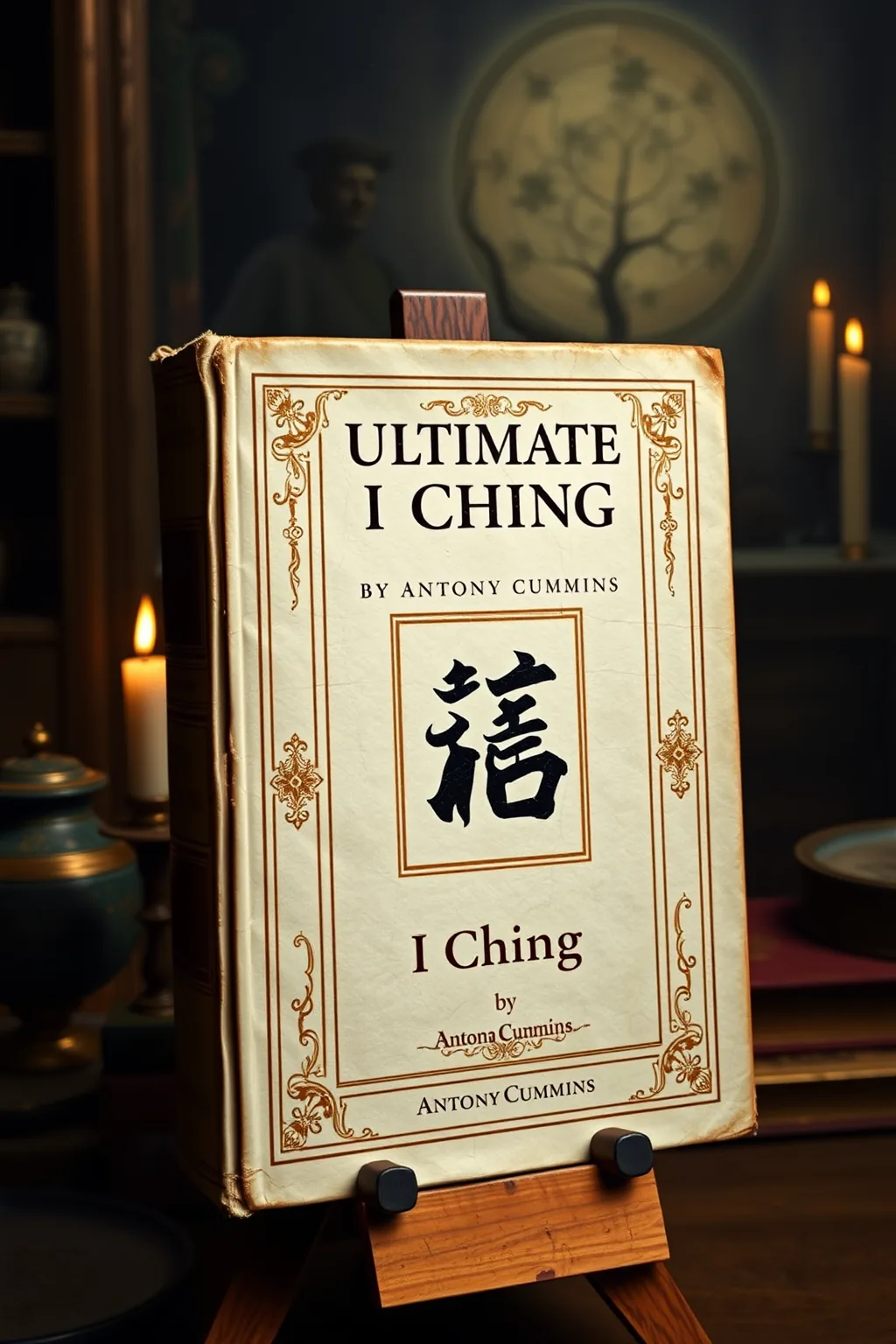
Ultimate I Ching
 61
61

Ultimate I Ching



Alaric Kestrel, Metaphysical Studies Reviewer: Antony Cummins' 'Ultimate I Ching' stands as a monumental achievement in esoteric literature. It masterfully navigates the labyrinthine symbolism of this ancient Chinese divination system, presenting its profound insights with clarity and depth. Cummins' scholarship shines, offering a rendition that is both accessible and deeply spiritual. This work is essential for anyone serious about understanding the I Ching beyond superficial interpretation, providing a robust foundation for both academic study and personal practice. Its strength lies in its ability to reveal the philosophical and mystical currents that have guided countless individuals through the ebb and flow of existence. Highly recommended for practitioners and scholars alike.
📝 Description
61
Antony Cummins' 'Ultimate I Ching' was published in 2013, aiming to demystify the ancient Chinese oracle.
This book presents Antony Cummins' interpretation of the I Ching, a foundational text in Chinese philosophy and divination. Cummins focuses on the I Ching's application as a system for understanding cosmic patterns and human behavior, moving beyond simple fortune-telling. He aims to reveal the philosophical depth of the text, connecting its principles to concepts of balance and natural order.
The work breaks down the sixty-four hexagrams and their constituent lines, suggesting each holds a specific insight. Cummins frames the I Ching as a tool for self-awareness and aligning oneself with universal cycles. It is intended for those who approach the text with seriousness, whether for personal practice or academic study.
The I Ching, or Book of Changes, has been a central text in Taoism and Chinese esoteric traditions for over two millennia. Its divinatory system, based on sixty-four hexagrams derived from combinations of yin and yang lines, is used to understand the dynamics of change in the universe and human affairs. Esoteric interpretations often focus on the I Ching's role in aligning the individual with the Tao, the fundamental principle of the cosmos, and its use in practices seeking spiritual insight and cosmic harmony.
💡 Why Read This Book?
Uncover the profound philosophical and mystical secrets of the I Ching, a cornerstone of ancient wisdom. Antony Cummins provides a clear, evocative pathway into its complex symbolism, making it accessible to both neophytes and seasoned practitioners. This book is an indispensable tool for those seeking to understand the cycles of change, align with universal energies, and cultivate inner harmony. Ideal for seekers, scholars, and anyone ready to engage with a timeless oracle for personal growth and spiritual insight.
⭐ Reader Reviews
Honest opinions from readers who have explored this book.
❓ Frequently Asked Questions
What makes this 'Ultimate I Ching' different from other translations?
This edition transcends literal translation by focusing on the esoteric and philosophical underpinnings, offering deeper insights into the symbolic language and mystical applications, making it a richer experience for the dedicated student.
Is the I Ching only for divination?
While renowned as an oracle, the I Ching is a profound philosophical text offering insights into change, balance, and the nature of reality. It serves as a guide for ethical living and understanding cosmic patterns.
Who is the ideal reader for this book?
This book is ideal for seekers of spiritual wisdom, scholars of ancient philosophies, and practitioners of divination who wish to deepen their understanding of the I Ching's profound symbolic language and practical applications.
How does the I Ching relate to other esoteric traditions?
The I Ching shares thematic resonances with various esoteric traditions, particularly in its exploration of duality, balance, interconnectedness, and the unfolding of cosmic patterns, offering a universal framework for understanding existence.
Can I learn to cast the I Ching using this book?
Absolutely. The 'Ultimate I Ching' provides comprehensive guidance on understanding the hexagrams, their meanings, and the methods for casting, empowering you to engage with this ancient oracle for personal reflection and guidance.
🔮 Key Themes & Symbolism
The Taoist Undercurrents
This edition meticulously traces the profound influence of Taoist philosophy on the I Ching, revealing how the text embodies the principles of Yin and Yang, the ceaseless flow of the Tao, and the concept of Wu Wei (non-action). It explores how the hexagrams illustrate the dynamic interplay of these forces, offering a map of the natural order and a guide to living in harmony with its rhythms. The reader is invited to see the I Ching not just as a divinatory tool, but as a living expression of the universe's fundamental principles.
Alchemical Symbolism and Transformation
Beyond its divinatory function, the 'Ultimate I Ching' studies the alchemical symbolism embedded within each hexagram and line. It presents the I Ching as a spiritual alchemy, a process of transforming the lead of ignorance and discord into the gold of wisdom and enlightenment. The text illuminates how understanding and reading through the changes depicted in the hexagrams can lead to profound personal transformation, fostering resilience, adaptability, and inner equilibrium in the face of life's inevitable shifts and challenges.
The Oracle as a Mirror of the Soul
Antony Cummins positions the I Ching as a sacred mirror, reflecting not only external circumstances but also the inner field of the querent. This perspective emphasizes the I Ching's role in self-discovery and spiritual growth. The book guides the reader in interpreting the oracle's messages as clear insights into their own psyche, motivations, and potential pathways forward. It encourages a contemplative approach, where the act of consulting the I Ching becomes a dialogue with the deeper self and the subtle energies of existence.
💬 Memorable Quotes
Direct passages from the work, attributed to the author.
“The Book of Changes is the wisdom of the sages.”
— This highlights the I Ching's esteemed status as a repository of useful insights, passed down from ancient masters who understood the fundamental laws of existence.
“Change is the only constant, and wisdom lies in understanding its flow.”
— This expresses the core message of the I Ching: that life is in perpetual flux, and true understanding comes from harmonizing with, rather than resisting, these natural transformations.
“Within the sixty-four hexagrams, the universe unfolds.”
— This evocative statement underscores the comprehensive nature of the I Ching, suggesting that its symbolic framework contains the blueprint for all phenomena and the interconnectedness of all things.
“The oracle whispers secrets to the attentive ear.”
— This emphasizes the divinatory aspect, suggesting that the I Ching's insights are not overtly stated but require a receptive and contemplative mind to discern their deeper meanings.
“Harmony is found not in stillness, but in balanced movement.”
— This philosophical nugget points to the dynamic nature of balance within the I Ching, advocating for adaptability and fluid responsiveness to life's conditions rather than rigid adherence to stasis.
🌙 Esoteric Significance
Tradition
The 'Ultimate I Ching' is deeply rooted in the Taoist and Confucian traditions of ancient China, serving as a bridge between practical divination and profound philosophical inquiry. It embodies the Taoist principles of Yin and Yang, the natural flow of the Tao, and the concept of Wu Wei, while also reflecting Confucian ethics of balance, order, and self-cultivation. Its esoteric significance lies in its capacity to act as a cosmic map and a guide for spiritual transformation, revealing the interconnectedness of all phenomena and the underlying principles governing existence.
Symbolism
The core symbolism of the I Ching revolves around the eight trigrams (Ba Gua) and their sixty-four hexagrams, formed by combining two trigrams. These symbols represent fundamental forces of nature (heaven, earth, thunder, water, mountain, wind, fire, lake) and archetypal human situations. Each line within a hexagram carries its own significance, representing stages of development or potential outcomes. The esoteric meaning lies in the dynamic interplay of these symbols, illustrating the constant flux and transformation inherent in the universe, and offering a language to understand the subtle energies that shape destiny.
Modern Relevance
In the modern era, the 'Ultimate I Ching' offers a powerful antidote to the chaos and uncertainty many experience. Its emphasis on understanding change, finding balance, and cultivating inner resilience provides practical tools for navigating complex personal and professional lives. The I Ching's cyclical view of time encourages a more patient and adaptable approach to challenges, while its philosophical depth fosters self-awareness and ethical decision-making. It remains a vital resource for those seeking a deeper connection to universal principles and a more harmonious way of living.
👥 Who Should Read This Book
This comprehensive exploration of the 'Ultimate I Ching' is designed for a diverse audience. **Beginners** will find a clear and accessible entry point into the world of this ancient oracle, guided by Antony Cummins' insightful prose. **Scholars** of Eastern philosophy and comparative religion will appreciate the meticulous attention to historical context and the deep dive into symbolic meaning. **Seekers** of spiritual wisdom and personal growth will discover a profound tool for self-reflection and guidance. **Practitioners** of divination and metaphysics will find a rich resource to deepen their understanding and enhance their practice with new layers of interpretation and esoteric insight.
📜 Historical Context
The I Ching, or 'Book of Changes,' emerged from ancient China, with its earliest roots stretching back to the Western Zhou dynasty (c. 1046–771 BCE). Initially a manual for divination, it evolved over centuries to become a central to Chinese philosophy, ethics, and cosmology. Its development was significantly shaped by Confucian scholars, who integrated its principles into their ethical and political theories, and by Taoist thinkers, who saw in its cycles a reflection of the Tao. The Han dynasty (206 BCE–220 CE) saw further consolidation of its text and commentary, particularly through the work of the Ten Wings, attributed to Confucius and his disciples, which elevated the I Ching from a mere divinatory tool to a profound metaphysical treatise. Its influence permeated East Asian culture, impacting art, medicine, strategy, and personal development, making it one of the most enduring and globally significant texts in the history of human thought.
📔 Journal Prompts
Reflect on a recent situation where you experienced significant change. How did the principles of the I Ching manifest in that experience?
Consider a hexagram that speaks to your current life circumstances. What specific lines or imagery stand out to you, and why?
How can the concept of Yin and Yang be applied to achieve greater balance in your daily life?
What does the idea of 'fate' mean to you in the context of the I Ching's teachings on change and destiny?
Imagine you could ask the I Ching one question about your life's purpose. What would it be, and how might a hexagram offer guidance?
🗂️ Glossary
Hexagram
A symbol composed of six stacked lines, each representing either a solid (Yang) or broken (Yin) line. There are 64 unique hexagrams, forming the core structure of the I Ching, each representing a distinct situation or stage of change.
Trigram
A symbol composed of three stacked lines (Yang or Yin). There are eight trigrams, each representing a fundamental element or force in nature, such as Heaven, Earth, Water, and Fire.
Yang
In the I Ching, represented by a solid line (—). It symbolizes the active, masculine, light, and creative principle, associated with heaven, day, and strength.
Yin
In the I Ching, represented by a broken line (- -). It symbolizes the passive, feminine, dark, and receptive principle, associated with earth, night, and yielding.
Tao
The fundamental principle of the universe in Taoism, often translated as 'the Way.' It represents the natural order, the source of all things, and the continuous, effortless flow of existence.
This book appears in 2 collections
🔮 Readers Also Liked
Browse all →








More by Antony Cummins
All books →
From the “I Ching” Collection
View all →









More Free Divination & Tarot Books
View all →