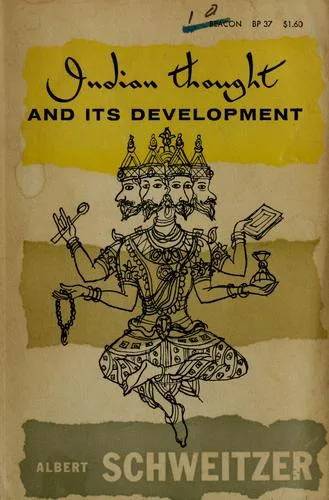
Indian thought and its development
 80
80

Indian thought and its development
Schweitzer's "Indian Thought and Its Development" presents a monumental effort to map the intellectual terrain of India through the lens of a European rationalist. His chapter on the ethical implications of the Upanishads, for instance, reveals the profound influence of Vedic metaphysics on subsequent Indian thought, a point he addresses with considerable detail. However, the work is not without its limitations. Schweitzer's "reverence for life" ethic, while noble, occasionally colors his interpretations, leading him to critique certain Indian philosophical strands for what he perceives as a detachment from worldly engagement. This perspective, while informative, reflects the philosophical biases of his time and context. Despite this, the book remains a significant scholarly resource for its comprehensive scope and Schweitzer's characteristic intellectual honesty. It is a demanding but rewarding study for those interested in the historical reception of Indian philosophy in the West.
📝 Description
80
Albert Schweitzer published 'Indian Thought and Its Development' in 1952, analyzing Indian philosophy from a Western viewpoint.
Albert Schweitzer's 1952 book, 'Indian Thought and Its Development,' offers a scholarly examination of Indian philosophy and religion.
Schweitzer, a Nobel laureate, applied a Western analytical framework to traditions such as Vedic thought, Brahmanism, Jainism, and Buddhism. The book traces the evolution of Indian intellectual history, identifying core ethical and metaphysical concepts that shaped its diverse schools of thought. It is intended for readers with a serious interest in the history of philosophy and religion, particularly those focused on non-Western traditions. Academic researchers, comparative religion students, and individuals seeking a structured overview of Indian thought from a 20th-century European perspective will find it valuable. Those new to Indian philosophy may find Schweitzer's methodical approach demanding but useful.
Published in the mid-20th century, the work emerged during a period of growing global interest in Eastern philosophies. Schweitzer's interpretation is informed by his own ethical framework, 'reverence for life,' which sometimes led him to critically assess perceived pessimism in Indian thought.
Albert Schweitzer's work engages with the Western academic tradition of studying Eastern religions during the mid-20th century. It reflects a scholarly attempt to categorize and understand Indian philosophical and religious systems through a European lens. Schweitzer's personal ethical philosophy, 'reverence for life,' shapes his interpretation, leading to comparisons and critiques of concepts like liberation and the nature of the divine as understood in various Indian schools.
💡 Why Read This Book?
• Gain a structured understanding of the evolution of Indian philosophical schools, from Vedic thought to Buddhism, as analyzed through a 20th-century Western critical lens, as Schweitzer meticulously traces these developments from the earliest Upanishads. • Appreciate the influence of "reverence for life" ethics on philosophical interpretation, recognizing how Schweitzer's own ethical framework shapes his assessment of concepts like karma and moksha. • Examine the historical dialogue between Western and Eastern thought by engaging with Schweitzer's mid-20th-century scholarly approach to complex Indian metaphysical and soteriological doctrines.
⭐ Reader Reviews
Honest opinions from readers who have explored this book.
❓ Frequently Asked Questions
What is the primary focus of Albert Schweitzer's "Indian Thought and Its Development"?
The book's primary focus is a comprehensive historical and philosophical analysis of the development of Indian thought, covering traditions from Vedic times through Buddhism and Jainism, as examined by a 20th-century Western scholar.
When was "Indian Thought and Its Development" first published?
"Indian Thought and Its Development" was first published in 1952, reflecting the intellectual climate and scholarly approaches to Eastern philosophies of that era.
Does Schweitzer discuss Buddhism in the book?
Yes, Schweitzer dedicates significant attention to Buddhism, tracing its origins and development within the broader context of Indian philosophical and religious evolution, assessing its ethical dimensions.
What is "reverence for life" and how does it relate to this book?
"Reverence for life" is Albert Schweitzer's core ethical principle, emphasizing respect for all living things. He applies this philosophy to interpret and sometimes critique Indian thought, particularly its views on suffering and detachment.
Is this book suitable for beginners in Indian philosophy?
While comprehensive, the book's dense scholarly style and Schweitzer's analytical framework may be challenging for absolute beginners. It is more suited for those with some prior exposure or a strong academic interest.
What are some key Indian concepts explored by Schweitzer?
Schweitzer explores concepts such as karma, reincarnation, moksha (liberation), the nature of Brahman, and the ethical systems found within Vedic, Brahmanical, Jain, and Buddhist traditions.
🔮 Key Themes & Symbolism
Evolution of Indian Ethics
Schweitzer meticulously traces the development of ethical frameworks within Indian traditions, from the early Upanishads to the teachings of Buddhism and Jainism. He analyzes how concepts of duty (dharma) and liberation (moksha) evolved and interacted with philosophical views on the self and the cosmos. His assessment is often filtered through his own 'reverence for life' philosophy, leading to observations on the perceived ascetism or world-renunciation present in some Indian schools. This provides a critical perspective on the practical and metaphysical underpinnings of Indian moral thought.
Metaphysics of Brahman and Atman
A significant portion of the book is dedicated to understanding the central metaphysical concepts of Brahman (the ultimate reality) and Atman (the self or soul) as they emerged and were debated within Indian philosophy. Schweitzer examines how these ideas, particularly prominent in the Upanishads, influenced subsequent schools of thought, including Vedanta. He analyzes the relationship between the individual soul and the universal consciousness, exploring various interpretations of their unity or distinction and their implications for spiritual realization.
The Concept of Liberation (Moksha)
Schweitzer investigates the diverse paths and philosophical underpinnings leading to liberation (moksha) in Indian thought. He contrasts the approaches of different traditions, such as the ascetic practices in Jainism, the Eightfold Path in Buddhism, and the devotional aspects in later Hinduism. His analysis focuses on how the desire for release from the cycle of birth and death (samsara) shaped Indian worldview and spiritual practices, evaluating the perceived efficacy and philosophical coherence of these liberation strategies.
Buddhism's Ethical Orientation
The book provides a detailed examination of Buddhism, analyzing its origins and core tenets, particularly the Four Noble Truths and the concept of anatta (no-self). Schweitzer critically assesses the ethical dimensions of Buddhist philosophy, often contrasting it with Brahmanical traditions. He explores the Buddhist emphasis on compassion and the cessation of suffering, evaluating its philosophical underpinnings and its role in the broader field of Indian religious development. His analysis highlights Buddhism's unique contribution to Indian ethical thought.
💬 Memorable Quotes
Direct passages from the work, attributed to the author.
“The ethical thought of India is characterized by pessimism.”
— This statement, reflecting Schweitzer's perspective, suggests that Indian philosophies often stem from a somber view of existence, emphasizing suffering and the need for escape, which he contrasts with more optimistic or life-affirming ethical systems.
“Buddhism offers a path to end suffering through detachment.”
— This interpretation reflects Schweitzer's understanding of the Four Noble Truths and the Eightfold Path. He examines how the doctrine of anatta and the emphasis on overcoming craving are central to Buddhism's ethical and spiritual program.
“The Upanishads explore the unity of Atman and Brahman.”
— This points to a core philosophical exploration within the Upanishads, a key focus for Schweitzer. It highlights the inquiry into the fundamental identity between the individual soul and the universal divine principle.
💡 Key Ideas
Editorial paraphrase of the work's core concepts — not direct quotes.
Brahman is the eternal, unchanging reality.
This paraphrased concept captures a foundational idea in Upanishadic and Vedantic thought, which Schweitzer explores. It posits a singular, ultimate, and immutable ground of all being, distinct from the transient world of phenomena.
The goal of Indian philosophy is release from the cycle of rebirth.
This summarizes the pervasive soteriological aim across many Indian traditions. Schweitzer analyzes the various doctrines and practices—karma, dharma, yoga, meditation—that seek to achieve this ultimate freedom from samsara.
🌙 Esoteric Significance
Tradition
While not strictly an esoteric text in the vein of Hermeticism or Kabbalah, Schweitzer's work engages with the philosophical underpinnings of traditions that often have esoteric dimensions. His detailed examination of Vedic thought, Upanishadic metaphysics, and Buddhist philosophy places him within the lineage of Western scholars attempting to systematize and understand these ancient wisdom systems. His approach, however, is more historical-philosophical than initiatory, though it lays groundwork for understanding concepts that mystics and practitioners engage with.
Symbolism
Schweitzer's analysis touches upon key symbols within Indian thought, such as the Wheel of Samsara, representing the cyclical nature of existence, suffering, and rebirth. He also discusses the concept of Brahman, often symbolized by the "Om" mantra, as the ultimate, ineffable reality. His interpretation of these symbols focuses on their philosophical implications for understanding the human condition and the pursuit of liberation from worldly entanglement.
Modern Relevance
Contemporary scholars and practitioners of comparative religion and philosophy continue to reference Schweitzer's work for its historical context and detailed exposition of Indian thought. Thinkers exploring Eastern philosophies within Western frameworks, or those critically examining the historical reception of Indian ideas in the West, find his analysis valuable. His ethical considerations, particularly regarding suffering and compassion, also resonate with modern discussions in applied ethics and interfaith dialogue.
👥 Who Should Read This Book
• Students of comparative religion and philosophy: Those seeking a structured, scholarly overview of Indian religious and philosophical history from a significant 20th-century Western perspective. • Researchers of Western philosophical engagement with Eastern thought: Individuals interested in how European intellectuals historically interpreted and critiqued Indian metaphysical and ethical systems. • Readers interested in Albert Schweitzer's broader intellectual contributions: Those who wish to understand how his ethical philosophy of "reverence for life" was applied to the study of non-Western traditions.
📜 Historical Context
Published in 1952, "Indian Thought and Its Development" emerged at a central moment in post-World War II intellectual history. Western scholarship on Indian religions was burgeoning, influenced by colonial encounters and a growing interest in comparative philosophy. Schweitzer, already a globally recognized figure for his work in ethics and medicine, brought his distinct "reverence for life" philosophy to bear on this subject. The book engaged with prevailing European interpretations, which often viewed Indian thought through a lens of asceticism or detachment, sometimes contrasting it with Western activism. Contemporaries like Sarvepalli Radhakrishnan were also producing seminal works on Indian philosophy, creating a rich intellectual dialogue. Schweitzer's work, while highly respected for its scope, also faced scrutiny for its inherent Western philosophical biases in evaluating Eastern traditions, particularly its critique of perceived pessimism.
📔 Journal Prompts
The concept of Brahman as ultimate reality.
The ethical implications of karma and rebirth.
Buddhism's path to the cessation of suffering.
The pursuit of moksha across Indian traditions.
Schweitzer's application of "reverence for life" to Indian ethics.
🗂️ Glossary
Upanishads
A collection of philosophical texts forming the theoretical basis for the Hindu religion. They represent the culmination of Vedic religion and contain the seeds of later Indian philosophical systems.
Brahman
In Hinduism, the supreme, impersonal cosmic spirit, the ultimate reality that underlies all phenomena. It is considered eternal, infinite, and unchanging.
Atman
The individual soul or self in Hinduism. A central tenet of Vedanta is the identity of Atman with Brahman (Atman is Brahman).
Karma
The principle of cause and effect in Hindu, Buddhist, Jain, and Sikh traditions, where actions in this life determine one's fate in future lives.
Moksha
Liberation from the cycle of death and rebirth (samsara). It is the ultimate goal in Hinduism, Buddhism, Jainism, and Sikhism, though the paths to achieve it vary.
Samsara
The cycle of death and rebirth, a continuous process of reincarnation governed by karma. It is often viewed as a state of suffering from which liberation is sought.
Anatta
A fundamental doctrine in Buddhism, meaning 'no-self' or 'non-essence.' It asserts that there is no permanent, unchanging self or soul in any living being.
🔮 Readers Also Liked
Browse all →









More by Albert Schweitzer
All books →


More Free Occult Philosophy Books
View all →