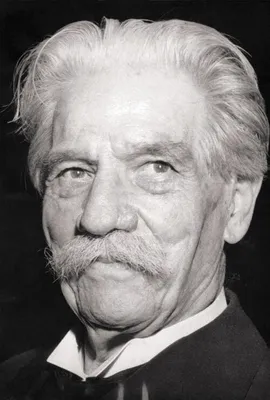
Albert Schweitzer
Albert Schweitzer was a polymath theologian, philosopher, and physician known for his "Reverence for Life" philosophy and humanitarian work.
Albert Schweitzer, born in Alsace in 1875, was a remarkable figure with diverse talents, excelling as a theologian, organist, musicologist, philosopher, and physician. He challenged prevailing views on Jesus and Pauline Christianity, proposing that the concept of "being in Christ" was central, with justification by faith as a secondary element. His profound philosophy of "Reverence for Life" earned him the Nobel Peace Prize in 1952. This philosophy was most notably embodied in his establishment and long-term dedication to the Albert Schweitzer Hospital in Lambaréné, Africa. Schweitzer's influence extended to music, where he was a renowned scholar of J.S. Bach, contributing significantly to the understanding of Bach's organ music and inspiring the Organ Reform Movement. He pursued medical studies later in life, dedicating himself to humanitarian service.
Philosophical and Theological Contributions
Schweitzer's theological work involved a critical examination of historical interpretations of Jesus, proposing that the mystical concept of "being in Christ" was fundamental to Pauline Christianity, rather than justification by faith. He advocated for a unified faith and purpose, influenced by his upbringing in a religiously tolerant environment in Alsace. His philosophy of "Reverence for Life" became a cornerstone of his ethical and humanitarian endeavors, emphasizing the intrinsic value of all living things. This philosophy was not merely theoretical but was actively put into practice through his extensive medical work in Africa.
Musical Scholarship and Influence
As a distinguished organist and musicologist, Schweitzer dedicated significant study to the works of Johann Sebastian Bach. He developed a unique interpretative approach, viewing Bach's religious music as visually illustrative, with musical elements mirroring the text's imagery and themes. His seminal work, "J. S. Bach: Le Musicien-Poète," revolutionized the understanding of Bach's compositions. Schweitzer was also instrumental in the Organ Reform Movement (Orgelbewegung), advocating for a return to Baroque principles in organ building and playing, moving away from the excesses of Romanticism. His collaborations with figures like Charles-Marie Widor and his own recordings further cemented his legacy in the musical world.
Humanitarian and Medical Work
Schweitzer's commitment to humanitarianism led him to pursue a medical degree later in life. In 1913, he established the Albert Schweitzer Hospital in Lambaréné, French Equatorial Africa (modern-day Gabon). He dedicated decades to this mission, providing medical care to underserved populations and embodying his philosophy of "Reverence for Life" through direct action. The hospital became a symbol of his dedication to alleviating suffering and promoting well-being, earning him international recognition, including the Nobel Peace Prize.
Key Ideas
- Reverence for Life: An ethical philosophy emphasizing the intrinsic value of all living beings and the moral imperative to respect and preserve life.
- Being in Christ: A theological concept positing the mystical union with Christ as central to Christian experience and doctrine.
- Pictorial representation in Bach's music: An interpretative approach suggesting Bach's musical motifs visually illustrate the text's meaning.
Books by Albert Schweitzer
4 free public domain books · Read online or download