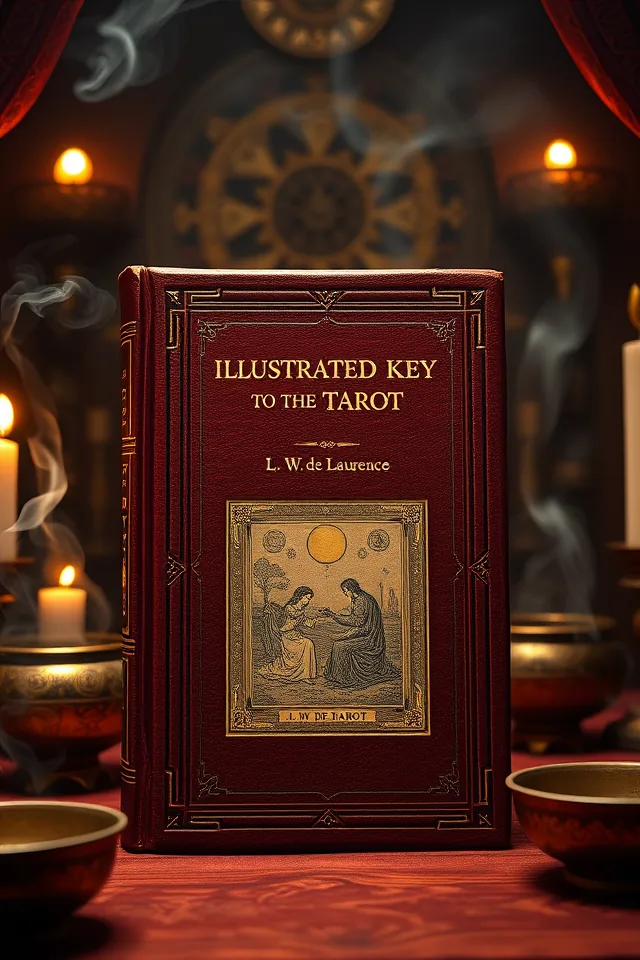
Illustrated Key to the Tarot
 74
74

Illustrated Key to the Tarot
De Laurence's "Illustrated Key to the Tarot" presents a dense, unvarnished look at occult Tarot as understood at the turn of the 20th century. Its strength lies in its comprehensive approach, attempting to codify the meanings of all 78 cards with extensive symbolic associations, particularly those linking them to Kabbalistic principles and astrological signs. The facsimile nature of this 2010 edition, with its restored imagery, is a genuine service to historical occult studies. However, the prose can be dense and at times repetitive, lacking the elegance found in some contemporary works by Waite or Mathers. A notable passage detailing the astrological correspondences for the Minor Arcana illustrates this thoroughness, though it demands significant prior knowledge. The book serves as a historical artifact as much as a practical guide; its value is in understanding a specific, influential approach to Tarot.
📝 Description
74
First published in 2010, The Illustrated Key to the Tarot reconstructs a foundational occult text.
This facsimile reprint of L. W. De Laurence's Illustrated Key to the Tarot presents the cards as more than just a game. It frames the Tarot as a system for divination, occult philosophy, and spiritual growth. The book details the symbolism and meaning of each Major and Minor Arcana card. It draws on established esoteric traditions, aiming for clarity and fidelity to the original work.
The intended audience is serious Tarot students who prefer historical occult interpretations over modern psychological ones. It suits readers looking for an illustrated guide that connects ancient symbolism with practical use. Those involved with Hermeticism, Kabbalah, or other Western esoteric paths will find the explanations and historical background useful.
L. W. De Laurence compiled occult literature in the early 20th century, a time of widespread interest in spiritualism. This Tarot guide synthesizes ideas from figures like Eliphas Lévi and Arthur Edward Waite, who significantly shaped the esoteric understanding of the cards. The book aligns with prevalent occult theories, linking the Tarot to the Hebrew alphabet and the Tree of Life.
💡 Why Read This Book?
• Understand the Kabbalistic framework De Laurence applies to the Tarot, offering a specific lens for interpreting card combinations beyond simple divinatory meanings. • Examine the detailed astrological correspondences for each Minor Arcana card, a crucial element in early 20th-century occultism that provides a different interpretive layer. • Appreciate the historical significance of L. W. De Laurence's publishing efforts in disseminating esoteric knowledge, understanding how texts like this shaped occult discourse.
⭐ Reader Reviews
Honest opinions from readers who have explored this book.
❓ Frequently Asked Questions
What is the primary focus of L. W. De Laurence's 'Illustrated Key to the Tarot'?
The book focuses on the occult and divinatory interpretations of the Tarot, presenting it as a system linked to Kabbalah, astrology, and Hermetic philosophy, rather than a purely psychological tool.
When was the original work by L. W. De Laurence first published?
While this specific facsimile edition was published in 2010, L. W. De Laurence was a prolific publisher of occult texts primarily in the early 20th century, with his original works appearing around that period.
Does the book provide interpretations for all 78 Tarot cards?
Yes, the 'Illustrated Key to the Tarot' aims to provide comprehensive interpretations for both the Major Arcana (22 cards) and the Minor Arcana (56 cards), along with their court cards.
What makes this 2010 edition significant?
This edition is a facsimile reprint that emphasizes high-quality restoration. It ensures that all original pages are present and legible, and photographic images are professionally restored, offering a clear presentation of De Laurence's original work.
What esoteric traditions does De Laurence's Tarot interpretation draw upon?
De Laurence's work heavily draws upon Western esoteric traditions, including Hermeticism, Kabbalah (specifically the Tree of Life), and Western astrology, integrating these systems into his Tarot readings.
Is this book suitable for beginners in Tarot?
While it covers all cards, its dense, historical occult approach might be challenging for absolute beginners. It is best suited for those with some existing knowledge or a strong interest in traditional esoteric interpretations.
🔮 Key Themes & Symbolism
Kabbalistic Correspondences
The work meticulously maps the 22 Major Arcana cards to the Hebrew alphabet and the paths on the Tree of Life. This approach, prevalent in early 20th-century occultism, positions the Tarot as a visual key to Kabbalistic cosmology. De Laurence details how each card's symbolism reflects specific divine emanations and spiritual journeys within the Kabbalistic framework, offering a structured method for divination and spiritual insight through this ancient mystical system.
Astrological Integration
A significant portion of the book is dedicated to assigning astrological rulerships to each Tarot card, including the Minor Arcana. This integration reflects the syncretic nature of Western esotericism, where different symbolic systems are often interwoven. De Laurence explains how planetary, zodiacal, and elemental influences manifest through the cards, providing an additional layer of interpretation for divinatory readings and understanding cosmic energies.
Symbolic Interpretation Methods
De Laurence emphasizes that the Tarot is fundamentally a symbolic language. The book guides readers on how to decode these symbols, moving beyond literal meanings to grasp deeper occult truths. It highlights the importance of imagery, numerology, and traditional associations in understanding the cards' messages, advocating for a meditative and analytical approach to Tarot study.
Divination and Fate
The 'Key' presents the Tarot as a tool for foretelling the future and understanding the unfolding of destiny. It introduces various spread techniques and explains how card positions interact to reveal patterns in a querent's life. The underlying philosophy suggests that the cards reflect underlying spiritual and material forces, allowing for insights into potential outcomes and karmic influences.
💬 Memorable Quotes
Direct passages from the work, attributed to the author.
“The Tarot is a sacred book, a book of pictures, symbols, and enigmas.”
— This statement captures De Laurence's view of the Tarot not as mere playing cards, but as a profound esoteric text, rich with layered meanings accessible through dedicated study and symbolic interpretation.
“Each card is a doorway, a key to understanding the secrets of the universe.”
— This highlights the transformative potential of the Tarot, suggesting that engaging with each card's symbolism can unlock deeper spiritual knowledge and cosmic understanding for the dedicated practitioner.
“The true meaning of the Tarot lies not in the images alone, but in the occult philosophy they represent.”
— This emphasizes that a superficial glance at the illustrations is insufficient; true comprehension requires understanding the underlying esoteric systems, such as Kabbalah and astrology, that De Laurence connects to the cards.
“The Minor Arcana are the daily bread of divination, reflecting earthly matters and mundane influences.”
— This interpretation distinguishes the function of the Minor Arcana from the Major Arcana, framing them as practical tools for understanding the events and energies of everyday life and material existence.
“Astrology and the Tarot are twin sciences, informative the path of destiny.”
— This expresses the deep interconnectedness De Laurence sees between celestial movements and the cards, presenting them as complementary systems for understanding fate and the spiritual journey.
🌙 Esoteric Significance
Tradition
De Laurence's work firmly sits within the Western Esoteric Tradition, particularly the lineage influenced by Hermeticism and Kabbalah. It follows the late 19th and early 20th-century trend of integrating Tarot symbolism with the Tree of Life and Hebrew alphabet correspondences, a method popularized by figures associated with occult orders. This approach views the Tarot not just as a divinatory tool but as a sacred text mirroring cosmic principles and the path of spiritual initiation.
Symbolism
Key symbols include the Fool, often interpreted as the beginning of the spiritual journey or the divine spark. The High Priestess represents hidden knowledge and intuition, frequently linked to the Moon and the mysteries of the subconscious. The Wheel of Fortune symbolizes destiny, cycles of change, and divine intervention, connecting the terrestrial to the celestial through its inherent movement and the astrological forces governing it.
Modern Relevance
Contemporary occultists and Tarot practitioners interested in historical approaches often reference De Laurence's work for its comprehensive cataloging of traditional meanings. His emphasis on Kabbalistic and astrological links continues to inform modern Tarot study, particularly within Hermetic and ceremonial magic circles. While newer interpretations focus on psychology or archetypes, De Laurence's text remains a valuable resource for understanding the historical evolution of Tarot's esoteric application.
👥 Who Should Read This Book
• Students of Western Esotericism: Those seeking to understand the historical integration of Tarot with Kabbalah and astrology, as practiced in the early 20th century. • Divination Practitioners: Individuals looking for detailed, traditional interpretations and correspondences for both Major and Minor Arcana to enhance their reading skills. • Occult Historians: Researchers interested in the dissemination of esoteric knowledge during the early 20th century and the specific methodologies promoted by figures like L. W. De Laurence.
📜 Historical Context
L. W. De Laurence operated within the vibrant, albeit sometimes contentious, occult revival of the late 19th and early 20th centuries. This era saw a surge of interest in spiritualism, Theosophy, and various forms of Western esotericism, fueled by figures like Helena Blavatsky and the Hermetic Order of the Golden Dawn. De Laurence's publishing house, established around the turn of the 20th century, specialized in reprinting and compiling works on magic, divination, and occult philosophy. His approach often synthesized ideas from multiple sources, aiming to create comprehensive manuals for practitioners. This period also saw significant developments in Tarot scholarship, notably Arthur Edward Waite's influential "The Pictorial Key to the Tarot" (1910), which presented a different, more mystical interpretation. De Laurence's work, while sharing the esoteric focus, often presented a more direct, instruction-oriented manual rooted in the occult traditions he curated.
📔 Journal Prompts
The symbolism of The Fool in relation to the concept of Kether.
The astrological correspondences assigned to the suit of Wands.
How the path of The Hierophant mirrors a specific Kabbalistic concept.
The significance of the number 7 as applied to The Chariot.
Reflect on the connection between The Moon card and intuition.
🗂️ Glossary
Major Arcana
The 22 trump cards of the Tarot deck, representing significant life lessons, spiritual archetypes, and major events in a person's journey.
Minor Arcana
The 56 cards of the Tarot deck, divided into four suits (Wands, Cups, Swords, Pentacles), which typically represent daily events, challenges, and mundane circumstances.
Kabbalah
A system of Jewish mysticism that deals with the nature of God and the universe, often visualized through the Tree of Life and its ten Sephiroth.
Tree of Life
A diagram used in Kabbalah to represent the structure of the universe and the process of creation, consisting of ten spheres (Sephiroth) connected by paths.
Astrological Correspondences
The system of assigning planets, zodiac signs, and elements to Tarot cards, reflecting the belief that celestial energies influence earthly events and human experience.
Divination
The practice of seeking knowledge of the future or the unknown by supernatural means, often using tools like the Tarot cards.
Facsimile Reprint
A reproduction of an original document or book that aims to be as identical as possible to the original in appearance and content.