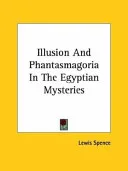
Illusion and Phantasmagoria in the Egypt
 80
80

Illusion and Phantasmagoria in the Egypt
Lewis Spence’s "Illusion and Phantasmagoria in Egypt" offers a compelling, if at times dense, dissection of ancient Egyptian cosmological frameworks. Spence avoids simplistic interpretations, instead focusing on the very mechanisms by which illusion and reality were understood and articulated in this ancient culture. A particular strength lies in his detailed examination of the 'Ka' and 'Ba', providing a nuanced view of Egyptian conceptions of the soul. However, the work occasionally suffers from an academic dryness that might deter the casual reader, with certain passages feeling overly focused on textual minutiae rather than broader implications. The section exploring the phantasmagoric aspects of divine encounters, particularly concerning the Duat, is intellectually stimulating and showcases Spence's command of the subject. Ultimately, it is a valuable resource for those seeking a scholarly yet accessible entry into the philosophical underpinnings of Egyptian belief.
📝 Description
80
Lewis Spence's 2005 book analyzes Egyptian mythology's role in shaping reality perception.
Lewis Spence's "Illusion and Phantasmagoria in Egypt" investigates how ancient Egyptians understood their world. The book goes beyond merely listing myths; it looks at the psychological and philosophical ideas behind their beliefs about the cosmos, the afterlife, and gods. Spence examines how Egyptians created meaning through stories and rituals, particularly concerning divine intervention.
The work is for students of ancient religions, those who study comparative mythology, and anyone interested in the philosophical side of occult traditions. It will appeal to readers who want a thorough yet understandable look at how belief systems affect culture and individual thought, especially in ancient Egypt. Spence builds on earlier Egyptological work, engaging with and sometimes questioning established views from scholars like Flinders Petrie and James Henry Breasted.
Spence's work fits within the study of comparative religion and occult philosophy, focusing on how ancient cultures perceived supernatural realities. It examines the Egyptian worldview not just as a historical subject but as a system of thought that influenced the perception of existence and the afterlife. The book touches on concepts like soul components and cosmic order, which are common themes in esoteric traditions seeking to understand hidden structures of reality and consciousness.
💡 Why Read This Book?
• Gain a distinct perspective on the Egyptian understanding of the soul, by exploring Spence's analysis of the 'Ka' and 'Ba' beyond common interpretations. • Grasp the ancient Egyptian concept of 'Isfet' (chaos) and 'Ma'at' (order), understanding how these forces shaped their worldview and daily rituals. • Examine the practical application of Egyptian beliefs through funerary texts, learning how the Book of the Dead functioned as a guide to the afterlife.
⭐ Reader Reviews
Honest opinions from readers who have explored this book.
❓ Frequently Asked Questions
What specific ancient Egyptian texts does Lewis Spence analyze in "Illusion and Phantasmagoria in Egypt"?
The book frequently references and analyzes sections from key funerary texts, most notably the Book of the Dead, as well as the Pyramid Texts and Coffin Texts. Spence uses these to illustrate the Egyptian perception of the afterlife and divine realms.
How does Spence differentiate between 'illusion' and 'phantasmagoria' in the Egyptian context?
Spence uses 'illusion' to describe the subjective or perceived nature of reality and divinity, while 'phantasmagoria' refers to the vivid, often dreamlike or supernatural, manifestations experienced or believed to be experienced by individuals, particularly in religious or funerary contexts.
What role do dreams play in the book's exploration of Egyptian beliefs?
Dreams are presented as a crucial interface between the human and divine realms for ancient Egyptians. Spence explores how dreams were interpreted as messages, omens, or even direct encounters with deities, blurring the lines between waking reality and the phantasmagoric.
Does the book discuss the Egyptian concept of the afterlife in detail?
Yes, a significant portion of the book is dedicated to the Egyptian conception of the afterlife, the journey through the Duat, and the judgment process. Spence examines how beliefs about the soul's components, like the 'Ka' and 'Ba', were integral to this post-mortem existence.
When was "Illusion and Phantasmagoria in Egypt" first published?
The work by Lewis Spence was first published on December 1, 2005, making it a relatively modern scholarly analysis of ancient Egyptian esoteric concepts.
What is 'Ma'at' according to Spence's analysis?
Spence explains 'Ma'at' not just as a goddess but as a fundamental cosmic principle of truth, balance, order, harmony, law, morality, and justice. It represents the ideal state of the universe that the Egyptians strove to maintain.
🔮 Key Themes & Symbolism
Perception of Divinity
Spence investigates how ancient Egyptians perceived their deities not as distant, abstract beings, but as forces that actively manifested and interacted within the world, often through phenomena that could be interpreted as illusions or phantasmagoric visions. The work examines the rituals and narratives designed to bridge the gap between the human and the divine, exploring the psychological mechanisms that allowed for such profound belief in the tangible presence of the gods and the supernatural.
The Nature of the Soul
Central to the book is an exploration of the complex Egyptian concept of the soul, particularly the 'Ka' (life force) and 'Ba' (personality/spirit). Spence explores how these distinct but interconnected components were believed to persist after death, influencing funerary practices and the Egyptians' understanding of personal identity and consciousness beyond the physical form. This analysis highlights a complex spiritual anatomy.
Cosmic Order and Chaos
The work illuminates the fundamental Egyptian duality of 'Ma'at' (order, truth, balance) and 'Isfet' (chaos, falsehood, disorder). Spence elucidates how this worldview permeated every aspect of Egyptian life, from political governance to religious observances and the meticulous preparations for the afterlife. The struggle to maintain Ma'at against the ever-present threat of Isfet is presented as a driving force in their civilization.
The Duat and the Afterlife
Spence examines the Egyptian conception of the Duat, the underworld or field of the dead, as a field of trials and transformations. The book analyzes funerary texts that served as guidebooks, detailing the symbolic geography, the deities encountered, and the judgments faced. This section underscores the Egyptian belief in a structured, albeit mysterious, post-mortem existence that required extensive preparation and knowledge.
💬 Memorable Quotes
Direct passages from the work, attributed to the author.
“The careful preservation of the body and the provision of funerary texts were practical necessities for the soul's journey.”
— This interpretation emphasizes the pragmatic approach ancient Egyptians took towards ensuring a successful afterlife. It points to the understanding that spiritual continuity was directly linked to material and ritualistic provisions for the deceased.
“Deities were not static figures but dynamic forces that could manifest in diverse and sometimes startling ways.”
— This concept, as presented by Spence, suggests that Egyptian theology viewed gods as active agents capable of appearing in forms or through events that might seem illusory or phantasmagoric to an outside observer, reflecting a fluid understanding of divine presence.
“The Duat was a field of transformation, where the deceased faced trials to achieve a perfected state.”
— This interpretation focuses on the active nature of the afterlife in Egyptian belief. It suggests the Duat was not simply a passive resting place but a challenging arena where the soul underwent necessary purification and development.
💡 Key Ideas
Editorial paraphrase of the work's core concepts — not direct quotes.
The Egyptian mind sought to reconcile the observed world with a spiritual reality that was often perceived through dreams and visions.
This paraphrase highlights Spence's argument that ancient Egyptians did not necessarily draw a sharp distinction between empirical reality and supernatural experiences, viewing dreams and visions as valid avenues for understanding the divine and the cosmos.
The balance of Ma'at was essential not only for the cosmos but for the ethical conduct of individuals.
This paraphrase captures the essence of Ma'at as a moral and social imperative, not merely a cosmic principle. It implies that maintaining this balance was a personal responsibility tied to righteous living and societal harmony.
🌙 Esoteric Significance
Tradition
This work fits within the broader tradition of Western Esotericism, particularly its engagement with ancient civilizations as sources of hidden wisdom. While not strictly Hermetic or Gnostic, it draws upon a lineage that seeks deeper, symbolic meanings within religious texts and mythologies, similar to the approaches found in Theosophy or later New Age interpretations. Spence's analysis departs from purely historical or anthropological accounts by emphasizing the subjective, psychological, and 'magical' aspects of Egyptian belief.
Symbolism
Key symbols explored include the 'Ankh' (symbol of life, often interpreted esoterically as representing the union of male and female principles or spiritual rebirth) and the 'Eye of Horus' (Wadjet), representing protection, royal power, and good health, but also seen in esoteric circles as a symbol of consciousness and spiritual perception. The concept of the Duat itself functions as a potent symbol of the soul's journey through the subconscious and the challenges of spiritual transformation.
Modern Relevance
Contemporary practitioners of various esoteric paths, including some modern Hermetic orders and individual occultists, continue to draw inspiration from Spence's interpretations of Egyptian cosmology and symbolism. His work provides a bridge for those seeking to integrate ancient Egyptian concepts into modern magical or spiritual practices, offering a framework for understanding deities, rituals, and the afterlife that appeals to contemporary esoteric thought.
👥 Who Should Read This Book
• Students of comparative mythology and ancient religions seeking a deeper understanding of Egyptian belief systems beyond surface-level descriptions. • Esoteric practitioners and occultists interested in exploring the potential magical and symbolic applications of ancient Egyptian concepts and deities. • Readers fascinated by the intersection of psychology, philosophy, and religion, particularly concerning how ancient cultures perceived reality and the divine.
📜 Historical Context
Lewis Spence's "Illusion and Phantasmagoria in Egypt" emerged in the early 21st century, a period when academic Egyptology had long moved beyond the pioneering fieldwork of figures like Flinders Petrie (active late 19th/early 20th century) and the monumental surveys of James Henry Breasted. Spence's work engages with the established understanding of Egyptian religion and mythology, but filters it through a lens informed by comparative mythology and esoteric philosophy, traditions that flourished independently of mainstream archaeology. While archaeology in the early 1900s focused heavily on material culture and dynastic history, scholars like Spence often explored the symbolic and psychological dimensions of Egyptian belief systems. The book thus represents a continuation of the esoteric interpretation of ancient cultures, a vein that ran parallel to, and sometimes critiqued, more conventional academic approaches, without a direct, documented citation by a specific contemporary scholar in this genre.
📔 Journal Prompts
The Egyptian concept of 'Isfet' versus 'Ma'at': How do these opposing forces manifest in contemporary societal structures?
Reflection on the Egyptian 'Ka' and 'Ba': What aspects of my own consciousness feel most enduring beyond the immediate self?
The Duat as a symbolic landscape: What personal 'trials' must one navigate for spiritual growth?
Analyzing the Egyptian perception of divine manifestation: How do modern cultures interpret seemingly inexplicable phenomena?
The role of funerary texts in ancient Egypt: What modern practices reflect a similar desire to guide or prepare for the unknown?
🗂️ Glossary
Ka
One of the principal components of the soul in ancient Egyptian belief, often translated as the 'life force' or 'vital essence'. It was thought to be sustained by food and drink and to reside in the tomb after death.
Ba
Another key aspect of the soul, generally understood as the personality, character, or spiritual manifestation of an individual. The Ba could travel between the tomb and the world of the living.
Duat
The ancient Egyptian underworld or field of the dead. It was depicted as a complex landscape through which the sun god Ra traveled at night and where the souls of the deceased underwent judgment and transformation.
Ma'at
A fundamental concept representing truth, balance, order, harmony, law, morality, and justice. It was personified as a goddess and was essential for the proper functioning of the cosmos and society.
Isfet
The antithesis of Ma'at; representing chaos, falsehood, disorder, injustice, and violence. The Egyptians believed it was a constant threat to the established order that needed to be kept in check.
Phantasmagoria
A sequence of real or imaginary images like those seen in a dream; a constantly shifting complex succession of things seen or imagined. In the context of the book, it refers to the vivid, often supernatural or illusory, experiences related to religious belief and the afterlife.
Book of the Dead
A modern name for an ancient Egyptian compilation of spells intended to assist a dead person's journey through the Duat, or underworld, into the afterlife. It contained prayers, hymns, and magical formulas.