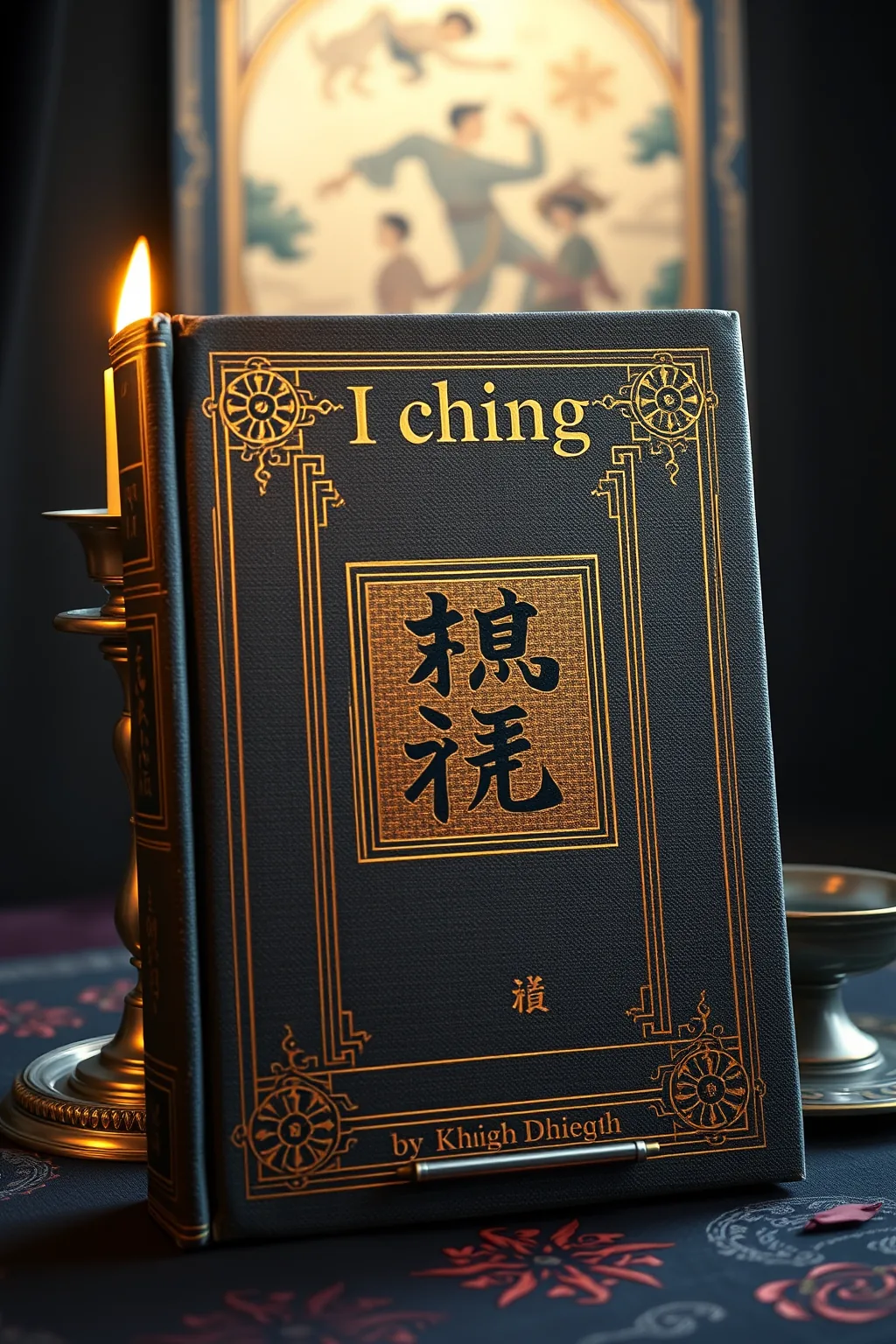
I ching
 61
61

I ching



Khigh Dhiegh's rendition of the I Ching is a triumph of scholarly dedication and esoteric insight. Moving beyond mere translation, Dhiegh imbues the ancient text with a palpable spiritual gravity, illuminating its profound philosophical underpinnings and predictive power. His interpretation masterfully deciphers the complex symbolism, offering clarity for those seeking to understand the subtle energies of change. This is an essential text for serious students of Eastern mysticism, divination, and the philosophy of transformation. It is not a casual read, but a profound engagement with one of humanity's most enduring wisdom traditions, offering practical guidance and deep existential contemplation. A cornerstone for any serious occult library.
📝 Description
61
Khigh Dhiegh's 1973 book deciphers the I Ching's hexagrams as cosmic patterns.
Khigh Dhiegh's work on the I Ching, published in 1973, presents the Chinese Book of Changes not just as a divination tool, but as a system of cosmic order.
Dhiegh examines the hexagrams and their changing lines, interpreting them as fundamental patterns that influence both the universe and individual lives. The book details insights into the flow of fortune, the interaction of Yin and Yang, and the principles of change. It is intended for serious students of esoteric thought or those seeking philosophical guidance.
The prose aims to create a reflective atmosphere, encouraging readers to consider the structure of fate and possibilities for personal growth. Dhiegh's I Ching offers a perspective on life's cycles, the value of patience, and living in balance with constant transformation. It invites a deeper engagement with the universe's underlying messages.
This book engages with the I Ching, a foundational text in Chinese philosophy and divination originating over three millennia ago. It is part of a long tradition that views the hexagrams as symbolic representations of universal processes and human situations. Esoteric interpretations often focus on the I Ching as a map for understanding consciousness, destiny, and the interconnectedness of all things, moving beyond simple fortune-telling to a framework for self-cultivation and alignment with natural forces.
💡 Why Read This Book?
Unlock the secrets of cosmic flow and personal destiny. This edition of the I Ching by Khigh Dhiegh offers unparalleled depth for seekers of ancient wisdom, providing profound insights into the principles of change, fate, and harmonious living. Ideal for practitioners of divination, philosophers, and anyone yearning for a deeper understanding of life's intricate patterns.
⭐ Reader Reviews
Honest opinions from readers who have explored this book.
❓ Frequently Asked Questions
What is the I Ching?
The I Ching, or Book of Changes, is an ancient Chinese divination text and one of the oldest of the Chinese classics. It is revered for its profound philosophical insights and its system of sixty-four hexagrams representing fundamental archetypes of existence.
Who was Khigh Dhiegh?
Khigh Dhiegh was an American actor and martial artist, deeply immersed in Eastern philosophies and esoteric studies. His passion led him to translate and interpret the I Ching, bringing his unique perspective to the ancient text.
How is the I Ching used for divination?
Divination with the I Ching typically involves casting coins or yarrow stalks to generate a hexagram, which is then interpreted using the text's commentary and imagery to provide guidance on a specific situation or question.
What does 'Yi jing' mean?
'Yi jing' is another transliteration of the Chinese characters for the Book of Changes. It translates literally to 'change classic' or 'book of changes'.
Is this book suitable for beginners?
While the I Ching is complex, Khigh Dhiegh's approach aims to make it accessible. Beginners should approach it with patience and a willingness to study, perhaps starting with introductory sections and focusing on key hexagrams.
🔮 Key Themes & Symbolism
The Dynamics of Change
This edition studies the I Ching's core philosophy: the perpetual and transformative nature of existence. It explores how understanding the constant flux allows for wiser decision-making, adaptability, and a deeper connection to the cosmic rhythm. The text reveals change not as chaos, but as an ordered, cyclical process governed by immutable principles, offering a framework for navigating life's inevitable shifts with grace and foresight.
Archetypal Symbolism
The sixty-four hexagrams of the I Ching are presented as potent archetypes, each encapsulating a fundamental situation or pattern of human experience. Dhiegh's work illuminates the rich symbolic language, connecting these ancient patterns to universal truths and offering useful insights into the human psyche and the forces that shape our reality. These symbols serve as a visual and conceptual map of consciousness and the cosmos.
Oracular Guidance and Wisdom
Beyond its philosophical depth, the I Ching serves as a powerful oracle. This edition guides readers in consulting the text for practical advice and spiritual illumination. It emphasizes developing intuition and discernment when interpreting the hexagrams, fostering a dialogue with the inner self and the subtle energies of the universe to gain clarity and make choices aligned with destiny.
💬 Memorable Quotes
Direct passages from the work, attributed to the author.
“When you are in doubt, do not move.”
— This advises patience and stillness when faced with uncertainty, suggesting that premature action can lead to undesirable outcomes.
“The soft overcomes the hard; the weak overcomes the strong.”
— A evidence of the power of gentleness, perseverance, and subtle influence over brute force, illustrating a fundamental principle of natural law.
“To know the enemy and know yourself, you need not fear the result of a hundred battles.”
— Emphasizing self-awareness and understanding external circumstances as crucial for navigating challenges and achieving success in any endeavor.
💡 Key Ideas
Editorial paraphrase of the work's core concepts — not direct quotes.
The superior man acts before he speaks, and then speaks according to his action.
This quote highlights the importance of integrity and aligning one's words with one's deeds, a core part of ethical conduct and true wisdom.
In the midst of chaos, there is also opportunity.
This quote captures the I Ching's optimistic outlook, suggesting that even in challenging times, the seeds of growth and positive transformation can be found.
🌙 Esoteric Significance
Tradition
The I Ching is a core part of Taoist and Confucian philosophical traditions, deeply interwoven with Chinese esoteric practices. It is considered a vital text within the broader spectrum of East Asian mysticism, influencing geomancy (Feng Shui), Traditional Chinese Medicine, and various schools of contemplative practice aimed at aligning with the Tao.
Symbolism
Its primary symbolism lies in the eighty-one possible combinations of Yin (broken line) and Yang (unbroken line) forming sixty-four hexagrams. These represent universal archetypes of situations, forces, and states of being. The interplay of these lines and their transformations symbolize the dynamic, ever-changing nature of reality, the cosmic dance of creation and dissolution.
Modern Relevance
In contemporary times, the I Ching remains remarkably relevant. It offers a timeless framework for understanding personal growth, decision-making, and navigating complexity. Its principles of adaptability, balance, and cyclical change resonate deeply in a world grappling with rapid technological advancement and societal shifts, providing a grounding wisdom for modern challenges.
👥 Who Should Read This Book
This edition of the I Ching is a treasure for a wide audience. **Beginners** seeking an accessible yet profound introduction to ancient Chinese wisdom and divination will find Dhiegh's interpretations useful. **Scholars** of Eastern philosophy and comparative religion will appreciate its depth and unique perspective. **Seekers** of spiritual guidance and self-discovery will find it an invaluable tool for introspection and insight. **Practitioners** of occult arts and divination will discover a potent oracle and a rich source of symbolic understanding to enhance their craft.
📜 Historical Context
The I Ching originates from ancient China, with its earliest layers dating back over 3,000 years. Its development spans millennia, evolving from rudimentary divination practices to a sophisticated philosophical system. During the Zhou Dynasty (c. 1046–256 BCE), the text became more formalized, with extensive commentaries attributed to Confucius and his disciples. Its influence permeated Chinese culture, impacting philosophy, politics, art, and medicine. Throughout its history, it has been continuously studied, interpreted, and revered, serving as a bedrock of Chinese thought and a significant contribution to global intellectual heritage, particularly within esoteric and mystical traditions.
📔 Journal Prompts
Reflect on a recent significant change in your life. How does the I Ching's concept of transformation apply?
Consider a recurring pattern or challenge you face. Which hexagrams might represent this situation?
How can you better integrate the principles of Yin and Yang into your daily life?
What does it mean to 'act before you speak' in your current circumstances?
If the I Ching were to offer you advice on your current path, what do you imagine it would be?
🗂️ Glossary
Hexagram
A figure composed of six stacked horizontal lines, where each line is either Yang (unbroken) or Yin (broken). There are 64 unique hexagrams in the I Ching, each representing a fundamental archetype or situation.
Yin
In Chinese philosophy, Yin represents the passive, dark, feminine, receptive, and yielding aspects of the universe. It is symbolized by a broken line (– –).
Yang
In Chinese philosophy, Yang represents the active, light, masculine, creative, and assertive aspects of the universe. It is symbolized by an unbroken line (—).
Tao
The fundamental principle of the universe in Taoism, often translated as 'The Way.' It is the natural order and the source of all existence, embodying balance and cosmic harmony.
Trigram
A figure composed of three stacked lines, either Yin or Yang. There are eight basic trigrams, which are the building blocks for the 64 hexagrams in the I Ching.
This book appears in 3 collections
🔮 Readers Also Liked
Browse all →









More by Khigh Dhiegh
All books →
From the “Tarot” Collection
View all →







More Free Divination & Tarot Books
View all →