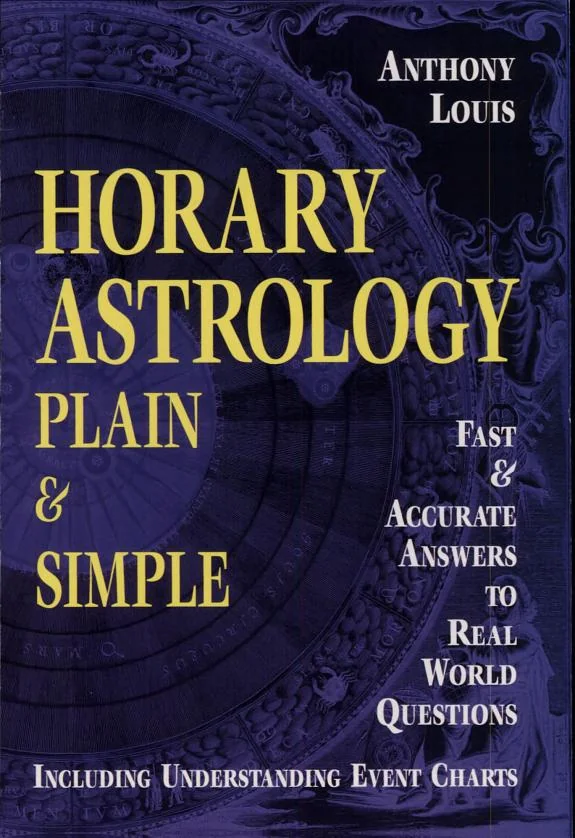
Horary Astrology: Plain and Simple
 80
80

Horary Astrology: Plain and Simple
Anthony Louis’s *Horary Astrology: Plain and Simple* delivers on its promise, offering a straightforward approach to a complex art. The text excels in its clarity, demystifying the process of casting and interpreting horary charts for those beyond the beginner stages. Louis’s strength lies in his pragmatic explanations of core principles, such as the use of planetary rulers and the Moon’s role in signifying outcomes. A particularly well-explained section discusses the 'reception' of planets, detailing how mutual acceptance or debilitation can color the answer. However, the book's brevity sometimes leaves one wishing for more detailed case studies to illustrate the nuances of more challenging charts. A reader might desire further exploration of how to handle severely afflicted significators or complex inter-chart relationships. Despite this, for its intended audience, the work provides a solid and reliable foundation for practicing astrological divination. It serves as a competent, no-nonsense manual for gaining direct answers from the celestial clockwork.
📝 Description
80
Anthony Louis's 2002 book demystifies horary astrology for the practical practitioner.
Horary astrology answers specific questions using a chart cast for the moment the question is understood. This method differs from natal astrology, which analyzes a birth chart. Instead, horary astrology seeks direct answers for concerns, from locating lost items to making major life choices. This guide is intended for astrologers who have a basic grasp of astrological principles like planets, signs, houses, and aspects.
It focuses on applying astrology as a tool for immediate problem-solving and personal guidance. The book explains how to interpret the significators for the questioner and the subject of the query. The ruler of the Ascendant usually represents the questioner, while the ruler of the relevant house signifies the matter asked about. The Moon also acts as a general significator of unfolding events.
Horary astrology is an ancient divinatory art with roots in Hellenistic Egypt, medieval Islamic astrology, and the European Renaissance. Anthony Louis revisits this tradition, making it accessible to modern practitioners. The practice involves casting a chart for the precise moment a question is posed and understood, then interpreting planetary relationships to find answers.
💡 Why Read This Book?
• Gain practical skills in astrological divination by learning to cast and interpret charts specifically for answering pressing questions, as detailed in the book’s methodical approach to significators. • Understand the specific roles of planetary rulers and the Moon in horary interpretation, moving beyond general astrological symbolism to concrete, question-specific meanings. • Acquire a tool for immediate problem-solving, enabling you to consult a chart for guidance on concrete issues like lost items or financial decisions, mirroring the book's focus on actionable answers.
⭐ Reader Reviews
Honest opinions from readers who have explored this book.
❓ Frequently Asked Questions
What is the primary difference between horary astrology and natal astrology?
Natal astrology analyzes a person's birth chart for inherent potentials and life patterns. Horary astrology, however, casts a chart for the exact moment a specific question is posed and understood, aiming to provide a direct answer to that singular query.
Who is the ideal reader for 'Horary Astrology: Plain and Simple'?
This book is best suited for intermediate astrologers who already possess a foundational knowledge of planetary meanings, zodiac signs, and houses, and wish to specialize in the art of question-based divination.
When was 'Horary Astrology: Plain and Simple' first published?
The original publication date for Anthony Louis's 'Horary Astrology: Plain and Simple' was 1998, making it a relatively modern guide to an ancient practice.
What kind of questions can horary astrology answer?
Horary astrology is designed to answer specific, pressing questions about personal concerns, such as 'Will I get this job?', 'Where are my lost keys?', or 'Should I make this investment?' It focuses on immediate, actionable inquiries.
Does the book cover the historical development of horary astrology?
Yes, the work situates horary astrology within its historical lineage, touching upon its ancient roots and its place in various astrological traditions before its modern application.
What are 'significators' in horary astrology?
Significators are planets or house cusps that represent the querent (the questioner) and the subject of the question. Identifying and interpreting these significators is a core technique in horary astrology.
🔮 Key Themes & Symbolism
The Art of Questioning
The book emphasizes that the efficacy of horary astrology hinges on the precise formulation and understanding of the question. It details how a well-posed query allows the astrologer to cast an accurate chart, identifying the correct significators for both the questioner and the matter at hand. This focus transforms astrology from a passive study into an active dialogue with the cosmos, offering direct guidance for specific concerns.
Planetary Significators and Rulership
Central to horary practice is the identification of planetary significators. The work explains how the ruler of the Ascendant represents the querent, while rulers of other relevant houses (e.g., the 7th for marriage, the 2nd for finances) represent the subject of the question. Understanding the condition, dignity, and aspects of these rulers is presented as the key to unlocking the chart's answer.
The Moon as Event Significator
Beyond representing the querent or aspects of the question, the Moon plays a crucial role as a general significator of events and the unfolding of circumstances. The book details how the Moon's sign, house placement, and aspects to other planets, particularly its 'last aspect' and 'next aspect', provide vital clues about the timing and nature of the outcome.
Practical Application
Unlike theoretical astrological texts, *Horary Astrology: Plain and Simple* is geared towards immediate application. It provides a framework for using astrological charts as diagnostic tools for real-world problems, from locating lost objects to assessing the viability of a business venture. The emphasis is on obtaining clear, decisive answers rather than generalized interpretations.
💬 Memorable Quotes
Direct passages from the work, attributed to the author.
“Horary astrology is the best method for getting answers to questions of pressing personal concern.”
— This statement highlights the book's core premise: that horary is uniquely suited for providing direct, practical responses to urgent personal dilemmas, serving as a focused divinatory tool.
“When used wisely, horary acts like a trusted advisor to whom you can turn in times of trouble.”
— This frames horary astrology not just as a technique, but as a reliable, almost sentient source of counsel, emphasizing the wisdom and discernment required for its effective practice.
“The ruler of the Ascendant typically represents the querent.”
— This is a fundamental principle of horary interpretation, establishing the primary significator for the person asking the question, thereby grounding the chart's analysis in the querent's perspective.
“The Moon... signifies events.”
— This concise interpretation underscores the Moon's critical function in horary as the indicator of how circumstances will unfold and the ultimate outcome of the situation queried.
“The condition and relationships of these significators are paramount.”
— This emphasizes that the true meaning of a horary chart lies not just in identifying significators, but in analyzing their strengths, weaknesses, and interactions with other celestial bodies.
🌙 Esoteric Significance
Tradition
Horary astrology belongs to the broader Hermetic and Aristotelian traditions of Western esotericism, which view the celestial bodies as having a direct causal or symbolic relationship with earthly events. It operates on the principle of 'as above, so below,' treating the moment of the question as a microcosm reflecting the macrocosm. This work fits within the lineage of astrological divination practiced since antiquity, particularly its medieval and Renaissance forms.
Symbolism
Key symbols include the Ascendant (representing the querent and the beginning of the matter), the Descendant (often representing partners or open enemies), and the Midheaven (signifying career and public standing). Planets like Saturn can symbolize delays or obstacles, while Jupiter often indicates fortune or expansion. The Moon, as a general significator, symbolizes the flow of events and the emotional climate surrounding the question.
Modern Relevance
Contemporary practitioners of traditional astrology, many of whom are active online and in various esoteric organizations, continue to draw heavily on horary techniques. Thinkers and schools focused on Hellenistic revivalism, as well as those seeking practical, predictive tools beyond natal chart analysis, find Louis's approach highly relevant for its clarity and directness in problem-solving.
👥 Who Should Read This Book
• Intermediate astrologers seeking to add a practical, divinatory skill to their practice, enabling them to offer direct answers to specific client questions. • Students of Western esotericism interested in the historical practice of astrological divination and its application as a tool for insight and problem-solving. • Individuals curious about how celestial configurations at a specific moment can reportedly reflect and inform answers to pressing personal concerns, moving beyond natal chart interpretation.
📜 Historical Context
Published in 1998, Anthony Louis's *Horary Astrology: Plain and Simple* emerged during a period of renewed interest in traditional astrological techniques, including horary. The late 20th century saw a significant movement away from purely psychological interpretations of astrology back towards more predictive and divinatory methods, a trend exemplified by figures like John Frawley. This resurgence was partly a reaction against what some perceived as the overly esoteric or vague nature of modern psychological astrology. While contemporaries like Robert Hand were also studying Hellenistic texts, Louis's work offered a more accessible, step-by-step guide for practitioners eager to apply these ancient methods. The reception of such works generally favored those who valued practical application and historical authenticity, positioning Louis's book as a valuable resource for serious students of traditional astrology seeking concrete answers.
📔 Journal Prompts
The significator for the querent and its house placement.
The Moon's last aspect and its implications for the question's resolution.
Planetary receptions between the significators of the querent and the quesited.
The role of Saturn in the chart concerning delays or limitations.
The outcome indicated by the ruler of the 10th house for questions related to career.
🗂️ Glossary
Horary Astrology
A branch of astrology focused on casting and interpreting a chart for the precise moment a question is asked and understood, aiming to provide a direct answer.
Querent
The person asking the question in a horary astrology reading. The querent is typically represented by the ruler of the Ascendant.
Quesited
The subject matter of the question being asked. The quesited is represented by the ruler of the house associated with the specific topic of the query.
Significator
A planet or house cusp that represents a person, thing, or matter within a horary chart. Each key element of the question has specific significators.
Ascendant (ASC)
The zodiac sign and degree rising on the eastern horizon at the time the horary chart is cast. It typically signifies the querent.
House Ruler
The planet that governs the zodiac sign located on the cusp of a particular astrological house. This ruler's condition is crucial for interpreting the house's meaning.
Reception
The relationship between two planets based on their essential dignities and accidental afflictions, indicating how they interact or influence each other within the chart.
This book appears in 1 collection
🔮 Readers Also Liked
Browse all →








From the “Horary Astrology” Collection
View all →









More Free Astrology & Cosmology Books
View all →